Contents
- Why this topic matters
- What an import program really is
- Start with the business model, not the shipment
- Define the product scope clearly
- Separate snack, foodservice and ingredient channels
- Build the specification and sample base
- How to evaluate and shortlist suppliers
- Pricing and landed-cost thinking
- Documentation and compliance flow
- Shipment planning and first-order structure
- Receiving, review and post-arrival learning
- Moving from a trial order to a real program
- Commercial perspective
- Technical perspective
- Buyer checklist before launch
- Common mistakes to avoid
- How Atlas uses this knowledge
- Frequently asked questions
Why this topic matters
A pistachio import program is often judged only by its first shipment, but that is too narrow. A successful program is built on the decisions made before the shipment is ever packed. Buyers need to decide which products belong in the program, which customer segments the program will serve, what quality language will be used internally, how quotations will be compared, which documents matter at approval stage and what the company needs to learn from the first order before volume is increased.
In Turkish pistachio sourcing, those decisions matter because the category is broad. A buyer may initially ask for “Turkish pistachios” but later realize the business actually needs different logic for in-shell snack distribution, premium pastry kernels, foodservice cuts, confectionery filling inputs or paste-oriented supply. If that structure is not created early, the import program can become reactive instead of disciplined.
Stronger preparation leads to better product choice, cleaner supplier communication, better internal alignment and fewer avoidable surprises during launch.
What an import program really is
An import program is more than a one-off purchase. It is a sourcing framework designed to support repeated commercial activity. That framework typically includes product definitions, approved supply logic, quotation methods, documentation expectations, shipment routines, internal approval responsibilities and some form of repeat-order discipline.
It turns product interest into a repeatable system
Without a program structure, every inquiry can feel like a fresh negotiation. That slows the business down and makes internal comparison harder.
It creates a shared internal language
Procurement, quality, finance, sales and warehouse teams often need to work with the same product in different ways. A program helps align those views instead of letting each department improvise its own definition.
It improves scaling after the first order
If the first order succeeds, the company needs a clear basis for repetition. A real import program gives the business that basis.
Start with the business model, not the shipment
One of the most common mistakes in launching an import program is beginning with logistics instead of business purpose. Before discussing container timing, pack formats or payment mechanics, the buyer should define what the imported pistachios will actually do in the business.
Who is the end customer?
Is the business supplying retail snack buyers, gourmet stores, horeca channels, pastry manufacturers, industrial food producers or private-label customers? Different customer groups need different product logic.
What margin structure is expected?
A distributor, brand owner and ingredient manufacturer may all import pistachios, but the margin logic and price tolerance of their markets may differ significantly.
Is the program product-led or market-led?
Some importers already know which pistachio form they want. Others start from a customer request and need to build the product definition around that request.
Will the company launch broad or narrow?
Some businesses begin with one hero SKU and expand later. Others launch several forms together. Both approaches can work, but the documentation and operational discipline needed will differ.
Define the product scope clearly
Once the business model is clear, the buyer should define the initial product scope. This is where many import programs either become focused or become vague.
Choose the initial categories carefully
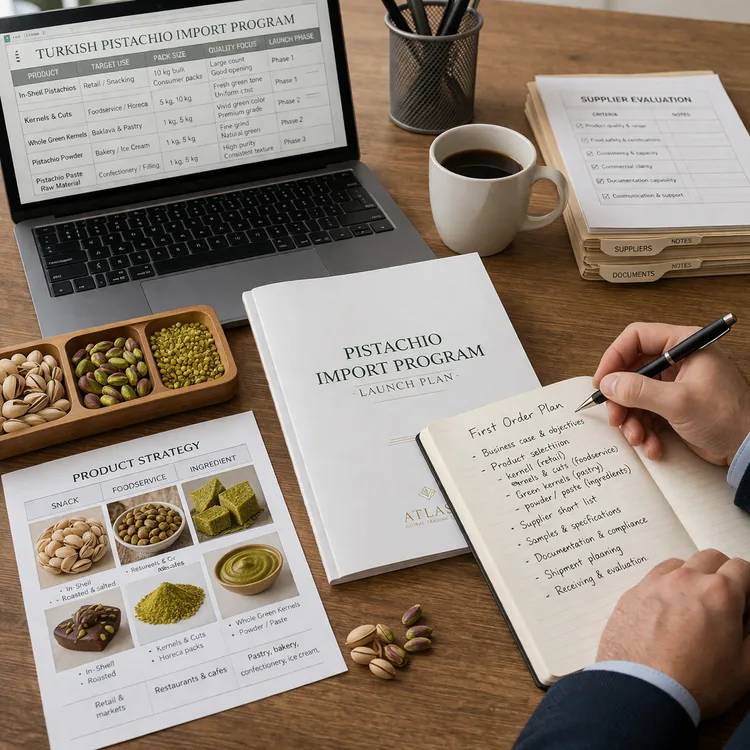
The buyer should define whether the first phase will include in-shell snack pistachios, whole kernels, cuts, powder, paste-oriented raw material or a combination of these.
Define visible-use versus internal-use products
A product intended for direct visual impact in pastry or confectionery should not be evaluated in the same way as a product that will disappear into a filling or processed ingredient system.
Avoid launching too many loosely defined items
A narrower first-phase portfolio with clearer product definitions is often easier to launch and manage than a broad catalog built on generic descriptions.
Separate snack, foodservice and ingredient channels
A strong import program usually benefits from channel separation. Even if the products come from the same origin, the commercial logic should not be merged carelessly.
Snack channel
Ready-to-eat and retail-facing products are often judged by direct-consumption appeal, roast character, visual appearance and consumer pack suitability.
Foodservice channel
Horeca and kitchen buyers often care more about usability, speed, plating consistency, pack practicality and application fit.
Ingredient channel
Confectionery, pastry, bakery and industrial customers usually care more about product form, cut logic, kernel tone, powder behavior, paste suitability and process consistency.
Why separation helps
This separation improves quoting, sampling and internal pricing logic because the company stops comparing unlike products using the same decision criteria.
Build the specification and sample base
Before a serious import program is launched, the buyer should develop a basic specification and sample structure. This stage is often one of the highest-leverage parts of the process.
Write clearer product definitions
Each item should have a product identity that distinguishes it from neighboring grades and forms.
Define the intended use
A specification becomes more useful when it states what the product is for, not only what it is called.
Review samples in context
A pastry kernel should be judged for pastry use. A paste input should be judged in relation to filling or cream systems. A snack product should be judged as a direct eating experience.
Use sample review to improve the spec
The purpose of a sample is not only to approve or reject. It is also to improve the precision of the product definition before the first order is placed.
How to evaluate and shortlist suppliers
Supplier choice should support the structure of the program, not just the first shipment. A strong supplier relationship is built on more than product availability alone.
Can the supplier speak clearly about product categories?
Suppliers who understand the commercial difference between snack, foodservice and ingredient use usually communicate more usefully with B2B buyers.
Can the supplier support documentation discipline?
Import programs depend on more than samples and prices. They also depend on invoice clarity, packing logic, reference alignment and shipment documentation structure.
Can the supplier support repeatability?
A launch program should think beyond the first order. Buyers benefit from suppliers who can discuss consistency, category logic and future scaling rationally.
Can the supplier recommend the right product rather than only quote what was asked?
In complex categories, that kind of grounded guidance often becomes a competitive advantage.
Pricing and landed-cost thinking
Many import programs fail to develop strong pricing logic because they compare supplier offers too narrowly. A robust program should think in terms of landed use-value rather than headline price alone.
Price should be evaluated against application
A visually premium kernel may be correct for a gourmet pastry channel and inefficient for an internal-use paste program. The correct question is not whether one offer is cheaper, but whether it is cheaper for the right product.
Packaging and operational fit affect real cost
A lower-priced item can become more expensive if the pack style, cut definition or product fit creates extra rework, waste or customer dissatisfaction.
Launch with a pricing framework, not just a number
The buyer should know why each item sits where it does in the range: value, mainstream, premium visible-use, specialized ingredient or heritage-led premium.
Documentation and compliance flow
A launch program is much smoother when documentation expectations are defined early. Documentation should not be treated as a last-minute export detail.
Clarify required document types early
Commercial invoice, packing list, origin-related papers, product references and customer-specific documents should be discussed before shipment execution, not after.
Connect specifications to documentation
Product descriptions on the paperwork should match the commercial understanding of the item. This is easier when a written product specification exists.
Review documentation flow as part of supplier onboarding
Documentation quality is part of operational reliability. A strong import program treats it as part of supplier evaluation, not as a separate administrative matter.
Shipment planning and first-order structure
The first shipment should be planned as a learning step, not only as a buying step. That does not mean treating it casually. It means using it to validate the structure of the new import program.
Keep the first order strategically useful
The first order should be large enough to test receiving, paperwork, product fit and internal handling realistically, but controlled enough that the business can learn from it.
Align shipping structure with the actual sales plan
A first order should match the business model. Distributors, ingredient users and brand owners usually need different SKU mixes and pack-size logic.
Prepare receiving teams before arrival
Warehouse, quality and commercial teams should know what is arriving, how it is packed and what the reference expectations are.
Receiving, review and post-arrival learning
One of the biggest missed opportunities in a new import program is failing to turn the first order into structured learning. Arrival review should be intentional.
Check the product against the approved description
This is where good pre-shipment specification work pays off.
Capture operational feedback
Sales, warehouse, quality, foodservice customers and technical users may all notice different things. Their feedback should be captured separately and then compared.
Refine the program after the first cycle
Strong import programs improve after the first order. Packaging, documentation, product mix, supplier messaging and sample interpretation often become sharper after real market contact.
Moving from a trial order to a real program
A business moves from trial buying to program buying when it starts repeating decisions intentionally rather than re-making them every time.
Lock the approved product definitions
The company should know which items are approved, how they are described and what channel they belong to.
Document repeat-order rules
The team should know what references matter at reorder stage, what pack formats are standard and what type of variation needs explicit re-approval.
Separate stable lines from exploratory lines
Some items are core range products. Others may remain developmental. A good import program treats them differently.
Commercial perspective
Successful pistachio purchasing starts with the final application. Buyers compare kernel color, cut size, roasting profile, purity, packaging style and order consistency according to whether the product will be used for snacks, confectionery, pastry, ice cream or ingredient manufacturing.
A launch program becomes stronger when the buyer defines those categories in advance instead of trying to fit all products into one general sourcing conversation. Better structure improves quotation accuracy, pricing logic and internal decision speed.
- Define the intended end use before comparing offers.
- Review format, color, aroma, packaging and repeatability together.
- Share clear product requirements so pricing and supply discussions are more accurate.
- Separate launch-stage assumptions from long-term program decisions.
Technical perspective
Technical expectations vary by customer segment. Snack buyers often focus on shell opening, roast profile and appearance. Ingredient buyers typically look more closely at kernel tone, cut size, grind consistency, purity, moisture management and performance during processing.
Articles like this help connect those quality cues to practical buying language so teams can review products with greater confidence and consistency. For a new import program, that clarity is especially useful because it helps technical teams define what must be checked at sample stage, what should be verified at receiving stage and which differences actually matter commercially.
Technical review is most valuable when it is aligned with the commercial role of the product rather than treated as a generic quality ritual.
Simple comparison: spot buying vs program buying
| Dimension | Spot buying | Structured import program |
|---|---|---|
| Product definition | Often broad or reactive | Clearer and tied to end use |
| Supplier communication | Often shipment-specific | More repeatable and reference-based |
| Sample discipline | Can be informal | More closely linked to future approvals |
| Documentation flow | Handled transaction by transaction | Built into the operating model |
| Scaling potential | Less predictable | Stronger once the first cycle is validated |
Buyer checklist before launch
Before committing to the first pistachio import cycle, buyers should be able to answer the following questions clearly:
- What exact product forms are included in phase one?
- Which customer segment does each item serve?
- Have we separated snack, foodservice and ingredient logic appropriately?
- Do we have a clear product description or specification for each item?
- Have we reviewed samples against the real intended use?
- Do we understand the documentation flow we need before shipment?
- Is the first order sized to teach us something useful without creating uncontrolled risk?
- Do we know what success looks like after the first order arrives?
Common mistakes to avoid
-
Starting with supplier search before product definition.
This often leads to broad quotations and weaker comparison quality. -
Treating all pistachio forms as one commercial category.
Snack, foodservice and ingredient programs usually need different logic. -
Approving samples without a written reference framework.
This can make the first shipment harder to evaluate consistently. -
Underestimating documentation and receiving workflow.
Launch programs depend on operational discipline as much as on product choice. -
Scaling too fast without learning from the first cycle.
A good first order should inform the structure of the real ongoing program. -
Comparing prices without comparing application fit.
The wrong product at a lower price is still the wrong launch decision.
How Atlas uses this knowledge
Atlas uses academy content to make product discussions clearer and more useful. Each article supports a better understanding of product forms, applications, quality expectations and the questions buyers should ask before placing an order.
On a topic like import-program design, that means helping buyers move beyond generic sourcing intent and toward a more structured market-entry approach. Instead of starting with broad price requests, buyers can define the role of each product, the commercial channel it serves, the documentation it needs and the way the first order should be used as a learning cycle.
- Connect commercial guidance to relevant product categories.
- Connect technical information to real manufacturing applications.
- Support faster, better-prepared conversations with buyers.
- Reduce ambiguity around kernels, cuts, powder and paste-oriented products.
- Help teams build import programs that are easier to repeat and easier to scale.
Key takeaway
Atlas Guide to Launching a Pistachio Import Program gives buyers a stronger framework for evaluating Turkish pistachios with confidence. Better information leads to better product choices, smoother communication and more effective purchasing decisions.
A strong import program begins with clear business intent, disciplined product definition and thoughtful supplier alignment. It grows through samples, documentation, first-order learning and repeat-order structure. In premium Turkish pistachio trade, that discipline is not bureaucracy. It is part of commercial success.
Frequently asked questions
Who is this article for?
This article is intended for B2B buyers, importers, distributors, brand owners and food manufacturers researching Turkish pistachio supply.
What is a pistachio import program?
A pistachio import program is a structured sourcing approach that covers product selection, supplier qualification, pricing logic, sample review, documentation, shipment planning and repeat-order consistency rather than relying only on one-off spot buying.
What is the first step in launching one?
The first step is usually defining the commercial goal clearly: which product forms are needed, who the target customers are, what application each item serves and how the business plans to sell or use the imported pistachios.
Should buyers launch several pistachio forms at once?
Not always. Some businesses benefit from starting with a narrow first-phase portfolio and then expanding after the first cycle is understood properly.
Why do sample and specification stages matter so much?
Because they help the buyer and supplier define the same product clearly before commercial volume is committed. That reduces confusion later.
What makes the first shipment successful?
A strong first shipment is one that validates the product fit, documentation flow, receiving process and internal commercial assumptions well enough to improve the next cycle.
Can Atlas help with sourcing?
Yes. Atlas helps buyers think more clearly about product form, application, documentation flow and commercial fit so sourcing discussions become more structured and more useful.