Contents
- Why this topic matters
- Why foodservice buying is different from retail and industry
- Main pistachio forms used in foodservice
- When whole kernels make more sense
- When cuts, granules and slices make more sense
- When pistachio powder makes more sense
- When pistachio paste makes more sense
- Choosing by type of foodservice operation
- Operational factors buyers should evaluate
- Commercial perspective
- Technical perspective
- Buyer checklist before ordering
- Common mistakes to avoid
- How Atlas uses this knowledge
- Frequently asked questions
Why this topic matters
Foodservice operations live between two pressures: culinary quality and operational practicality. A chef or buyer may want a premium pistachio presentation, but the kitchen also needs speed, repeatability and manageable cost per portion. A distributor may want to offer broad choice, but the end customer usually wants a product that saves time, reduces preparation steps and supports dependable output during busy service periods.
This is why foodservice pistachio selection should not start with generic phrases such as “premium quality” alone. It should start with application. Is the pistachio used as a visible garnish, mixed into dessert filling, processed into bakery dough, folded into gelato, sprinkled over breakfast items, blended into sauce, or sold as a table snack? Each answer points toward a different form.
In practice, choosing the wrong form can create hidden cost: too much kitchen labor, inconsistent plating, unnecessary waste, difficult storage, or paying for a visual grade that disappears during processing. Choosing the right form improves efficiency and makes the premium value of Turkish pistachios more usable in daily operations.
Why foodservice buying is different from retail and industry
Foodservice is its own commercial environment. It is not identical to retail snack distribution, and it is not identical to fully industrial food manufacturing. Foodservice buyers usually need a balance between product quality and kitchen usability.
Retail snack buying focuses on direct consumer presentation
Retail snack buyers often care most about consumer pack appeal, shelf-ready presentation and direct eating experience. Foodservice buyers may still care about appearance, but they also think about prep time, portioning and plate performance.
Industrial buying focuses on large-scale process fit
Industrial buyers often optimize around continuous production, technical consistency and process efficiency at scale. Foodservice buyers are usually closer to daily service reality, where practical handling and menu flexibility matter more.
Foodservice buying sits in the middle
In horeca channels, the product often needs to look premium and still be easy to use. That is why product form matters so much. The ingredient must support both culinary ambition and operational discipline.
Main pistachio forms used in foodservice
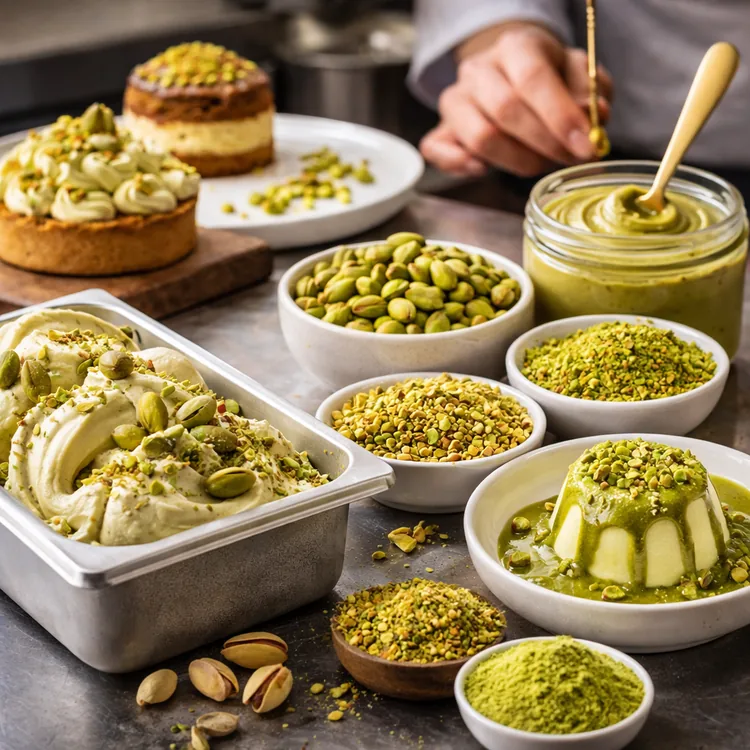
Foodservice buyers may work with several pistachio formats at once. The main forms usually include:
- In-shell pistachios for table snacks, bar service or direct presentation.
- Whole kernels for garnish, premium inclusions and visible pastry use.
- Cuts, granules and slices for toppings, plated desserts, bakery finishing and confectionery decoration.
- Pistachio powder for cakes, sponge systems, batters, coatings and recipe integration.
- Pistachio paste for creams, fillings, gelato, sauces, spreads and premium dessert systems.
The important point is that these forms are not interchangeable. Each one solves a different operational problem.
When whole kernels make more sense
Whole kernels are often selected when the pistachio must remain visible and recognizable as a premium ingredient. They are especially useful where the customer should immediately see real pistachio presence.
Premium garnish and final finishing
Whole kernels work well on plated desserts, high-end pastry, breakfast bowls, chocolate presentations and premium buffet applications where ingredient visibility adds value.
Visible pastry and confectionery use
If the pistachio is placed on top of tartlets, entremets, cakes or chocolate items, whole kernels can create a stronger premium signal than smaller formats.
Luxury hotel and hospitality presentation
Hotels and upscale venues often care about visual detail. Whole kernels are useful where the pistachio functions almost like a finishing statement rather than just an ingredient.
When not to overuse whole kernels
Whole kernels are not always the most efficient choice. For products where the nut will be chopped in-house or mixed into bulk recipes, the labor and cost logic may favor another form.
When cuts, granules and slices make more sense
Cuts, granules and slices are often among the most practical forms for foodservice because they combine visual appeal with easier kitchen use.
Toppings and plating consistency
These formats make it easier to apply pistachio evenly across multiple servings. That helps with portion control, visual uniformity and service speed.
Bakery and pastry finishing
Foodservice pastry teams often use cuts or slices for croissants, cakes, tarts, mousse desserts and chocolate items because the format is more immediately usable than whole kernels.
Dessert bars, gelato and buffet applications
Granules and cuts work well in dessert counters, gelato shops and self-service displays where the pistachio needs to look attractive but also remain easy to portion.
Less prep, less waste
Pre-cut formats can reduce in-house chopping labor and create more predictable output, especially in operations with limited prep staff or high service turnover.
When pistachio powder makes more sense
Pistachio powder is often selected when the pistachio needs to become part of the recipe system rather than remain a visible finishing element.
Cakes, sponge and bakery mixes
Powder is useful when foodservice buyers want pistachio character distributed through a batter or pastry base rather than sitting only on the surface.
Dusting, coating and pastry decoration
In some premium dessert concepts, powder is used as a fine decorative element or as part of a coating system on the outside of pastries and confections.
More even flavor distribution
Powder can help create a more uniform pistachio note across a recipe, which is often useful in bakery and dessert kitchens that want repeatable flavor across multiple portions.
When powder may not be enough alone
If the menu concept depends on visible pistachio texture or premium garnish effect, powder may need to be paired with kernels or cuts rather than used alone.
When pistachio paste makes more sense
Pistachio paste is especially important in foodservice operations that need intense pistachio identity in cream systems, dessert fillings, gelato, sauces or premium plated desserts.
Gelato and frozen dessert use
Paste is often the natural choice where a smooth pistachio profile, rich flavor integration and consistent blending are central to the final product.
Pastry creams, fillings and dessert interiors
Foodservice pastry teams may use paste in entremets, choux fillings, tart interiors, cake layers and plated dessert components where the pistachio must carry the flavor structure.
Luxury breakfast and brunch concepts
In some hospitality environments, pistachio paste can support premium spreads, dessert sauces or pistachio-forward accompaniments used across breakfast and café service.
High-value but application-sensitive
Paste can be one of the most commercially valuable forms, but only when the operation genuinely needs that functionality. It should be chosen because the menu benefits from it, not simply because it sounds premium.
Choosing by type of foodservice operation
Restaurants
Restaurants often need flexible forms that support both garnish and recipe use. Whole kernels, cuts and paste are common choices depending on whether the pistachio is used on plated desserts, salads, sauces, meat accompaniments or premium sweets.
Hotels and hospitality groups
Hotels typically value range. Breakfast service, banquet desserts, pastry sections, lounge offerings and gifting programs may all need different forms. Larger hospitality buyers often benefit from buying multiple formats rather than forcing one format into every use.
Pastry shops and bakery counters
These buyers commonly need kernels, slices, cuts, powder and paste because pastry operations use pistachios in both visible and internal roles. Application fit is especially important here.
Gelato and dessert specialists
Paste and powder often become more important in these channels, though cuts and kernels may still be needed for topping or premium finishing.
Catering and banqueting
Catering operations often prioritize consistency, easy scaling and portion control. Pre-cut formats or operationally practical ingredient forms may be more useful than labor-heavy in-house preparation.
Horeca distributors
Distributors should think in terms of customer segmentation. A single pistachio SKU rarely serves hotel pastry, restaurant plating, gelato application and direct table snack use equally well.
Operational factors buyers should evaluate
In foodservice, product form should be selected against real kitchen and service conditions.
Prep time and labor availability
If the kitchen is short on prep time, a more ready-to-use form can create more value than a rawer format that needs extra handling.
Portion control
Foodservice profitability depends heavily on controllable usage. Cuts, powder and paste often support more standardized portioning than manual chopping does.
Storage and pack practicality
The best pistachio form also depends on how the operation stores ingredients, how fast it turns inventory and whether the team can protect product quality after opening.
Service speed
In busy foodservice environments, a beautiful ingredient that slows service may become commercially less attractive. The correct form should support the pace of the operation.
Menu stability and repeatability
Buyers should ask whether the product helps create the same result every day across shifts, locations or service periods.
Commercial perspective
Successful pistachio purchasing in foodservice starts with the final application. Buyers compare format, color, aroma, visual effect, kitchen usability, pack logic and repeatability together, not as separate isolated features. A well-chosen pistachio form can reduce labor, improve plate consistency and support a stronger premium menu story at the same time.
Foodservice purchasing is especially sensitive to hidden cost. A cheaper product may not be a better buy if it requires more in-house trimming, chopping, blending or reworking. A more suitable form can sometimes create better total value even when the headline price is higher.
This is why buyers should compare offers according to use-case. A pastry kitchen, a hotel buffet team and a distributor supplying cafés may all buy Turkish pistachios, but they are not buying the same type of solution.
Technical perspective
Technical expectations vary by foodservice segment. Some buyers focus on visible garnish quality and premium presentation. Others focus on how the ingredient behaves in creams, doughs, batters, fillings or frozen systems. In all cases, clarity of form helps technical teams work more consistently.
Whole kernels may be reviewed for visual impact and finishing suitability. Cuts may be evaluated for topping consistency and coverage. Powder may be reviewed for integration and granulation logic. Paste may be assessed for flavor role and recipe functionality. The more clearly the intended role is defined, the more useful the technical evaluation becomes.
Articles like this help connect those operational and technical expectations to better buying language, so teams can review products with greater confidence and less ambiguity.
Simple comparison: which form solves which problem?
| Pistachio form | Best suited for | Main strength | Main caution |
|---|---|---|---|
| Whole kernels | Premium garnish, visible pastry, luxury presentation | Strong visual impact | Can be less efficient if chopped in-house |
| Cuts / granules / slices | Toppings, bakery, desserts, buffet use | Good balance of appearance and practicality | Need correct size for the application |
| Pistachio powder | Bakery, batter systems, coatings, recipe integration | Even distribution | Less visual presence on its own |
| Pistachio paste | Gelato, fillings, creams, plated dessert systems | Strong flavor role and smooth integration | Should be chosen for real application need |
| In-shell pistachios | Table snack, bar snack, direct presentation | Direct consumer-facing appeal | Less relevant for most recipe-driven kitchens |
Buyer checklist before ordering
Before comparing prices, foodservice buyers should clarify the role of the pistachio in the operation.
- Will the pistachio be used as garnish, topping, recipe input, filling base or direct snack?
- Does the kitchen need whole visual impact or ready-to-use efficiency?
- How much in-house prep labor is realistically available?
- Does the operation need multiple forms for multiple menu roles?
- Will the ingredient remain visible to the guest or become part of a recipe system?
- What pack size best suits turnover speed and storage conditions?
- Are we paying for a visual grade that our application will not fully use?
- Can the product support consistent output during busy service periods?
Common mistakes to avoid
-
Choosing by price alone.
A cheaper form may create more labor, more waste or weaker plate consistency. -
Using one pistachio form for every application.
Many foodservice operations perform better when they use different forms for garnish, recipe work and fillings. -
Overbuying premium visual grade for internal use.
If the pistachio disappears into a cream or batter, the highest visible presentation may not be necessary. -
Ignoring service speed.
A form that looks attractive in theory may slow daily execution in practice. -
Not thinking about pack practicality.
Good foodservice buying includes storage and handling discipline, not only recipe logic. -
Using vague product language.
“Premium pistachios” is less useful than specifying kernels, cuts, powder or paste for a clear use-case.
How Atlas uses this knowledge
Atlas uses academy content to make product discussions clearer and more useful. In foodservice, that means helping buyers move beyond general quality words and toward application-based product selection. A better question is not simply “Do we need premium pistachios?” but “Which pistachio form solves our kitchen and menu need most effectively?”
Each article supports a better understanding of product forms, applications, operational expectations and the questions buyers should ask before placing an order. That helps distributors speak more accurately to horeca customers, helps chefs buy more rationally, and helps sourcing teams match format to real daily use.
- Connect commercial guidance to relevant pistachio product categories.
- Connect technical information to real kitchen and pastry applications.
- Support faster, better-prepared conversations with buyers.
- Reduce ambiguity around kernels, cuts, powder and paste selection.
- Help foodservice operators buy with more confidence and less waste.
Key takeaway
Choosing pistachio forms for foodservice operations is not just a product decision. It is an operational decision. The right format helps the kitchen move faster, plate more consistently, control usage more accurately and deliver a stronger guest experience.
Whole kernels, cuts, powder and paste each solve different problems. The smartest buyers match those forms to real menu roles instead of relying on one generic pistachio solution. Once the intended use is clear, pricing, quality expectations and supplier discussions become much more productive.
Better information leads to better product choices, smoother communication and more effective purchasing decisions across restaurants, hotels, pastry kitchens, catering programs and horeca distribution.
Frequently asked questions
Who is this article for?
This article is intended for B2B buyers, importers, distributors, horeca suppliers, chefs, pastry kitchens and food manufacturers researching Turkish pistachio supply.
Why do foodservice operators need different pistachio forms?
Because different menu applications need different functionality. Garnish, topping, baking, filling and direct snack service do not all require the same product form.
Are whole kernels always the most premium choice?
Not always. They may be the strongest choice for visible premium presentation, but they are not always the most efficient form for kitchens that need speed and consistency.
When are cuts or slices more useful than whole kernels?
They are often more useful for toppings, pastry finishing, plated desserts and operations that want easier portion control with less in-house prep.
When is pistachio powder the right choice?
Powder is often the right choice for bakery, batter systems, coatings and recipes where the pistachio needs to integrate evenly rather than remain visually dominant.
When is pistachio paste the right choice?
Paste is often the right choice for gelato, creams, fillings, sauces and dessert systems where strong pistachio identity and smooth integration matter.
Can Atlas help buyers choose the right form for horeca use?
Yes. Atlas helps buyers think more clearly about product form, kitchen application, quality expectations and the commercial questions that matter before ordering.
Looking for Turkish pistachios for restaurants, hotels, pastry kitchens, gelato, catering or horeca distribution? Contact Atlas to discuss product form, application, pack style and supply requirements.