Contents
- Why this topic matters
- What snack and ingredient pistachios really mean
- Why the difference is commercial, not just physical
- What buyers usually expect from snack pistachios
- What buyers usually expect from ingredient pistachios
- How product form changes the buying logic
- How quality priorities change by category
- Packaging and logistics differences
- Pricing logic and value perception
- How different buyer segments should think about the distinction
- Questions buyers should ask suppliers
- Common mistakes to avoid
- How Atlas uses this knowledge
- Frequently asked questions
Why this topic matters
Pistachios are often discussed as if they are one broad commodity category. In practice, they are sold into very different downstream markets, and those markets do not measure value in the same way. A snack buyer is selling a ready-to-eat experience. An ingredient buyer is usually buying a component that must work inside another finished product. The same pistachio origin may therefore create very different commercial outcomes depending on how it is prepared, sorted, graded, packed and described.
This distinction matters because buyers can make expensive mistakes when they compare snack and ingredient products using the wrong criteria. A supplier quote may look attractive on price, but if the grade is designed for industrial use rather than consumer-facing retail snacks, the product may not meet the visual or sensory expectations of the target market. The reverse is also true. A buyer can overpay for a snack-grade look when the pistachio will later be chopped, blended, ground or turned into a paste where other factors matter more.
Better understanding creates better alignment. Once the buyer clearly separates snack logic from ingredient logic, product descriptions become easier to evaluate, quotations become easier to compare and sourcing conversations become more precise.
What snack and ingredient pistachios really mean
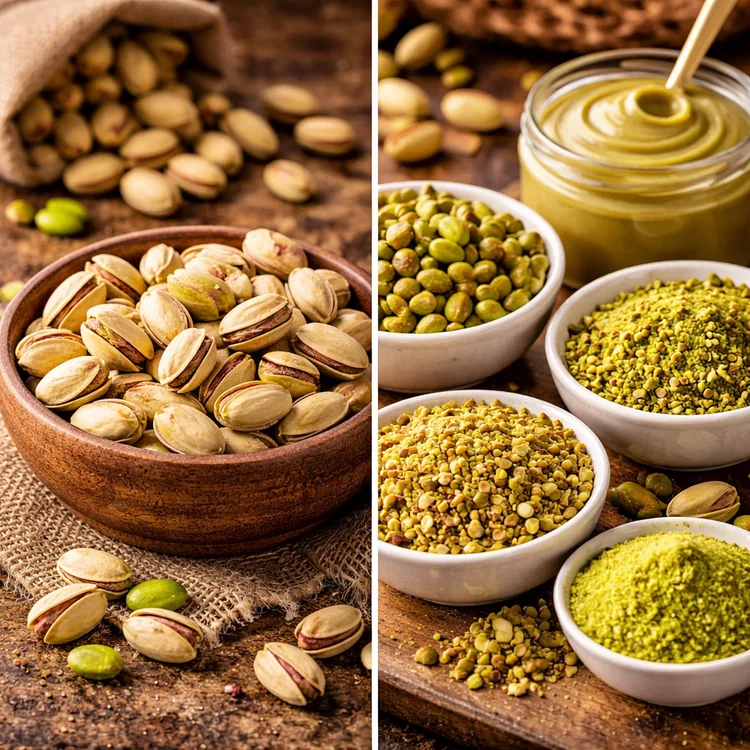
In commercial use, snack pistachios usually refer to products intended to be sold or consumed more directly in ready-to-eat form. These often include in-shell roasted pistachios and other formats where appearance, shell presentation, roast character and immediate eating experience matter strongly. Ingredient pistachios usually refer to products intended to be used in another food system. These may include kernels, cuts, granules, powder, paste-related raw material or other forms selected for pastry, confectionery, bakery, dairy, dessert, spreads or industrial use.
The important commercial point is that these categories are defined not only by physical format but by end use. A pistachio becomes “ingredient” not merely because it is out of shell or cut smaller, but because it is being evaluated by what it will do inside a formulation, processing line or finished branded product. In the same way, a pistachio becomes “snack” because it is being judged as a direct eating experience rather than as a hidden or semi-hidden input.
This is why strong sourcing starts with application. The buyer should first define whether the product is meant to be seen, eaten and judged directly, or whether it is meant to function inside something else.
Why the difference is commercial, not just physical
It is tempting to think the difference is only that snack pistachios are sold whole and ingredient pistachios are sold processed. That view is too narrow. The deeper difference is commercial. The product is being purchased under different expectations, sold to different people, and compared using different definitions of success.
Snack products are judged at the point of direct consumption
If the pistachio is a snack product, the buyer usually cares about how the product looks, opens, roasts, feels and tastes in immediate consumer use. The eating moment is the main value event.
Ingredient products are judged at the point of application performance
If the pistachio is an ingredient, the buyer often cares more about whether the product integrates into pastry, chocolate, fillings, powder systems, bakery mixes, topping applications or other manufacturing contexts. The main value event happens later, inside another finished product.
The same origin can serve both, but not in the same way
Turkish Antep pistachios can serve both snack and ingredient markets successfully, but the commercial priorities are different enough that buyers should not rely on one generic quality description for both.
What buyers usually expect from snack pistachios
Snack pistachios usually need to work as a consumer-facing product. Because of that, ready-to-eat presentation becomes a major part of the value proposition.
Appearance matters more immediately
Snack buyers often care about shell presentation, size uniformity, roast look, visible cleanliness and overall shelf appeal because the product must attract the customer before it is eaten.
Roast and eating profile matter strongly
The buyer is usually thinking about direct sensory experience: how the pistachio smells when opened, how it tastes, how crisp it feels and whether it supports repeat purchase in a snack setting.
Retail positioning shapes the specification
Snack products are often sold in consumer packs, premium snack assortments, convenience channels, specialty stores or branded ready-to-eat programs. That means packaging, visual consistency and product story become important parts of the decision.
Consumer expectation is more direct
The customer sees the pistachio and judges it directly. There is no pastry layer, chocolate shell or recipe matrix between the product and the consumer. As a result, presentation issues are more exposed.
What buyers usually expect from ingredient pistachios
Ingredient pistachios are usually evaluated through the lens of downstream use. They may still need to look attractive, especially in visible premium applications, but the product is often judged more heavily on how it performs inside another food category.
Application fit is central
Ingredient buyers want to know whether the pistachio suits the target product: confectionery, pastry, bakery, ice cream, topping systems, fillings, pastes, powders or industrial manufacturing use.
Format matters more than broad quality words
Terms such as kernel, cut, granule, powder and paste-oriented raw material become more useful than generic words like premium or top quality. The correct format depends on what the buyer is trying to make.
Technical consistency matters
Ingredient users often care more about consistency in cut size, kernel appearance, processing suitability, color profile, granulation logic, moisture awareness and production repeatability than snack buyers do.
Not every ingredient use needs the most visually premium grade
A paste or internal filling system may not need the same appearance logic as a visible pastry garnish or consumer-facing retail snack. Ingredient buyers who separate visible use from internal use often buy more efficiently.
How product form changes the buying logic
Product form is one of the clearest ways snack and ingredient categories diverge. Even when the raw material comes from the same supply region, the commercial language changes as the form changes.
In-shell formats
In-shell pistachios are most closely associated with snack use. Here the shell, roast style and immediate consumer handling experience matter strongly.
Kernels
Kernels can serve either category depending on the market. They may be sold as premium visible ingredients or in some cases as direct-consumption formats. But in B2B trade they are often evaluated more like ingredients than like standard snacks.
Cuts, granules and slices
These are typically ingredient-oriented forms selected for pastry, chocolate, bakery or topping use. Their value depends on how they support the finished product.
Powder and paste-related forms
These are clearly ingredient-driven formats. Buyers compare them through application logic rather than direct snack presentation.
The same buyer may need both categories
Distributors, importers or large manufacturers sometimes handle both snack and ingredient pistachios. In that case, they benefit from treating the two categories as separate sourcing conversations rather than one merged procurement line.
How quality priorities change by category
Both snack and ingredient pistachios can be high quality, but they are not always high quality for the same reasons.
Snack-quality priorities
- Consumer-facing appearance and visual uniformity
- Roast profile and ready-to-eat sensory appeal
- Shelf presentation and immediate attractiveness
- Direct eating experience
- Retail or branded snack suitability
Ingredient-quality priorities
- Correct product form for the target application
- Kernel tone, cut size or granulation consistency
- Processing suitability and handling reliability
- Visible vs internal use alignment
- Repeatability across manufacturing cycles
Some attributes overlap, but their weight changes
Cleanliness, consistency and dependable supply matter in both categories. What changes is the relative importance of each attribute. A snack buyer may place greater weight on external presentation. An ingredient buyer may place greater weight on application performance.
Simple comparison: snack pistachios vs ingredient pistachios
| Dimension | Snack pistachios | Ingredient pistachios |
|---|---|---|
| Main role | Ready-to-eat product | Input for another finished product |
| Main evaluation point | Direct consumer experience | Application performance in manufacturing |
| Typical priority | Appearance, roast, snack appeal | Format, consistency, technical fit |
| Common form | In-shell roasted or consumer-oriented format | Kernels, cuts, powder, paste-related forms |
| Commercial question | Will customers want to buy and eat this directly? | Will this perform correctly in the final application? |
Packaging and logistics differences
Packaging logic often changes significantly between snack and ingredient categories because the product moves through different commercial channels.
Snack packaging is often market-facing
Snack products may need packaging logic aligned with retail display, shelf life at point of sale, portioning or branded customer presentation.
Ingredient packaging is often workflow-facing
Ingredient products are more often packed with manufacturing, storage, handling and batch use in mind. The packaging must support receiving, opening, internal transfer and production use.
Case counts and unit logic are not equally important for both
A retail snack buyer may care about consumer unit logic and presentation. An industrial buyer may care more about production efficiency, pack size alignment and warehouse practicality.
The better the packaging matches the application, the better the commercial result
Good sourcing decisions look at packaging as part of category fit, not only as a transport detail.
Pricing logic and value perception
One of the biggest buying mistakes in pistachio trade is assuming that higher price always means better purchase quality in absolute terms. In reality, price only makes sense when measured against the final use.
Snack products often justify value through immediate presentation
If the product will be judged visually and sensorially at the retail snack level, stronger appearance and snack-ready characteristics may justify higher pricing.
Ingredient products justify value through performance
If the product will be turned into pastry, chocolate, bakery, fillings or paste systems, the correct question is whether the specification helps the finished product succeed. Paying for a highly visual snack feature that disappears during processing may not be efficient.
Over-specifying is a common cost trap
Buyers sometimes purchase snack-style premium characteristics for ingredient uses that do not need them. Others do the reverse and then discover the snack product looks weaker than intended in market. Both mistakes come from not separating categories properly.
How different buyer segments should think about the distinction
Importers and distributors
Importers who serve multiple customer types should avoid treating all pistachio products as one sales category. They benefit from segmenting snack, retail ingredient and industrial ingredient demand separately so that customers are offered the right product for the right purpose.
Private-label programs
Private-label buyers often need extra clarity because brand, purchasing and packaging teams may all be involved. A direct snack product and an ingredient product require different internal decision language and should not be approved on the same broad criteria.
Confectionery and pastry manufacturers
These buyers should focus heavily on ingredient fit. The correct format, cut logic, kernel tone or paste suitability often matters more than consumer-facing snack appearance.
Foodservice and horeca buyers
This segment may require either category depending on use. Some buyers need ready-to-serve snack presentation. Others need ingredient formats for desserts, bakery items or kitchen preparation.
Retail snack brands
These buyers should be especially careful not to evaluate consumer-ready products as if they were generic kernels or industrial ingredient material. Presentation and eating experience are central to the business model.
How visible use changes the decision
One of the most useful practical questions a buyer can ask is whether the pistachio will remain visible in the final form or become internal to a recipe system.
Directly visible and directly consumed
This usually points toward snack logic, where appearance and ready-to-eat appeal carry greater commercial weight.
Visible but ingredient-based
Premium pastry toppings, chocolate decorations and visible cuts can still be ingredient products, but they may need stronger visual standards than internal-use ingredients do.
Not clearly visible after processing
Once the pistachio is blended into paste, powder, fillings or internal recipe systems, the buying logic often shifts further toward functional and cost-performance considerations.
Questions buyers should ask suppliers
Better purchasing usually starts with better questions. Instead of asking only for price, buyers should define the commercial role of the pistachio clearly.
Commercial questions
- Is this product mainly intended for snack sale or for ingredient use?
- Which customer segment usually buys this grade?
- Would you position this product as retail-facing, foodservice-facing or industrial?
- Are we comparing a snack-ready product with an ingredient-oriented product by mistake?
Technical questions
- What product form is most appropriate for our application?
- How should we think about visual expectations versus processing expectations?
- Does this grade suit direct consumption, visible ingredient use or internal recipe use?
- What quality attributes matter most for this category?
Strategic questions
- Are we overpaying for a presentation feature our application does not need?
- Are we under-specifying for a market that will judge the product directly?
- Should we buy separate pistachio grades for snack and ingredient channels?
Common mistakes to avoid
-
Comparing snack and ingredient offers as if they are the same category.
Similar names can hide very different commercial purposes. -
Using generic quality language.
Words like premium or export quality do not explain whether the product is right for snack sale or ingredient manufacturing. -
Ignoring the final application.
The same pistachio may create value in one use and unnecessary cost in another. -
Assuming direct-consumption standards always apply to ingredient use.
Many industrial applications need a different kind of optimization. -
Assuming ingredient pricing should match snack pricing logic.
The value drivers are different, so the comparison framework should be different too.
How Atlas uses this knowledge
Atlas uses academy content to make pistachio sourcing discussions more practical and more precise. In a topic like snack versus ingredient differentiation, that means helping buyers move beyond broad product names and toward application-based product thinking.
Instead of reducing the conversation to price or origin alone, we encourage buyers to define what the pistachio is meant to do in the market: serve as a direct snack, support a retail ingredient format, function inside pastry or confectionery production, or feed an industrial process with repeatable consistency. Once the product role is clear, grade logic and supplier communication become much more effective.
- We connect commercial guidance to real pistachio product categories.
- We connect technical detail to downstream food applications.
- We help buyers compare offers more accurately before ordering.
- We support clearer conversations around kernels, cuts, powder and paste-oriented products.
- We aim to reduce ambiguity in Turkish pistachio sourcing decisions.
Final takeaway
The commercial differences between snack and ingredient pistachios are not a minor classification issue. They affect how products are described, priced, packed, evaluated and ultimately sold. Snack pistachios are usually judged as direct eating experiences. Ingredient pistachios are usually judged as performance-driven inputs inside another product system.
Buyers who understand this distinction make better decisions because they stop comparing unlike products on the same criteria. They ask more precise questions, request more appropriate specifications and align cost with actual end-use value.
Better pistachio sourcing starts with better category clarity. Once the buyer defines whether the product is meant for direct snack consumption or for ingredient performance, the rest of the commercial conversation becomes more rational, more efficient and more useful.
Frequently asked questions
Who is this article for?
This article is intended for B2B buyers, importers, distributors, brand owners, private-label programs and food manufacturers researching Turkish pistachio supply.
What is the main difference between snack and ingredient pistachios?
Snack pistachios are usually judged more directly as ready-to-eat products, while ingredient pistachios are usually judged by how well they fit a manufacturing or formulation application.
Are snack pistachios always better?
No. They are not automatically better. They are optimized for a different commercial role. An ingredient buyer may not need the same priorities as a retail snack buyer.
Can kernels be ingredient products?
Yes. Kernels are often ingredient-focused in B2B trade, especially when they are used in pastry, confectionery, bakery, toppings, fillings, powder or paste-oriented applications.
Why does this distinction matter in pricing?
Because different categories create value in different ways. Paying for snack-facing presentation may make sense in one market and be unnecessary in another.
What is the best way to compare offers?
Start by defining the end use clearly. Then compare the product form, grade logic, application fit, consistency and packaging in relation to that use.
Can Atlas help buyers clarify which category they need?
Yes. Atlas helps buyers think more clearly about product form, application, market expectations and the commercial questions that matter before an order is placed.
Looking for Turkish pistachios for retail snack, ingredient manufacturing, confectionery, pastry or industrial food applications? Contact Atlas to discuss product form, application, packaging and supply requirements.