Contents
- Why this topic matters
- What crunchy and smooth pistachio paste mean in practice
- Why paste texture matters commercially
- When smooth pistachio paste makes more sense
- When crunchy pistachio paste makes more sense
- Why many confectionery products need a hybrid approach
- Texture and premium positioning
- Technical considerations for manufacturers
- Visible texture vs. hidden texture
- How different buyer segments should think about the choice
- Pricing logic and value perception
- Questions buyers should ask suppliers
- Common mistakes to avoid
- How Atlas uses this knowledge
- Frequently asked questions
Why this topic matters
Confectionery categories increasingly depend on texture differentiation. Many premium chocolate bars, filled pralines, spread-filled products, dessert-inspired pieces and gifting formats succeed because they create contrast: smooth and crunchy, soft and crisp, creamy and particulate, refined and indulgent. Pistachio paste often sits at the center of that contrast.
Buyers therefore need to think beyond the generic term “pistachio paste.” Two pastes can both be pistachio-based yet create completely different consumer experiences. A smooth paste may signal elegance, continuity and a polished finish. A crunchy paste may signal abundance, handcrafted richness and a more substantial bite. Neither choice is automatically superior. The right choice depends on how the finished confectionery product is supposed to feel, look and sell.
This topic matters especially for Turkish pistachio buyers because premium Antep pistachios are often chosen not only for flavor, but also for the quality story they help tell. When paste texture is aligned with the product concept, the pistachio ingredient becomes more commercially powerful. When it is misaligned, the product may feel confused or less convincing in the market.
What crunchy and smooth pistachio paste mean in practice
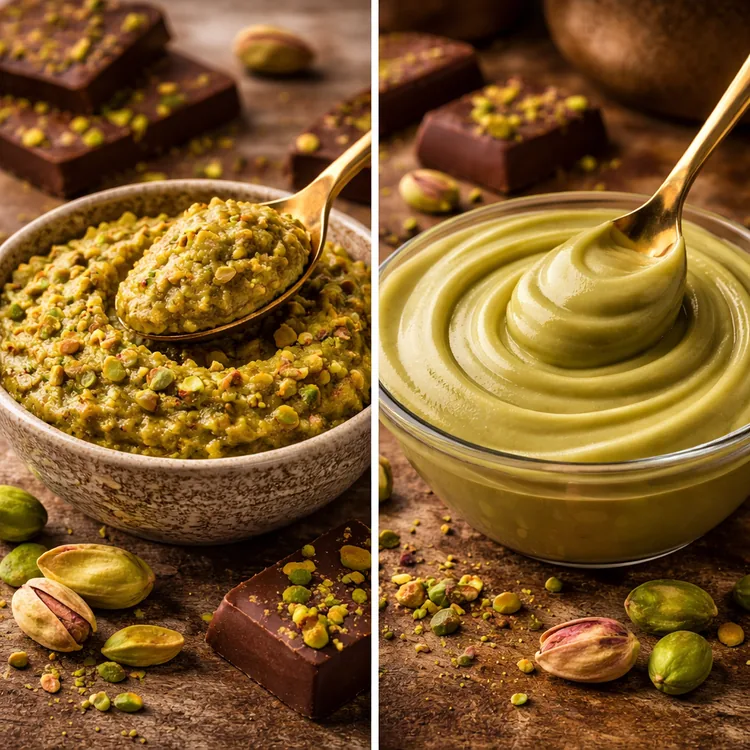
In practical confectionery terms, smooth pistachio paste generally refers to a more uniform, more refined pistachio system designed to create an even mouthfeel, cohesive filling structure and more polished sensory result. Crunchy pistachio paste generally refers to a pistachio system that retains a more noticeable particulate character, delivering bite, nut presence and textural variation inside the finished product.
These terms are useful commercially because they describe how the product behaves in the mouth and in the concept, not only how it looks before use. A buyer selecting smooth paste is often prioritizing elegance, spreadability, cream integration or controlled filling structure. A buyer selecting crunchy paste is often prioritizing texture contrast, indulgence, visible nut identity or a more substantial interior feel.
Texture decisions therefore sit at the intersection of formulation and positioning. The chosen paste does not only affect manufacturing. It affects what the customer believes the product is.
Why paste texture matters commercially
It changes the product story
Smooth texture often supports a more refined confectionery narrative. It fits products presented as elegant, creamy, luxurious or polished. Crunchy texture often supports a richer, more indulgent and more experiential narrative. It fits products marketed around generosity, depth, contrast and bite.
It changes perceived value
Texture can strongly influence how premium a product feels. In some products, a smooth center feels more sophisticated and premium. In others, crunch feels more premium because it signals visible pistachio presence, greater ingredient abundance or a more handcrafted interior.
It changes product differentiation
In crowded confectionery categories, texture is one of the clearest ways to stand apart. A pistachio product that looks similar on the outside may feel completely different once eaten. That difference can become a major reason why consumers repurchase or talk about the product.
It changes which pistachio formats a buyer needs
A smooth paste decision often points toward one sourcing pathway. A crunchy paste decision may imply a different particle structure, a different raw material approach or even the need for multiple pistachio formats working together inside one recipe.
When smooth pistachio paste makes more sense
Smooth pistachio paste is often the stronger choice when the product concept relies on cohesion, creaminess and refined mouthfeel.
Praline-style fillings and elegant centers
If the product is meant to feel silky, uniform and luxurious inside the shell, smooth paste usually makes more sense. It helps create the kind of interior consumers associate with polished, premium confectionery rather than rustic or textural products.
Layered bars with a clean interior cut
Many premium bars are judged by how they look when opened or cut. A smooth pistachio layer can create a more even cross-section, especially when the brand wants the product to appear clean, composed and visually deliberate.
Products emphasizing creaminess over crunch
Some concepts are built around melt, softness and richness rather than bite. In these cases, a more uniform paste supports the intended sensory direction better.
Applications requiring more even integration
Smooth pistachio paste often fits better where the ingredient needs to blend more consistently into cream-based systems, praline-like fillings or refined confectionery interiors where particulate texture would feel disruptive.
Premium gifting and luxury presentation
Products positioned as elegant gifts often benefit from a cleaner and more controlled interior finish. Here, smooth paste can support a more sophisticated impression, especially when the packaging and product narrative lean toward refinement.
When crunchy pistachio paste makes more sense
Crunchy pistachio paste is often the stronger choice when the product needs contrast, perceived abundance and more obvious pistachio presence in the bite.
Products built around indulgent texture contrast
If the product depends on the contrast between chocolate shell and textured interior, crunchy paste may be far more effective. The paste becomes part of the eating event, not just a flavor carrier.
Chunkier, richer filled bars
Some filled bars are intentionally designed to feel generous, thick and substantial. In these products, crunchy pistachio paste can help deliver the “loaded” interior that consumers often associate with abundance and premium indulgence.
Confectionery with visible pistachio identity
Where the brand wants the customer to feel that real pistachio is present in a more physical way, crunchy paste may create stronger authenticity than a fully uniform interior.
Bakery-confectionery crossover concepts
Dessert bars, pastry-inspired chocolates, stuffed products and hybrid confectionery formats often benefit from texture more than classical pralines do. In these cases, crunchy pistachio paste can help bridge confectionery and dessert-style indulgence.
Social-media-driven or experiential product categories
Products that succeed because they offer a dramatic bite, visible texture or a memorable interior often benefit from a crunchier pistachio system. Texture becomes part of the product's marketability.
Why many confectionery products need a hybrid approach
The decision does not always need to be purely one or the other. Many of the most commercially successful products use a hybrid approach: a smooth pistachio base for cohesion and richness, combined with crunchy pistachio elements for bite and contrast.
Smooth base plus textured inclusion
This approach allows the product to maintain structural consistency while still creating a more interesting mouthfeel. It is especially useful in filled bars, premium chocolate pieces and layered confections.
Controlled texture rather than random texture
A hybrid system can feel more intentional than an overly coarse paste. The buyer gets the benefit of crunch while keeping the filling commercially tidy and more predictable.
Different pistachio roles inside one product
In some products, pistachio serves more than one role at once: flavor base, visual signal and textural event. A hybrid structure can support all three more effectively than a single uniform paste system.
Texture and premium positioning
One of the biggest mistakes buyers make is assuming that premium always means smoother. In reality, premium is defined by alignment. A smooth paste can be premium when the product is supposed to feel refined and polished. A crunchy paste can be premium when the product is supposed to feel abundant, ingredient-rich and indulgently textured.
Smooth premium
Smooth premium is associated with elegance, controlled craftsmanship, visual cleanliness and a more luxurious melt. This works well in classic pralines, luxury gift assortments and carefully layered center-filled products.
Crunchy premium
Crunchy premium is associated with richness, generosity, artisanal abundance and a more emotionally dramatic bite. This works especially well in premium bars, trend-led products and products where contrast itself is part of the value proposition.
Premium should match the promise
If the outer packaging, photography and marketing story promise an indulgent textured experience, a very smooth interior may disappoint. If the brand promises refined luxury, an overly coarse center may feel less consistent with the positioning. Premium texture decisions should therefore be driven by brand promise as much as by recipe preference.
Technical considerations for manufacturers
Texture decisions in pistachio paste also influence manufacturing logic. The buyer must think not only about eating quality, but also about how the paste needs to behave inside the line, in the fill, in storage and in the final presentation.
Filling structure and body
Some products require a more cohesive interior that holds its shape cleanly. Others benefit from a thicker, more dynamic interior with visible texture. The right paste should support the intended structure rather than force the formulator to compensate around it.
Mouthfeel design
Mouthfeel is one of the main reasons to choose one paste texture over another. A smooth paste creates continuity. A crunchy paste introduces interruption and contrast. The technical team should decide which sensation defines the product.
Cut appearance and cross-section
Many confectionery products are photographed opened, cut or broken. The pistachio center needs to look appropriate in that visual context. Smooth interiors communicate polish. Crunchy interiors communicate loaded richness.
Interaction with other textured elements
If the product already contains wafers, biscuit layers, kataifi, nut inclusions or crisped components, the pistachio paste may not need to provide all of the texture itself. In such cases, smooth paste may be the better balancing choice. If there are few other texture sources, crunchy paste may become more important.
Repeatability
The more successful a product becomes, the more important repeatability becomes. Buyers should therefore think about whether the chosen texture direction can be supported consistently across batches and order cycles.
Visible texture vs. hidden texture
Another useful distinction is whether the pistachio texture will be visible to the customer or mainly experienced only during eating.
Visible texture
If the customer can see the pistachio particles in the cut-open product or exposed filling, crunchy paste may add both sensory value and visual credibility. The product looks more obviously pistachio-rich.
Hidden texture
If the pistachio texture is largely hidden inside the product, the decision becomes more sensory than visual. In these cases, the brand must decide whether the product needs a surprising crunch or a more seamless cream experience.
Consumer expectation matters
If the visual presentation suggests a smooth center, the eating experience should generally align with that expectation. If the product is marketed around crunch, loaded texture or premium contrast, the paste should help fulfill that promise.
How different buyer segments should think about the choice
For premium chocolate brands
- Choose smooth paste when the brand language emphasizes elegance, creaminess and luxury finish.
- Choose crunchy paste when the product is sold around indulgent bite, richness and texture-driven differentiation.
- Use hybrid systems when both refinement and contrast matter.
For private-label manufacturers
- Match texture to the end customer's brand promise rather than defaulting to one style.
- Clarify whether the client wants a refined center, a loaded bite or a combination of both.
- Think about repeatability and appearance in the final packed format.
For industrial manufacturers
- Evaluate whether texture is a core value driver or a secondary product feature.
- Do not over-specify crunch if other ingredients already create contrast.
- Do not over-smooth a product that is supposed to feel substantial and indulgent.
For distributors and ingredient traders
- Segment customers by application rather than offering one pistachio paste style to everyone.
- Explain paste texture in terms of end-use, not only in terms of general quality language.
- Help buyers understand that smooth and crunchy are different tools, not a simple hierarchy.
Pricing logic and value perception
Texture decisions should also be judged economically. The best pistachio paste is not the one that sounds most premium in isolation. It is the one that creates the most value inside the finished confectionery product.
Pay more when texture adds market value
If a crunchy pistachio interior materially improves the product's excitement, visual cross-section or consumer appeal, the added cost may be justified. If a smoother paste helps position the product as more luxurious and refined, that cost may also be justified.
Avoid paying for the wrong premium cue
A brand may assume it needs smooth luxury when its target market actually responds more strongly to visible indulgent texture. Another brand may assume crunch equals richness when its packaging and photography suggest polished elegance instead. The most expensive choice is often the wrong choice for the concept.
Judge texture after the product is finished
Buyers should evaluate value at finished-product level. The question is not only how the paste tastes from a sample spoon. The question is how it performs once layered, enrobed, packed, sold and eaten.
Simple comparison: crunchy vs. smooth pistachio paste
| Dimension | Smooth pistachio paste | Crunchy pistachio paste |
|---|---|---|
| Main sensory signal | Refined, creamy, cohesive | Textured, rich, indulgent |
| Best suited for | Elegant centers, pralines, smooth fillings | Texture-led bars, substantial fillings, experiential products |
| Visual effect in cross-section | Clean and polished | Loaded and dynamic |
| Common premium cue | Luxury refinement | Ingredient abundance |
| Common buying mistake | Choosing it when the product needs more drama | Choosing it when the product needs more elegance |
Questions buyers should ask suppliers
Commercial questions
- What confectionery applications is this paste texture best suited for?
- Would you position this as a refined center paste or a texture-led filling paste?
- Is this more appropriate for pralines, bars, gifting products or broader industrial use?
- How should we think about the price relative to the finished product role?
Technical questions
- How would you describe the texture profile in practical application terms?
- Is this paste intended to be used alone or combined with other pistachio components?
- Would you recommend it for smooth filling systems, textured interiors or hybrid structures?
- How consistent is the sensory feel from lot to lot?
Strategic questions
- Are we choosing texture based on real product need or on assumption?
- Would a hybrid approach serve our concept better than a single texture direction?
- Should we use different pistachio systems across different products in our range?
Common mistakes to avoid
-
Assuming smooth is always more premium.
In many products, visible crunch and richer bite feel more premium than a polished interior. -
Assuming crunchy is always more indulgent.
Some luxury products need elegance and melt rather than strong particulate texture. -
Choosing one texture for every product.
Different confectionery concepts often need different pistachio texture strategies. -
Ignoring the rest of the product structure.
The right paste choice depends on what other texture elements already exist in the formulation. -
Judging the paste only in isolation.
The important evaluation is how it performs inside the finished confectionery format. -
Using vague buying language.
Asking for “premium pistachio paste” is usually less useful than defining whether the product needs creaminess, crunch or a balance of both.
How Atlas uses this knowledge
Atlas uses academy content to help buyers think more precisely about pistachio ingredients and the roles they play in finished products. In confectionery applications, that means connecting pistachio paste not only to origin or general quality language, but also to texture, product architecture, premium positioning and commercial fit.
Rather than treating pistachio paste as a single broad category, we encourage buyers to define what the paste is supposed to do: create elegance, create contrast, support a richer bite, help a premium cross-section, or build a more indulgent center. The clearer those goals become, the easier it is to choose the right pistachio direction.
- We connect paste texture choices to real confectionery applications.
- We connect commercial positioning to formulation logic.
- We help buyers compare smooth, crunchy and hybrid pistachio systems more clearly.
- We support better questions before purchasing and product development decisions are made.
- We aim to reduce ambiguity in premium pistachio sourcing discussions.
Final takeaway
Crunchy vs. smooth pistachio paste in confectionery is not a small technical choice. It is a product identity choice. Smooth paste supports elegance, cohesion and refined mouthfeel. Crunchy paste supports contrast, richness and a more dramatic sensory experience. Many successful products use both.
The best buyers do not ask which option sounds more premium in general. They ask which option makes their particular product stronger. Once the decision is tied to application, the sourcing discussion becomes more precise, more commercially rational and more useful.
Better pistachio sourcing starts with better product thinking. When texture is treated as a deliberate strategy rather than an afterthought, buyers create confectionery products that are easier to position, easier to differentiate and more convincing in the market.
Frequently asked questions
Who is this article for?
This article is intended for B2B buyers, importers, confectionery brands, private-label programs, distributors and food manufacturers researching Turkish pistachio paste supply.
What is the difference between crunchy and smooth pistachio paste?
Smooth pistachio paste is generally chosen for a more uniform and refined filling experience, while crunchy pistachio paste is usually chosen for more noticeable texture, bite and pistachio presence.
Is smooth pistachio paste always more premium?
No. Premium depends on the product concept. Smooth may feel more premium in refined luxury centers, while crunchy may feel more premium in indulgent, texture-led confectionery.
When should buyers choose crunchy pistachio paste?
Buyers often choose crunchy pistachio paste when the product relies on texture contrast, visible pistachio character, richer bite or a more substantial interior feel.
When should buyers choose smooth pistachio paste?
Buyers often choose smooth pistachio paste for pralines, refined center fillings, elegant layered chocolates and products where cohesive creaminess matters more than nut bite.
Can one product use both textures?
Yes. Many premium confectionery products use a smooth pistachio base combined with crunchy pistachio elements to create both cohesion and contrast.
Can Atlas help buyers think through the right pistachio paste direction?
Yes. Atlas helps buyers connect product form, texture goals, application needs and commercial priorities so sourcing conversations become more practical and more accurate.
Looking for Turkish pistachio paste for premium chocolate, confectionery fillings, private-label products or industrial manufacturing? Contact Atlas to discuss texture direction, product form, application and supply requirements.