Contents
- Why this topic matters
- What moisture management means in pistachio trade
- Why shelf life is not just a printed date
- How moisture affects product quality
- Risk points across the supply chain
- Why different pistachio formats behave differently
- Why packaging matters
- Storage and transport considerations
- Commercial perspective for buyers
- Technical perspective for food manufacturers
- Buyer checklist before ordering
- Common mistakes to avoid
- How Atlas uses this knowledge
- Frequently asked questions
Why this topic matters
Pistachios are a premium product category in which quality perception depends on more than just visual grading. A shipment may look strong at origin, yet still underperform later if moisture control is weak. That is because shelf life is influenced not only by the product itself, but also by the environment around it. Moisture exposure can gradually affect texture, flavor expression, handling characteristics, packaging behavior and end-customer satisfaction.
This topic matters especially for importers, distributors and manufacturers who work with long shipping routes, warehouse turnover cycles, seasonal demand peaks and multiple packaging or repacking stages. In these situations, the pistachio is not judged only at the moment of packing. It is judged after time has passed. Buyers therefore need to think about how quality holds, not only how quality starts.
Moisture management is also important because it directly influences commercial predictability. Better-controlled product tends to support more stable presentation, better repeat ordering confidence and smoother downstream handling. Poorly controlled product can create complaints that appear later and are harder to manage because the shipment may have looked acceptable earlier in the process.
What moisture management means in pistachio trade
In practical B2B terms, moisture management refers to the steps taken to limit undesirable moisture exposure and maintain product stability from processing to final use. It is not only a technical plant issue. It is a supply-chain discipline. It includes how the product is handled after preparation, what packaging format is used, how storage is managed, how transport conditions are considered and how the buyer plans to use or distribute the pistachios after arrival.
Moisture management therefore sits at the intersection of quality control, logistics and commercial planning. A buyer who ignores moisture behavior may make the mistake of choosing product solely on price or visual grade. A buyer who understands moisture management is more likely to ask better questions about packing style, container exposure, storage discipline, repacking risk and final application suitability.
This is particularly relevant in pistachio trade because buyers purchase in several different formats: in-shell roasted products, natural kernels, green kernels, cuts, powder and ingredients intended for confectionery or pastry use. Each format interacts differently with the surrounding environment, which means moisture awareness should always be linked to product form.
Why shelf life is not just a printed date
Many buyers understandably look for a shelf-life statement or best-before period as a starting point. That is useful, but it does not tell the whole story. Shelf life is not just a printed number on a label. It is the practical ability of the product to remain commercially acceptable over time under expected handling conditions.
In other words, shelf life is experienced through performance. Does the product still feel crisp when it should? Does it still look clean and stable? Does it still align with customer expectations in retail or ingredient use? Does it still behave as intended in pastry, confectionery or snack applications? These are the real commercial expressions of shelf life.
This is why moisture management matters so much. Even when the product remains saleable in a technical sense, weak moisture control can reduce the quality impression earlier than the nominal shelf-life period might suggest. For premium categories like Turkish pistachios, that decline in perceived quality can have real commercial consequences.
How moisture affects product quality
Texture and bite
One of the most immediate ways buyers notice moisture-related change is through texture. In-shell roasted pistachios and many kernel products are valued partly for their clean, crisp eating quality. If moisture exposure interferes with that texture profile, the product can feel softer, less lively or less satisfying even if it still looks acceptable at first glance.
Texture matters commercially because customers often associate crispness with freshness. Once that sensory expectation weakens, the overall perception of quality may fall with it.
Flavor perception
Moisture exposure can also influence how flavor is perceived. Premium pistachio products are expected to carry a distinct nut identity and, depending on the form, a clean roasted or natural profile. If the handling environment is not well controlled, the product may gradually lose some of the freshness cues buyers value.
In commercial settings, this matters because flavor perception is not separated from storage quality in the mind of the customer. The buyer does not say, “the moisture conditions changed the product slightly.” The buyer simply says, “this lot does not feel as fresh as expected.”
Visual presentation
Moisture management can also affect how a product presents over time. This is especially important for premium retail packs, clear packaging, decorative kernels and visually sensitive ingredients. Even when the change is subtle, reduced visual sharpness or handling appeal can weaken merchandising performance and buyer confidence.
Flow and handling characteristics
For ingredient buyers, moisture-related issues are not only sensory. They may also affect how the product behaves during weighing, transferring, blending or packing. Kernels, cuts and powders that must move predictably through a process benefit from stable handling conditions. Moisture control therefore has operational value as well as product value.
Perceived consistency
One of the strongest hidden costs of weak moisture management is inconsistency. Two lots of similar origin and grade can create very different buyer experiences if one has been better protected across the supply chain. Over time, buyers tend to trust suppliers who deliver more stable product behavior, not just attractive starting specifications.
Risk points across the supply chain
Moisture management should be viewed across the full commercial journey of the pistachio, not only inside the processor's facility. Below are some of the most important risk points buyers should keep in mind.
After processing
Once pistachios have been cleaned, sorted, roasted or otherwise prepared, the product enters a stage where protective handling becomes especially important. Quality work done earlier can be undermined if the post-processing environment is not well managed.
During packing
The transition from product preparation to sealed packaging is critical. This stage helps determine how protected the product will be during storage and shipment. Packing is not only about presentation or shipping convenience. It is one of the main commercial barriers between the product and the surrounding environment.
Warehouse storage
Warehousing practices influence how well pistachios maintain their quality profile before dispatch or after import. Even a strong product can become harder to manage if storage discipline is weak or if environmental conditions fluctuate unnecessarily.
International transport
Long-distance shipments introduce another layer of risk because the product may travel through changing environments before it reaches the customer. This is especially relevant for export buyers with longer transit times, seasonal weather variation or multiple handling points.
Importer or distributor repacking
Repacking is often treated as a routine downstream step, but it can become a quality-sensitive stage if the product is exposed more than necessary. Buyers who repack, blend or portion pistachios should treat moisture control as part of their own quality system, not only as a supplier responsibility.
Final application environment
Ingredient buyers should also think about the environment in which the pistachio will ultimately be used. A powder for pastry, a kernel for premium confectionery and an in-shell roasted product for retail snacks all enter different downstream realities. Moisture awareness should therefore continue even after the product reaches the customer facility.
Why different pistachio formats behave differently
In-shell pistachios
In-shell pistachios are often evaluated heavily on eating quality, visual appeal and crispness. For these products, moisture-related quality loss is especially noticeable because the category is closely tied to snack pleasure and freshness perception. Buyers in this segment should think carefully about packaging format, shelf presentation and storage turnover.
Kernels
Kernels are more exposed as a product form and are commonly used in ingredient applications, premium retail formats and repacked food systems. Their handling environment matters because visual quality, texture and application performance are all important commercial outcomes.
Cuts and granules
Cut products are often destined for pastry, confectionery, bakery or topping use. Because they are a more processed format, buyers should pay attention not only to appearance and color, but also to how the material behaves in storage and production environments.
Powder
Pistachio powder is often used in pastry and dessert applications where consistency and handling behavior matter significantly. For these buyers, moisture management influences more than shelf life. It can affect formulation stability, texture expectations and the practical ease of using the ingredient in a repeated manufacturing setting.
Paste and paste-oriented raw material
For paste-related applications, the moisture conversation becomes more application-specific. Buyers typically care about functional suitability, processing reliability and the consistency of ingredient behavior. Moisture awareness remains relevant because the quality of upstream handling can still influence downstream manufacturing outcomes.
Why packaging matters
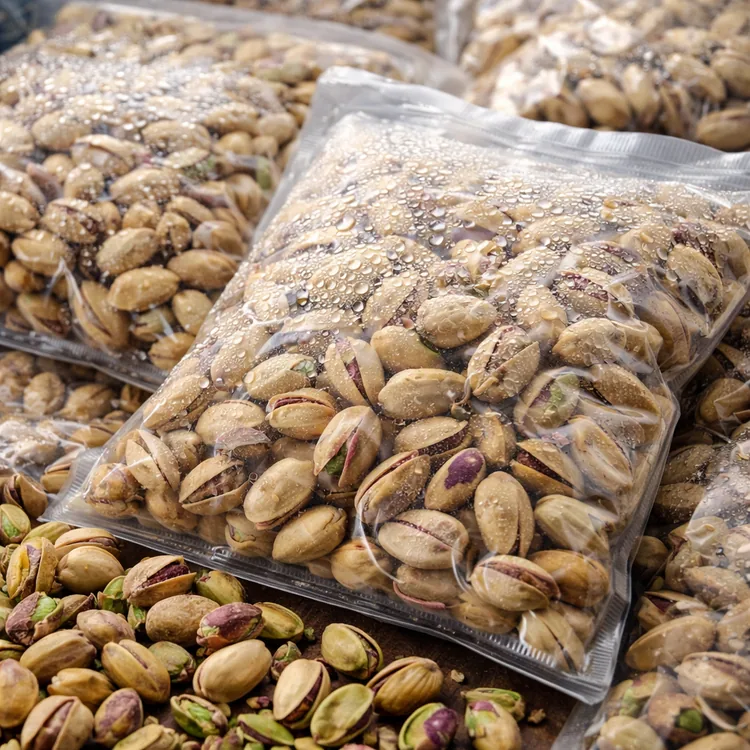
Packaging is one of the most important commercial tools in moisture management because it helps protect quality after the product leaves the processor. Buyers sometimes think of packaging only in terms of weight, branding or cost efficiency, but packaging also plays a product protection role.
Packaging is part of shelf-life strategy
A product's shelf-life performance is influenced by how well the packaging supports stability over time. Strong packaging decisions help preserve the intended quality condition of the product during storage, shipment and distribution.
Retail packaging and visibility
Premium retail packs often place extra importance on appearance because the product may be seen directly by the consumer. This makes moisture protection especially important, since the customer evaluates freshness partly through what they see and how the product later eats.
Bulk packaging for importers and manufacturers
For industrial or bulk buyers, packaging should match the logistical reality of the supply chain. A bulk format that seems efficient on paper may create avoidable handling risk if it does not suit the buyer's storage or production model. Smart buyers therefore assess packaging in relation to real use, not as a separate afterthought.
Repack-sensitive workflows
If the buyer intends to repack after import, that decision should be considered early. The original packaging, the repacking schedule and the exposure period all influence how well the product maintains its expected quality profile.
Storage and transport considerations
Good moisture management is reinforced by disciplined storage and transport planning. Even a well-prepared lot benefits from a handling environment that respects the product's quality goals.
Stable storage planning
Buyers should think in terms of stability and control. Warehouses, distribution centers and factory storage areas should support consistent product handling rather than exposing the product to unnecessary fluctuations or prolonged open handling.
Transit awareness
Long international routes can introduce time, climate variation and handling complexity. This does not automatically create a problem, but it does make packaging and shipment planning more important. Export buyers should always think about what happens to the product between loading and customer receipt, not only at dispatch.
Inventory turnover
Inventory age and turnover discipline affect real-world shelf-life performance. Buyers who rotate product efficiently and align purchasing with realistic demand planning are better positioned to maintain consistent quality in market.
Opened-pack handling
Once a pack is opened, the product enters a new handling phase. This matters especially for ingredient buyers, repackers and foodservice users who may open larger units and use them over time. Internal handling rules should therefore be treated as part of moisture management, not only the supplier's packaging decision.
Commercial perspective for buyers
From a commercial point of view, moisture management helps buyers protect value after purchase. This is important because premium pistachio trade is not only about acquiring a good-looking lot. It is about keeping that lot commercially strong until it reaches the end customer or enters production.
Fewer quality complaints
Better moisture awareness can reduce the risk of customer disappointment related to texture, freshness impression or handling inconsistency. Even when complaints are not formally technical, they often stem from how the product performed over time.
Better retail experience
For brands and distributors selling consumer-ready pistachios, shelf-life quality affects repeat purchase, premium perception and brand trust. Moisture control therefore supports the commercial side of product presentation.
Better quote comparison
Buyers should compare not only the product description and price, but also the protection logic around the product. Two offers may appear similar in grade and origin while differing in how well the product is prepared for real-world storage and transport conditions.
Stronger supply reliability
Suppliers who think seriously about handling quality, packaging fit and shipment protection often create more dependable long-term relationships. Over time, buyers value consistency in delivered condition as much as consistency in specification.
Technical perspective for food manufacturers
Manufacturers often experience moisture-related issues through process performance rather than only through sensory evaluation. This is why moisture management is relevant not just to retailers, but also to ingredient users.
Production consistency
Ingredient stability supports smoother use in pastry, confectionery, bakery and other food applications. When incoming product behaves more consistently, production teams can work with greater confidence.
Handling efficiency
Kernels, cuts and powders are easier to manage when their storage and exposure history has been handled thoughtfully. This reduces hidden friction in weighing, mixing, portioning and internal transfer.
Finished-product quality
In many applications, the quality of the pistachio ingredient contributes directly to the finished product's premium identity. Moisture management matters because it helps preserve the ingredient's intended value before it ever enters the formulation.
Application fit
Technical buyers should think about moisture management in relation to how the pistachio will be used. A visible topping, a kernel inclusion, a fine powder and a paste raw material may each place different emphasis on handling stability, so requirements should be discussed in application-specific terms.
Simple comparison: weak vs strong moisture-awareness in pistachio supply
| Dimension | Weak moisture awareness | Strong moisture awareness |
|---|---|---|
| Texture retention | Less predictable over time | More stable and commercially reliable |
| Freshness perception | May decline sooner | Better protected through the supply chain |
| Packaging role | Treated mainly as shipping material | Treated as part of shelf-life strategy |
| Buyer confidence | More uncertainty after arrival | Higher confidence in delivered condition |
| Downstream handling | More risk during storage and repacking | Better aligned with final use |
Buyer checklist before ordering
Buyers do not need to become laboratory specialists to make better decisions. They simply need to include moisture-related thinking in their commercial review.
Useful commercial questions
- What product form are we buying, and how sensitive is it to storage and handling conditions?
- Is the packaging format appropriate for our import, warehouse and repacking workflow?
- How long will the product realistically remain in our system before final sale or use?
- Will the product be sold directly, repacked, blended or used as an ingredient?
- Are we comparing offers based only on price, or also on delivered-condition reliability?
Useful technical questions
- How is the product protected after processing and before shipment?
- What packing approach is used for this specific product format?
- What should we pay attention to after the shipment arrives?
- Is this format more suitable for direct distribution or for fast ingredient turnover?
- What handling considerations matter most for this grade and application?
Useful internal questions
- Can our warehouse and repacking workflow protect the product properly after opening?
- Are we buying in pack sizes that match our actual usage speed?
- Do we need different packaging logic for retail, wholesale and industrial customers?
- Are we evaluating shelf life in real operational terms or only as a label statement?
Common mistakes to avoid
-
Assuming shelf life is only the supplier's problem.
Shelf-life performance continues to depend on storage, handling and exposure after the product leaves origin. -
Comparing products by price without comparing protection logic.
An attractive price may not reflect the true downstream risk if packaging or handling suitability is weak. -
Using the same packaging expectations for every pistachio format.
In-shell snacks, kernels, cuts and powders do not all behave the same way. -
Ignoring repacking as a quality-sensitive stage.
Repacking can become a hidden risk point if the buyer does not plan for it properly. -
Thinking only about the start of shelf life, not the end-use journey.
The real question is how the product performs after time has passed in the actual commercial chain.
Why moisture management should be linked to application
One of the most useful ways to think about moisture management is to connect it to the intended use of the product. A roasted in-shell pistachio sold in a premium snack pouch is judged heavily on crispness and eating experience. A kernel used in confectionery may be judged more on visual cleanliness, handling behavior and finished-product quality. A powder intended for pastry may be judged on production consistency and functional suitability. These are different commercial realities.
Because the end use changes the quality priority, buyers should avoid generic discussions such as “good shelf life” without defining what that means in context. Better purchasing conversations happen when the buyer explains the application clearly and the supplier aligns product protection accordingly.
Why stronger moisture management adds value
Good moisture management does not merely prevent problems. It actively protects the commercial value of the pistachio. It helps preserve the work already invested in origin selection, grading, roasting, sorting and packing. It supports better brand presentation, better product stability and better buyer confidence.
In that sense, moisture management is not just a technical safeguard. It is a value-preservation tool. In premium pistachio trade, preserving value over time is often just as important as creating value at origin.
How Atlas uses this knowledge
Atlas uses academy content to make product discussions clearer, more practical and more commercially relevant. Instead of reducing pistachio buying to a price conversation, we encourage buyers to think in terms of product form, application, handling quality, packaging logic and long-term commercial usability.
On topics like moisture management, this matters because many buyers know the product they want but have not yet turned that need into the right purchasing questions. Educational content helps bridge that gap. It helps buyers define what they need more clearly and communicate more effectively with processors and exporters.
- We connect commercial guidance to relevant product categories.
- We connect technical handling concepts to real market applications.
- We help buyers think about packaging, storage and shipment in a more practical way.
- We support clearer conversations between importers, distributors and suppliers.
- We aim to reduce avoidable ambiguity before purchasing decisions are made.
Final takeaway
Moisture management is one of the clearest examples of how real product quality extends beyond the raw material itself. In Turkish pistachio trade, shelf-life performance depends not only on origin and processing, but also on how well the product is protected after preparation.
For buyers, this means the smartest purchasing decisions are not based on price or appearance alone. They are based on a fuller understanding of how the product will move through storage, transport, repacking and final use. The better that journey is understood, the more effectively the buyer can protect freshness perception, texture quality and commercial reliability.
That is why better pistachio sourcing starts with better product thinking. When moisture management is considered part of the buying decision rather than an afterthought, buyers make stronger choices and create more dependable supply outcomes.
Frequently asked questions
Who is this article for?
This article is intended for B2B buyers, importers, distributors, private-label brands and food manufacturers researching Turkish pistachio supply and shelf-life handling.
Why does moisture matter for pistachios?
Moisture influences texture, freshness perception, storage stability, packaging performance and the product's commercial usability over time.
Does moisture management only matter in the factory?
No. It matters across the entire supply chain, including packing, warehousing, export shipment, importing, repacking and final customer handling.
Is moisture management important for both snack and ingredient products?
Yes. The exact quality risks may differ by format, but all pistachio categories benefit from thoughtful protection and storage discipline.
Why should importers think about packaging more carefully?
Because packaging is not only a transport detail. It is part of how product quality is protected between origin and end use.
What is the main commercial lesson for buyers?
Buyers should evaluate shelf life as a real handling journey rather than only a label statement. That means connecting product form, packaging, transport time, storage discipline and final use.
Can Atlas help buyers think through these issues?
Yes. Atlas helps buyers approach Turkish pistachio sourcing with better commercial and technical clarity across product form, application, packaging and supply-chain suitability.
Looking for Turkish pistachios for retail, wholesale or ingredient manufacturing? Contact Atlas to discuss product form, packaging, application and supply requirements.