Contents
- Why this topic matters
- What pistachio powder is in commercial terms
- Why premium pastry uses pistachio powder
- Main pastry application areas
- Performance factors that affect formulation
- How particle size changes functionality
- Color, aroma and visual impact
- Commercial buying perspective
- Technical buying perspective
- Application guidance by customer segment
- Questions buyers should ask suppliers
- Common mistakes to avoid
- How Atlas uses this knowledge
- Frequently asked questions
Why this topic matters
Premium pastry is one of the most demanding environments for pistachio ingredients. In snack applications, the ingredient may be judged mainly by broad sensory appeal and visual appearance. In pastry, the ingredient must also perform inside a formulation. That means pistachio powder is evaluated not only on flavor, but also on how it mixes, how it disperses, how it affects moisture perception, how it influences texture, how it shows in cross-sections and how consistently it behaves across repeated production runs.
For professional buyers, this changes the conversation significantly. The question is not merely whether the pistachio powder is attractive. The question is whether it is suitable for the intended application. A powder designed for decorative finishing may not be ideal for creams. A powder suitable for sponge batter may not be optimal for praline-style filling systems. A visually premium powder may be unnecessary for an application where it will be blended with other ingredients and its appearance will no longer be fully visible.
This is why strong pistachio sourcing depends on application knowledge. Buyers who understand how pistachio powder is actually used in pastry can compare offers more intelligently, specify requirements more accurately and avoid paying for the wrong type of product.
What pistachio powder is in commercial terms
In commercial supply, pistachio powder generally refers to pistachio kernels that have been processed into a finer particulate format suitable for ingredient use. However, this broad definition is not enough for purchasing decisions. Different powders can vary meaningfully in granulation, color, oil expression, visual brightness, particle uniformity and application suitability.
Some powders are intended for blending into doughs, batters or creams. Others are better suited to coating, topping or decorative use. Some may be used as an intermediate ingredient before further processing into filling systems, confectionery components or flavored bakery bases. In other words, the term “pistachio powder” covers several practical commercial realities rather than a single universal format.
For this reason, buyers should not rely on the product name alone. They should think in terms of end use, sensory expectations, granulation logic and production behavior.
Why premium pastry uses pistachio powder
Premium pastry uses pistachio powder because it offers a way to integrate pistachio character into a formulation more evenly than large pieces or whole kernels. It can distribute flavor more uniformly, create a smoother visual finish, support a more controlled texture and help pastry teams build products with a refined, deliberate pistachio profile rather than a random nut inclusion effect.
In addition, pistachio powder is highly versatile. It can act as a visible finish, a structural inclusion, a flavor-bearing dry component, a textural modifier or a premium positioning tool. This makes it especially valuable in products that must communicate indulgence, craftsmanship and ingredient quality.
In commercial pastry programs, pistachio powder is often chosen because it helps bridge the gap between sensory richness and manufacturing control. It gives product developers a more manageable pistachio format than whole nuts while preserving a strong premium ingredient identity.
Main pastry application areas
1) Sponge cakes and tea cakes
Pistachio powder is commonly used in sponge-style and cake-style formulations where a more distributed pistachio presence is preferred. In these products, powder can contribute both visual tone and flavor background. Compared with larger cuts, powder allows the pistachio character to become part of the crumb rather than appearing only in isolated pieces.
This can be especially useful in premium loaf cakes, travel cakes, petits gâteaux and plated dessert sponge components where the bakery team wants a consistent pistachio identity across each slice or portion. The powder may also help create a more refined eating experience than coarse inclusions alone.
2) Financiers, dacquoise and nut-based pastry bases
Nut-forward pastry formats often rely on finely processed nut ingredients to create structure, tenderness and a characteristic nut profile. Pistachio powder can be used in these applications when the goal is to bring pistachio identity into the base itself rather than limiting it to garnish or filling. In such uses, particle size and uniformity become especially important because they affect how evenly the powder integrates into the dry mix.
For high-end pastry businesses, this can be a strong differentiator. A pistachio financier or pistachio dacquoise layer has more credibility and product depth when the pistachio note comes from real ingredient integration rather than only surface decoration.
3) Sablé, tart doughs and cookie-style pastry components
In sablé and similar pastry bases, pistachio powder can be used to add a premium nut signature, visual nuance and a more specialized flavor identity. It may also help create a pastry line extension that feels more premium than a standard vanilla or almond-based version. For pastry brands, this matters commercially because pistachio often signals luxury, seasonal sophistication and elevated ingredient value.
In these categories, the formulation objective is often balance. Buyers want enough pistachio impact to create distinction without turning the dough into something overly heavy, visually dull or difficult to standardize.
4) Fillings and layered pastry systems
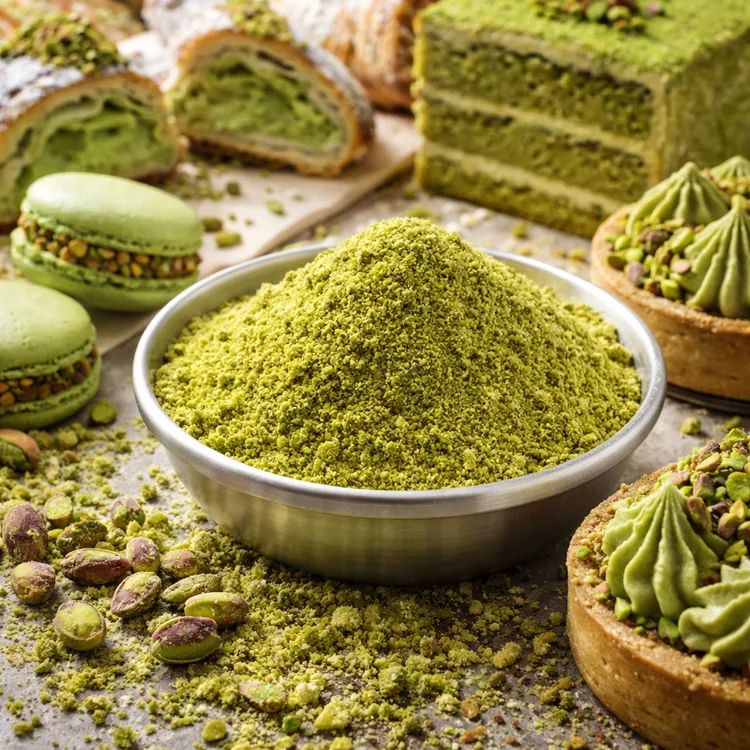
Pistachio powder can also be used inside filling systems where it contributes flavor density, body and product identity. Depending on the formulation style, it may serve as part of a dry nut base or as a component blended with sugar, dairy systems, fat-based systems or other pastry ingredients. In croissants, entremets, tartlets and filled choux concepts, the use of pistachio powder can help create a fuller pistachio character than a simple topping would achieve.
From a commercial perspective, this matters because premium pastry buyers increasingly expect pistachio products to taste genuinely pistachio-rich rather than merely green in color or branded with pistachio language.
5) Mousses, creams and layered desserts
In creams and mousse-style applications, pistachio powder may be used when developers want real pistachio material in the formulation rather than relying only on flavor systems. In these cases, powder behavior becomes highly application-sensitive. A powder that works well in sponge may not necessarily disperse in the same way inside a smooth cream system. For this reason, buyers who serve cream-based pastry manufacturers should pay particular attention to how processors describe the powder.
The visual and sensory role here is important. Pistachio powder can help create a more natural pistachio perception, especially when the product is positioned as premium, artisanal or ingredient-led.
6) Toppings, finishing and decorative use
One of the most visible uses of pistachio powder in pastry is decorative finishing. This can include dusting the surface of entremets, coating the sides of pastries, finishing plated desserts or adding a fine pistachio element to chocolates, tart rims and cream-topped products. In these applications, color tone, visual cleanliness and granulation uniformity become especially important because the powder is directly exposed to the customer's eye.
Decorative use is one of the clearest examples of why not all powders are interchangeable. A powder that performs well as an internal ingredient may not deliver the same visual elegance as a finishing powder intended for premium presentation.
7) Inclusion in premium bakery and viennoiserie concepts
Pistachio powder is also used in upscale bakery formats where the goal is not to create a classic pastry base, but to enrich laminated goods, brioche concepts, artisan buns, breakfast pastries and seasonal bakery products. In these settings, the powder can support premium positioning while also improving the depth of pistachio flavor throughout the product.
Performance factors that affect formulation
For pastry professionals, pistachio powder is not evaluated only as a flavoring component. Its formulation value depends on a combination of physical and sensory properties. Buyers who understand these factors are better equipped to source the right product.
Particle consistency
Uniform particle distribution affects blending behavior, visual consistency and the way the pistachio shows in finished pastry. A more controlled particle profile can help reduce variability from batch to batch and improve production predictability.
Color profile
Color matters differently across applications. In visible toppings and decorative finishes, it can be a primary quality driver. In internal pastry bases, it still matters, but may be secondary to flavor and process fit. Buyers should therefore assess color in relation to use, not in isolation.
Aroma intensity
Premium pastry benefits from ingredients that bring authentic aromatic character. Buyers often look for powders that support a recognizably pistachio-forward sensory identity rather than a weak or generic nut note.
Cleanliness and purity
Clean ingredient preparation supports product quality, visual refinement and production confidence. This is especially important where the powder is used in smooth fillings, visible finishes or delicate pâtisserie items.
Application-specific behavior
The same powder may behave differently depending on whether it is blended into a dry dough, dispersed in a cream, baked into a sponge or applied as a surface finish. This is why application-fit matters more than broad generalizations.
How particle size changes functionality
One of the most important but often overlooked aspects of pistachio powder is granulation. Particle size affects far more than appearance. It influences blending, distribution, mouthfeel, decorative elegance and the amount of visible pistachio texture in the final product.
Finer powders
Finer powders are often better suited to applications where smoother incorporation is desired. These may include cream systems, mousse-related formulations, delicate batters or decorative uses where a more refined surface look is preferred. A fine powder can help create a more elegant visual finish and a more continuous pistachio note across the formulation.
Medium powders
Medium granulation may be attractive where the buyer wants a balance between integration and visible nut identity. These powders can work in pastry bases, cakes, tart fillings and layered desserts where some texture expression is desirable but excessive coarseness would be disruptive.
Coarser powder-like formats
Some applications benefit from a more substantial particulate presence. In premium bakery concepts, coating systems or rustic-style pastries, a coarser format may help create a more obvious pistachio visual signal. However, buyers should be careful not to treat all coarse formats as functionally equivalent to true powder. The right format depends on the finished product.
The key lesson is simple: powder should be selected as a formulation tool, not merely as a category label.
Color, aroma and visual impact
Premium pastry is as much about visual expectation as it is about flavor. Pistachio powder helps shape both. When used well, it creates an ingredient story that consumers can see as well as taste. This is especially valuable in pâtisserie, hotel pastry, boutique bakery lines and upscale dessert retail, where ingredient visibility supports premium pricing.
Color, however, should always be judged in context. A more vivid-looking powder may be highly valuable for decorative finishing or exposed layers. But if the powder is intended for blending into darker pastry systems or mixed fillings, visual brightness may not be the most important purchasing criterion. In those cases, sensory performance and formulation fit may matter more.
Aroma also plays a critical role. A powder that delivers a clear pistachio identity can strengthen the authenticity of a premium pastry concept. This is particularly important in markets where customers are increasingly sensitive to whether premium ingredients are truly present or merely implied through branding and color cues.
Commercial buying perspective
From a commercial standpoint, pistachio powder sits at the intersection of ingredient performance and premium product storytelling. Buyers are not only purchasing a nut derivative. They are purchasing an ingredient that can affect menu perception, shelf presentation, product differentiation and margin logic.
Why the right grade matters commercially
Premium pastry operators do not all need the same powder. A luxury retail pâtisserie may prioritize appearance, color refinement and brand storytelling. A large food manufacturer may prioritize repeatability, supply consistency and application performance. A distributor may need a broadly versatile product that suits multiple customer types. The right powder grade depends on the business model.
Why price alone is misleading
Buyers sometimes compare pistachio powder offers as though they represent a single standardized commodity. In reality, the underlying differences in granulation, visual quality, application fit and processing consistency can be significant. A lower price may reflect a less suitable product rather than a better commercial opportunity.
How powder supports premium positioning
Pistachio has strong premium associations in many dessert categories. When pastry brands use real pistachio powder effectively, they strengthen the credibility of their premium claims. This can support better consumer trust, stronger menu appeal and a clearer basis for price differentiation.
Technical buying perspective
Technical buyers evaluate pistachio powder less by broad sales language and more by processing relevance. They want to know how the product behaves in a real formulation environment. That means looking beyond a simple product name and assessing powder characteristics in terms of usage.
Formulation compatibility
The powder should support the intended system rather than forcing the formulator to compensate for an unsuitable ingredient. This is why application discussion with the supplier matters.
Batch-to-batch consistency
Manufacturers benefit from ingredient consistency because it simplifies quality control and production planning. An inconsistent powder may create avoidable variation in appearance, flavor perception or finished product handling.
Visual suitability for exposed applications
Where the powder remains visible in the final product, technical quality and commercial quality overlap. Decorative finish powders must usually meet stronger expectations for uniformity and appearance than powders intended mainly for internal use.
Processing alignment
Technical teams should specify whether the powder is intended for dry mixing, fat-based systems, cream systems, bakery bases or final decoration. The more clearly this is defined, the easier it becomes to select the right material.
Application guidance by customer segment
For pâtisserie brands and premium dessert shops
- Prioritize powders that support visible quality and authentic pistachio identity.
- Think carefully about the difference between interior use and decorative use.
- Choose grades that reinforce premium presentation, not just raw ingredient cost efficiency.
For hotel, horeca and foodservice pastry operations
- Focus on consistency, usability and menu versatility.
- Consider whether one powder can cover multiple applications or whether separate grades are more efficient.
- Balance appearance requirements with operational practicality.
For industrial bakery and dessert manufacturers
- Prioritize repeatability, specification clarity and suitability for production scale.
- Define whether the powder is intended for internal structure, flavor distribution or surface use.
- Align the grade with the finished product's quality positioning and cost architecture.
For distributors and ingredient traders
- Segment buyers by application instead of offering one generic pistachio powder to all customers.
- Build sales language around performance and use-case, not only origin and price.
- Clarify whether the powder is better suited to bakery, pastry, confectionery or decorative use.
How premium pastry teams typically think about pistachio powder
In advanced pastry environments, product development teams usually think about pistachio powder in one of four roles:
- Flavor role — adding a true pistachio note throughout the product.
- Visual role — contributing color, refinement and premium recognition.
- Texture role — shaping the particulate character or body of the formulation.
- Commercial role — helping justify a more premium product story and price point.
The best sourcing decisions are made when buyers identify which of these roles matters most in the intended finished product.
Simple comparison: different priorities for different powder uses
| Use case | Main priority | Secondary priority | What buyers should focus on |
|---|---|---|---|
| Decorative finishing | Visual quality | Color consistency | Uniform granulation, elegant appearance, clean presentation |
| Sponge and cake systems | Even distribution | Flavor expression | Blend suitability, consistency, balanced particle profile |
| Fillings and layered desserts | Application fit | Aroma and texture | System compatibility, powder behavior in mixed formulations |
| Sablé and pastry doughs | Product identity | Texture contribution | Granulation, visual effect, premium positioning |
| Industrial bakery use | Repeatability | Commercial efficiency | Specification clarity, lot consistency, scalable usability |
Questions buyers should ask suppliers
Good buying outcomes usually depend on better questions. Instead of asking only for “pistachio powder price,” buyers should frame the discussion around application and performance.
Commercial questions
- What type of pastry applications is this powder best suited for?
- Is this grade mainly used for decoration, blending, fillings or broader bakery use?
- How consistent is the product from lot to lot?
- Is this grade more suitable for premium visible products or more functional industrial use?
- What is the most appropriate alternative if this exact powder is unavailable?
Technical questions
- How would you describe the granulation of this powder?
- Is it intended for internal formulation use, surface use or both?
- How is the product processed and prepared before packing?
- What kind of customers usually buy this specification?
- What should we prioritize for our application: finer texture, visual brightness or all-around usability?
Strategic questions
- Are we over-specifying for our finished product?
- Would a more cost-efficient grade perform just as well in our application?
- Should we use separate grades for visible finish and internal formulation?
- How should we evaluate this product relative to paste, cuts or kernels?
Common mistakes to avoid
-
Treating all pistachio powders as interchangeable.
Powder specification can change formulation behavior, visual results and commercial suitability. -
Buying on price without defining the application.
A cheaper powder may be less appropriate for premium pastry and more expensive in real operational terms. -
Using one grade for every use case.
Decorative finishing and internal blending often have different priorities. -
Overpaying for appearance where appearance is not critical.
Internal-use products may not require the same visual grade as exposed toppings or visible layers. -
Ignoring the connection between ingredient quality and brand positioning.
In premium pastry, real ingredient performance supports brand credibility.
Why this matters for Turkish pistachio sourcing
Buyers sourcing Turkish Antep pistachio ingredients often enter the conversation through origin, tradition and flavor reputation. Those factors are important, but practical application understanding is what transforms interest into an effective purchase. When the product form is pistachio powder, the buyer must go one step further and define how that origin is expected to perform in pastry reality.
The better the connection between origin quality and application logic, the more useful the sourcing process becomes. Instead of requesting a broad commodity-like quote, the buyer can request a product that is aligned with pastry format, intended texture, product presentation and commercial positioning.
How Atlas uses this knowledge
Atlas uses academy content to make product discussions more precise, more useful and more commercially relevant. Rather than treating pistachio ingredients as generic export items, we frame them in terms of how buyers actually use them. That means connecting powder specification to pastry applications, commercial priorities and formulation logic.
This approach helps buyers move beyond vague descriptions such as “premium powder” or “good quality.” Instead, it supports more productive questions: What is the product for? How visible will it be? Does the final application require visual elegance, deep flavor integration, or a balance of both? Are we buying for boutique pâtisserie, foodservice, industrial dessert manufacturing or ingredient distribution?
- We connect commercial guidance to relevant product categories.
- We connect technical product understanding to real manufacturing and pastry applications.
- We help buyers compare powders more intelligently by use-case, not only by name or price.
- We support clearer conversations around kernels, powder, paste and other pistachio ingredient forms.
- We aim to reduce ambiguity before purchasing decisions are made.
Final takeaway
Pistachio powder is one of the most versatile and commercially important ingredient forms in premium pastry. It can shape flavor perception, visual refinement, product texture and premium storytelling all at once. But its value depends on choosing the right powder for the right application.
For some buyers, the priority will be color and decorative elegance. For others, it will be blending performance, consistency or formulation fit. The most successful purchases usually happen when suppliers and buyers speak in application-specific terms rather than generic quality language.
That is why better pistachio powder sourcing starts with better product understanding. When buyers evaluate powder in relation to pastry function, granulation, visibility, formulation behavior and market positioning, they make stronger decisions and build more reliable product programs.
Frequently asked questions
Who is this article for?
This article is intended for B2B buyers, importers, distributors, pastry ingredient suppliers, private-label brands and food manufacturers researching Turkish pistachio powder supply.
What is pistachio powder used for in premium pastry?
It is used in sponge cakes, nut-based pastry bases, sablé doughs, fillings, creams, mousses, layered desserts, toppings and decorative finishes.
Is pistachio powder only a decorative ingredient?
No. In many pastry applications it contributes flavor, visual identity, texture and formulation structure, not only surface decoration.
Why does particle size matter?
Particle size affects how the powder blends, how visible it remains, how refined the final result looks and how suitable it is for different pastry systems.
Should every buyer choose the most premium-looking pistachio powder?
Not necessarily. The right choice depends on whether the powder will remain visible, be blended into an internal system, or be used mainly for flavor and product positioning.
Can one powder cover all pastry uses?
Sometimes, but not always. Many buyers benefit from using different specifications for decorative finish versus internal formulation.
Can Atlas help buyers choose the right pistachio ingredient form?
Yes. Atlas supports buyers by connecting product form, intended application, commercial goals and sourcing priorities across kernels, powder, paste and related pistachio ingredients.
Looking for Turkish pistachio powder for pastry, bakery, dessert manufacturing or ingredient distribution? Contact Atlas to discuss product form, target application, packaging and supply requirements.