Contents
- Why this topic matters
- What cleaning and grading really mean
- Where value is created in the processing stage
- What happens during the cleaning stage
- What happens during the grading stage
- Commercial benefits for buyers
- Technical benefits for food manufacturers
- How end use changes the right grade
- What buyers should ask processors
- Common buying mistakes to avoid
- How Atlas uses this knowledge
- Frequently asked questions
Why this topic matters
Many buyers assume that pistachios are mainly differentiated by origin, harvest quality and price. Those factors matter, but they are only part of the picture. Once pistachios enter the processing stage, the way they are cleaned, sorted, graded and prepared has a direct effect on how usable the final product becomes. Two lots from the same origin can create very different commercial outcomes if one is processed with tighter controls, better separation and more consistent grading.
This is especially important in B2B trade. Retail snack brands need attractive appearance and repeatable presentation. Ingredient buyers need dependable particle size, color and purity. Confectionery manufacturers care about how kernels behave inside fillings, toppings or pastes. Bakery producers want consistency from batch to batch. In all of these cases, the processor is not simply handling product. The processor is actively shaping product value.
A well-processed pistachio lot can reduce complaints, improve manufacturing efficiency, simplify internal quality control and support stronger brand positioning. A poorly processed lot can create the opposite result: more waste, more sorting, more inconsistency and more friction after purchase.
What cleaning and grading really mean
In commercial pistachio supply, cleaning refers to the removal of materials and defects that do not belong in the final saleable product. Grading refers to the systematic separation of pistachios into categories based on characteristics that matter to the intended application.
These characteristics may include size, shell condition, split ratio, color, kernel appearance, cut size, visible defects, foreign material presence and overall visual uniformity. Depending on the product form, grading may also include separation by destination category such as retail snack, industrial ingredient, kernels for further processing, cuts, powder or paste raw material.
In other words, processors add value by turning mixed, variable agricultural output into a more defined commercial specification. That specification is what allows a buyer to purchase with confidence.
Where value is created in the processing stage
Value creation in pistachio processing does not come from a single machine or a single inspection point. It comes from the combined effect of multiple controlled steps. Each step reduces variability and improves the probability that the final lot will meet buyer expectations.
- Removing dust, field residue and foreign matter improves cleanliness and presentation.
- Separating out unsuitable material improves consistency and lowers complaint risk.
- Grouping product by size or appearance makes the lot more predictable and usable.
- Aligning grade to application helps buyers pay for the right product instead of the wrong one.
- Packing a more uniform lot improves handling, merchandising and production planning.
For this reason, professional processing is not only a quality function. It is also a commercial function. Better processing helps translate crop potential into market value.
What happens during the cleaning stage
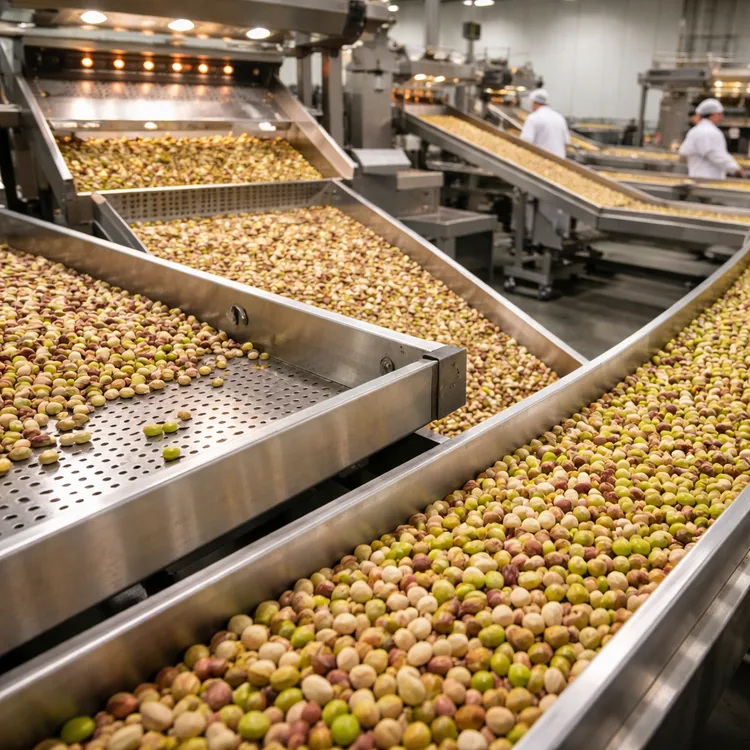
The cleaning stage is the foundation of value-added preparation. Before buyers assess higher-level quality attributes such as color or size consistency, the product first needs to be made clean, safe to handle and suitable for further sorting. In practice, cleaning can include several different forms of separation depending on the product form and processor setup.
1) Removal of field and harvest residue
Raw pistachios may contain natural dust, fine particles, shell pieces, small plant residue or other harvest-related material. Even when these materials are not large in volume, they affect both perception and functionality. A dusty or visibly unclean lot creates a weaker impression for buyers and can complicate later stages of roasting, packing or grinding.
2) Removal of foreign material
A professionally cleaned lot should be better protected against foreign matter contamination. This can include unwanted particles such as shell fragments, stones, stems, leaves, packaging residues or other non-product material. Buyers in export markets often view this as a basic requirement rather than an added extra.
3) Separation of loose shell particles and fines
This point is especially important when the product is intended for downstream food production. Loose shell particles and excessive fines can create handling issues, affect texture and interfere with product performance in sensitive applications such as fillings, creams, toppings, spreads, powders and bakery inclusions.
4) Preparation for more accurate grading
Good grading depends on good cleaning. If product is still mixed with dust, debris or loose fragments, appearance-based or size-based separation becomes less effective. Cleaning therefore improves not only hygiene and presentation, but also the accuracy of the grading stage that follows.
What happens during the grading stage
Grading is where a mixed pistachio lot becomes a structured commercial product. The aim is not simply to create “better” and “worse” material. The aim is to create categories that match different market needs. A snack buyer, an ice cream producer and a pistachio paste manufacturer may all buy from the same origin, but they rarely need the same grade.
Size grading
Size grading helps processors produce more uniform lots. In-shell products may be sorted according to screen size or comparable physical separation criteria. Kernel products may be sorted by whole kernel size, broken ratio or cut dimension depending on the format being offered. Greater uniformity improves presentation and also makes portioning, filling and processing more predictable.
Appearance grading
Buyers often evaluate pistachios first with their eyes. Appearance grading can help separate product according to visible features such as shell openness, kernel integrity, general cleanliness, surface condition and overall visual appeal. This is highly relevant in retail-oriented supply where consumer perception strongly affects sell-through.
Color grading
Color is particularly important for kernel-based applications. Different end uses place different value on kernel tone and visual brightness. Premium-looking inclusions, toppings and visible ingredient applications often require more attention to color consistency than applications where the product will be ground, blended or processed into another form.
Condition-based separation
Processors may also separate lots based on product condition. Depending on the form being prepared, this can include separation of closed-shell material, excessive breakage, visually weaker units, non-uniform cuts or other features that reduce suitability for the target market.
Application-based grading
One of the most commercially valuable functions of a processor is aligning a grade to its intended use. This is where processing adds practical value for the buyer. Instead of offering one generic pistachio, the processor can offer a format and grade that fits a specific need more accurately.
Commercial benefits for buyers
From a buyer's point of view, good cleaning and grading improve far more than product appearance. They affect pricing logic, market fit, customer satisfaction and operational efficiency.
Better quote comparison
When processors define grades clearly, buyers can compare offers more meaningfully. A low headline price can become misleading if the grade is inconsistent, overly mixed or poorly cleaned. A properly described grade makes commercial comparisons more accurate.
Improved consistency between shipments
Repeatability matters in B2B purchasing. Buyers usually prefer a dependable grade that performs consistently rather than a nominally attractive offer that changes from lot to lot. Good processing supports the kind of repeat ordering environment that long-term customers value.
Stronger retail presentation
In-shell snack products and visible kernel applications benefit from a cleaner, more uniform appearance. This can support better merchandising, better consumer perception and fewer quality complaints.
Lower downstream sorting burden
If the processor has already completed a strong cleaning and grading job, the buyer may spend less time correcting the lot after arrival. That saves labor, simplifies internal inspection and reduces hidden costs that are often ignored during initial price negotiations.
More suitable product-to-market matching
Not every buyer should pay for the highest visual grade. The right question is whether the grade is appropriate for the intended end use. Effective grading gives buyers options. A premium visual grade may be correct for gourmet retail. A more functional grade may be fully appropriate for paste or powder production. Good processors help buyers avoid both under-buying and over-buying.
Technical benefits for food manufacturers
Ingredient users often evaluate pistachios more technically than retail distributors do. For them, value-added processing is strongly connected to manufacturing performance.
Greater process stability
More consistent incoming material can help stabilize downstream operations. Whether the product is being chopped, ground, blended or incorporated into a recipe, reduced variability tends to support smoother production.
Improved visual consistency in finished products
In products where pistachio remains visible, such as fillings, toppings, inclusions or decorative applications, consistency in size and appearance can significantly influence the look of the final product.
Cleaner input for grinding or blending
For powder, meal or paste-oriented applications, cleanliness is especially important. Excessive unwanted particles or inconsistent raw material can affect texture, mouthfeel or the perceived quality of the finished product.
More reliable yield expectations
A more uniform lot makes it easier for manufacturers to plan their usage and estimate performance. Even where exact yield depends on the customer's own process, a better-defined input usually supports better forecasting.
How end use changes the right grade
There is no single “best” pistachio grade for every buyer. The best grade is the one that most effectively matches the product's final use, target price point and market expectations.
For in-shell snack brands
- Appearance and shell presentation are highly important.
- Uniformity in the lot affects shelf impact and consumer confidence.
- Cleanliness and visual consistency can influence repeat purchase behavior.
For kernel distributors
- Kernel color, integrity and overall visual appeal may drive grade selection.
- Cut ratio and breakage tolerance should be defined clearly.
- The intended customer base matters: retail ingredient, horeca or industrial use may require different specifications.
For confectionery and pastry manufacturers
- Color consistency and cut sizing can be critical for decorative or visible uses.
- Cleanliness matters for texture and visual finish.
- Grade selection should match whether the product is used as a topping, filling component or blended ingredient.
For paste and powder buyers
- The most expensive visual grade is not always necessary.
- Functional suitability, cleanliness and processing alignment matter more than retail-level appearance.
- A processor who understands the final application can help the buyer choose a more rational grade.
Cleaning and grading are closely linked to price formation
Buyers sometimes ask why apparently similar pistachio offers can differ in price. One important reason is that a more selective processing approach often creates a more defined, more consistent and more commercially useful output. Tighter grading usually means stricter separation, a narrower final specification and a higher level of control. Those factors can support higher value.
At the same time, a higher price does not automatically mean a better purchase. The real question is whether the grade is suitable for the intended application. A buyer can over-specify and end up paying for appearance or precision that the finished product does not actually require. The smartest purchasing decisions usually come from aligning grade, performance and market positioning rather than chasing either the cheapest or the most premium option blindly.
Examples of value added by processing
The easiest way to understand processor value is to compare raw mixed output with a finished commercial lot:
- A mixed in-shell lot becomes a cleaner, more uniform snack-grade product.
- A variable kernel lot becomes a more defined kernel grade suited to resale or industrial use.
- A broad mix of broken material becomes controlled cuts for topping or bakery applications.
- A suitable ingredient-grade input becomes a more practical raw material for powder or paste production.
In each case, the processor reduces uncertainty. Reduced uncertainty is a form of commercial value because it gives the buyer better planning ability and better product control.
How buyers should read specifications more carefully
Buyers should not stop at a basic product name such as “kernel” or “in-shell pistachio.” Those labels are too broad on their own. A more useful review should consider the following questions:
- Is the grade intended for retail display, ingredient use or further processing?
- How consistent is the lot in appearance and size?
- What kind of sorting or separation has been applied?
- Is the product sold as whole kernels, mixed kernels, cuts or another defined format?
- How will the chosen grade behave in the final application?
- Does the offer match the buyer's actual quality priorities or only sound attractive in general terms?
Better questions usually lead to better buying outcomes. This is one of the main reasons educational content matters in ingredient sourcing.
What buyers should ask processors before ordering
Good sourcing conversations are built on clear requirements. The more precisely the buyer explains the intended end use, the easier it becomes for the processor or exporter to recommend an appropriate grade.
Useful commercial questions
- What application is this grade most commonly used for?
- Is this offer aimed at retail, horeca or industrial processing?
- How consistent is the product from lot to lot?
- What packaging options are available for this grade?
- What is the most suitable alternative if this exact grade is not available?
Useful technical questions
- How is the product cleaned before packing?
- What kind of grading or sorting has been applied?
- Is the lot intended for direct consumption or further processing?
- How is cut size or kernel uniformity described?
- What quality attributes are considered most important for this product form?
Useful alignment questions
- Would you recommend this grade for visible applications or for blended use?
- Are we over-specifying for our application?
- Is there a more cost-efficient grade that still meets our performance needs?
- What should we prioritize: appearance, consistency, functionality or cost?
Common buying mistakes to avoid
In pistachio sourcing, several common mistakes lead to preventable dissatisfaction. Many of them come from treating pistachios as a generic commodity instead of an application-dependent ingredient.
-
Comparing price without comparing grade definition.
A cheaper offer may reflect a broader or less controlled grade rather than a true value advantage. -
Ignoring the final application.
A visually premium lot may not be necessary for paste, powder or blended manufacturing use. -
Assuming origin alone defines quality.
Origin matters, but the final commercial usability is also heavily shaped by the processor's preparation standards. -
Failing to define acceptable variability.
Buyers should be clear about what consistency means for their category. -
Using overly broad product language.
Terms like “good quality” or “premium” are too vague without application-specific detail.
Why processors matter more in ingredient markets than many buyers expect
In raw agricultural trade, producers create the crop. In ingredient trade, processors help create the specification. That distinction matters. The processor stands between harvest variability and customer expectation. Their job is to reduce mismatch.
For a buyer, this means the processor is not simply a logistical middle step. The processor can be one of the most important contributors to whether a product feels clean, consistent, usable and commercially dependable at the point of delivery.
This is also why supplier conversations should go beyond price and basic availability. The most useful discussions usually involve product form, application, consistency expectations, visual priorities, packaging needs and downstream manufacturing goals.
Simple comparison: raw mixed output vs. market-ready graded product
| Dimension | Less processed / mixed lot | Well-cleaned and graded lot |
|---|---|---|
| Appearance | More variable and less uniform | Cleaner and more consistent |
| Commercial clarity | Harder to compare and specify | Easier to match to end use |
| Handling | May require more internal checking | Usually easier to assess and use |
| Application fit | Broader and less defined | More targeted to category needs |
| Buyer confidence | Lower predictability | Higher predictability |
Key signals of a processor that understands buyer needs
Buyers often learn a lot from how a supplier discusses product. A processor with stronger commercial understanding usually does more than quote a price. They ask what the product is for. They explain grade logic. They distinguish between appearance-driven and functionality-driven supply.
- They ask about application before recommending a grade.
- They can explain the difference between commercial categories clearly.
- They understand that different buyers value different quality cues.
- They communicate in terms of consistency and fit, not only volume and price.
- They treat processing as part of product definition, not just post-harvest handling.
How Atlas uses this knowledge
Atlas uses academy content to make buyer conversations clearer, faster and more productive. Articles like this are designed to help customers think in commercial and technical terms at the same time. Instead of viewing pistachio purchasing as a simple price comparison exercise, we encourage buyers to define what success looks like in the final application.
In practice, that means connecting product form to real use cases. A snack-focused customer may care more about presentation and uniformity. A confectionery producer may care more about cut size and visual finish. A paste or powder buyer may prioritize functional suitability over premium retail appearance. The better these priorities are defined, the easier it becomes to guide sourcing in the right direction.
- We connect commercial guidance to relevant product categories.
- We connect technical information to real manufacturing applications.
- We help buyers ask better questions before placing orders.
- We support clearer alignment between grade, budget and end use.
- We aim to reduce ambiguity in product and sourcing discussions.
Final takeaway
Cleaning and grading are not minor finishing steps. They are central to how pistachios are transformed from agricultural output into dependable commercial products. Through better cleaning, processors improve purity and presentation. Through better grading, they improve consistency, application fit and purchasing clarity.
For importers, distributors and food manufacturers, this matters because the wrong grade can create hidden cost, while the right grade can improve results across quality control, customer satisfaction and production performance. The real value of professional processing is that it reduces uncertainty and increases suitability.
That is why better pistachio buying starts with better product understanding. When buyers evaluate Turkish Antep pistachios through the lens of cleaning, grading, application and consistency, they make stronger commercial decisions and create more reliable supply outcomes.
Frequently asked questions
Who is this article for?
This article is intended for B2B buyers, importers, distributors, private-label brands, ingredient traders and food manufacturers researching Turkish pistachio supply.
Does cleaning only affect appearance?
No. Cleaning affects appearance, handling quality, perceived cleanliness and the suitability of the product for later processing steps. It is both a visual and practical value-adding stage.
Does the highest grade always make the most sense?
Not necessarily. The best grade is the grade that fits the application. Some uses justify premium visual selection, while others are better served by a more functional and cost-efficient grade.
Why should ingredient buyers care about grading?
Because grading can influence consistency, cut definition, visual output, ease of handling and the degree to which incoming product aligns with the manufacturing process.
Can Atlas help buyers choose the right product form?
Yes. Atlas supports buyers by connecting sourcing questions to intended use, product form, application needs and commercial priorities.
Looking for Turkish pistachios for retail, industrial or ingredient use? Contact Atlas to discuss product form, application, packaging and supply requirements.