In this guide
- Why pistachio grade matters in baklava
- What “grade” really means
- Core quality priorities for baklava producers
- Which pistachio forms fit which baklava styles
- How color affects premium positioning
- Why cut size and texture matter
- How to balance quality and cost
- A practical buyer checklist
- Common sourcing mistakes
- Frequently asked questions
Why this topic matters
Baklava is one of the most pistachio-sensitive pastry formats in the market. In many other desserts, pistachio may act as a supporting inclusion or blended flavor layer. In baklava, by contrast, pistachio often defines the product’s identity. Customers notice the filling color, the distribution of the nut across the layers, the richness of the aroma and the visual impression created when the product is cut and presented. For this reason, the wrong pistachio grade can affect more than flavor. It can alter appearance, texture, yield perception and premium positioning.
That matters for artisan baklava shops, export baklava manufacturers, frozen dessert producers, foodservice suppliers and private-label brands alike. A pistachio that looks appropriate in a sample bag may still be the wrong choice if it grinds poorly, produces uneven interior texture, darkens the visual tone of the tray or creates avoidable waste in portioning. The correct buying decision therefore depends on how the pistachio performs inside the full baklava system, not just how attractive it appears in isolation.
In commercial terms, baklava producers are not really buying pistachios alone. They are buying a specific finished-product outcome. Grade selection should therefore start from the intended result on the tray, in the box and in the customer’s bite.
What “grade” really means in baklava sourcing
Many buyers use the word grade as if it referred to one simple ranking from lower to higher quality. In practice, pistachio grade for baklava is more nuanced. Grade often reflects a combination of visual characteristics, processing style, particle range, product form and intended commercial use. A pistachio can be a very good grade for one baklava application and the wrong grade for another.
That is why baklava producers should avoid choosing by vague labels alone. Terms such as premium, selected, extra green or industrial are only useful when the supplier explains what those labels mean in practical application terms. A clearer approach is to treat grade as a group of decision points:
- How green or bright the pistachio appears.
- How fine, coarse or uniform the cut is.
- Whether the product is whole kernel, broken kernel, diced material, powder or another prepared form.
- How visually clean and commercially consistent the material appears.
- Whether the product is best suited to interior filling, surface finishing or mixed use.
- How the grade aligns with the target price point and brand position of the final baklava.
When buyers think about grade in that broader way, sourcing conversations become much more useful. Instead of asking only for the best pistachio, they can ask for the most appropriate pistachio for the baklava they are actually producing.
Why baklava production has different priorities from other pistachio applications
Not all pistachio applications judge quality in the same way. A pistachio ingredient for ice cream, a chocolate inclusion and a decorative topping each have different success criteria. Baklava sits in a special category because it combines visible presentation, layered structure, pastry absorption behavior and a strong cultural expectation around what premium pistachio baklava should look and taste like.
For baklava production, several priorities usually matter at the same time:
- Color presentation: The pistachio should support the expected visual identity of the product.
- Even distribution: The nut should spread and sit consistently between layers or within the targeted filling zone.
- Texture control: The final mouthfeel should feel intentional, not dusty, oily, overly coarse or uneven.
- Aroma and flavor character: The pistachio should reinforce the baklava’s premium identity.
- Portion economics: The chosen grade should be commercially sustainable for the intended market segment.
That combination is why baklava buyers need a more application-specific decision process than general pistachio buyers.
Commercial perspective: the right grade depends on the baklava you are trying to sell
Before comparing pistachio offers, baklava producers should define the commercial role of the product they are making. A premium boutique tray for gift retail will not use the same decision logic as a large-volume bakery line, a frozen foodservice pack or a price-sensitive wholesale program. The more clearly the producer defines the market position, the easier it becomes to choose the right pistachio grade.
Premium artisan baklava
Premium artisan baklava often demands stronger visual identity, higher perceived pistachio richness and a more refined interior appearance. In this category, greener and more visually controlled material may justify the higher cost because the pistachio is part of the product’s premium promise.
Mid-market commercial baklava
For mid-market production, buyers often seek a balance between appearance and cost discipline. The goal is not necessarily the most expensive pistachio available, but a grade that gives a strong enough interior color, acceptable cut consistency and reliable flavor while protecting margin.
Industrial or high-volume production
In larger-scale production, repeatability and cost structure usually become more important. The right grade here may be one that processes consistently, fills evenly and delivers a stable finished appearance rather than the visually most elite kernel.
Export or branded retail baklava
When baklava is being sold across markets or under a brand name, producers often need more consistency from batch to batch. The pistachio grade should therefore support not only immediate production performance, but also brand continuity.
Start with the pistachio’s role inside the baklava
The most useful question a buyer can ask is not “What is your best pistachio grade?” but “How will this pistachio be used inside our baklava?” That question changes the conversation from generic quality language to application fit.
Pistachio may be used in several ways within baklava systems:
- As the main internal filling between pastry layers.
- As a more concentrated center layer in premium formats.
- As a surface garnish or finishing element.
- As part of a blend using different particle sizes or visual styles.
Each of these roles may justify a different product form or different grade emphasis. Some producers even use one pistachio grade for the interior and another for the surface to optimize both cost and presentation.
Which pistachio forms are commonly evaluated for baklava
Whole kernels
Whole kernels are not usually the most direct working format for standard baklava filling, but they may still matter for processors who want control over in-house cutting or for premium finishing and decorative uses. Whole kernels can offer flexibility, but they also require additional handling if the final application calls for a specific particle profile.
Broken kernels or coarse cuts
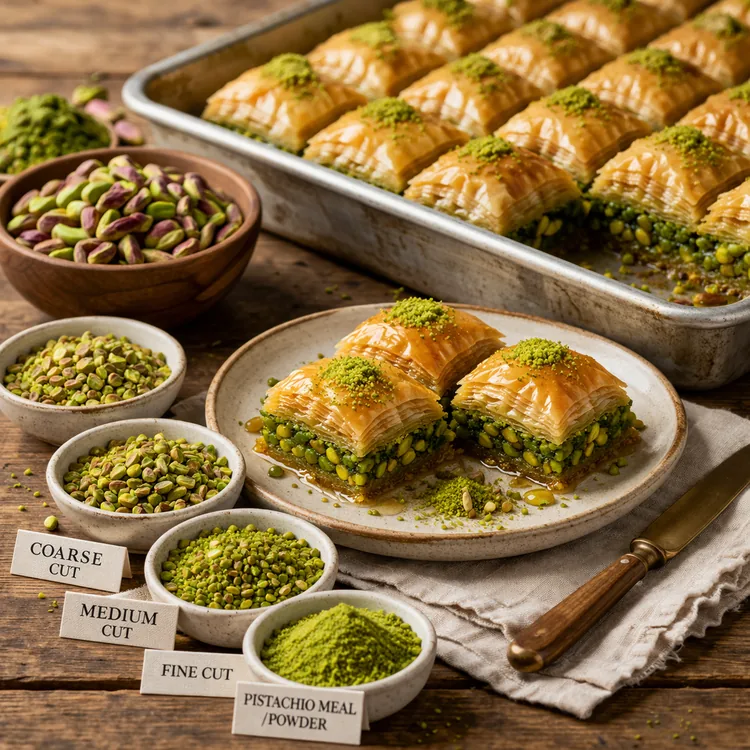
These are often evaluated when baklava producers want a more textured filling and a clearly nut-forward internal structure. Coarser grades may create a fuller bite and stronger visible nut identity, but the exact size range should match the product style and layering method.
Medium cuts
Medium cuts often provide a useful balance between visual presence and even distribution. For many baklava systems, this type of format can support a stable fill profile without appearing either too chunky or too powdery.
Fine cuts or meal-style material
Finer products may suit certain filling styles where a smoother and more uniform internal spread is preferred. However, if the material becomes too fine for the intended baklava style, the product can lose some visual distinction and textural interest.
Powder-like forms
Very fine pistachio products may be useful in selected formulations or blended systems, but they should be chosen carefully. In baklava, an overly powdery structure may change the perception of richness and can make the filling feel less distinct if the product style depends on visible nut structure.
Color is one of the most commercially important signals in baklava
For many baklava buyers, pistachio color is the first quality cue they focus on. That is understandable because color has strong commercial power. It shapes the customer’s first impression, supports premium positioning and influences how the cut product looks in retail display, trays, boxes and photography.
Yet color should be interpreted carefully. Darker or duller material may reduce the premium visual effect in some products, but “greener” is not automatically better in every commercial case. The correct color decision depends on:
- The market’s visual expectation for baklava.
- Whether the pistachio is highly visible after cutting.
- The target selling price and margin structure.
- The degree to which the brand relies on premium visual language.
For top-tier premium baklava, greener and more attractive material can be highly valuable because it reinforces the product promise. For broader commercial ranges, a balanced grade may be more appropriate if it still delivers acceptable appearance and stable flavor performance.
Why the “greenest” grade is not always the best buying decision
Many buyers become overly focused on maximum green intensity because it is easy to market and easy to recognize visually. But baklava is not sold as a pile of raw kernels. It is sold as a layered finished dessert. Once the pistachio is cut, distributed, baked and presented within pastry, other factors become equally important. These include fill behavior, texture, consistency and how well the material suits the producer’s process.
A more expensive, very visually selected pistachio may be justified when the brand depends on striking internal color and premium gift-style presentation. In other cases, a slightly less elite-looking grade may still be the better overall choice if it performs more economically while maintaining a strong finished result.
Cut size and particle consistency are central to baklava performance
Cut size affects far more than appearance. It influences how evenly the pistachio spreads, how the filling sits between layers, how much texture the customer perceives and how cleanly the finished tray portions. This is why baklava producers should compare grades not only by color, but also by the structure of the material itself.
Coarser cuts
Coarser cuts may suit baklava styles that aim for a more pronounced nut bite and stronger internal differentiation. They can create a generous, ingredient-rich impression. But if the cut is too uneven, filling distribution may become less controlled.
Balanced medium cuts
Many baklava producers prefer a balanced particle range because it provides good spreadability while still preserving texture. This type of grade often supports both visual appeal and practical production handling.
Fine cuts
Fine cuts may support smoother fill behavior, but buyers should confirm that the resulting texture still matches the intended product identity. Baklava that should feel rich and nut-defined may lose some of that character if the pistachio becomes too fine.
Flavor and aroma should be judged with the final pastry in mind
Baklava is a composite dessert. Pistachio flavor is experienced together with pastry layers, sweetness, fat and overall mouthfeel. For that reason, pistachio should be evaluated in a way that reflects the final application rather than in isolation alone. A product that smells excellent in a sample may still need to prove that it holds its identity well inside the full baklava system.
Baklava producers should think about:
- Whether the pistachio remains clearly recognizable in the finished pastry.
- Whether the aroma supports the premium identity of the product.
- Whether the chosen grade gives the expected nut richness for the target market.
- Whether the producer is paying for a quality level that will actually be noticed in the final item.
This is another reason application trials or sample review in the real baklava process can be more meaningful than judging loose pistachios alone.
Visual cleanliness matters more than some buyers realize
In baklava, the pistachio is often visible in the cut cross-section and sometimes on the surface. That means visual cleanliness can influence product perception directly. Even when the pistachio is not shown as a garnish, the internal look of the slice or piece still communicates quality.
Buyers should therefore assess whether the product appears commercially coherent for the intended baklava category. In premium products, any visual inconsistency may stand out more strongly. In broader commercial categories, the acceptable range may be wider, but presentation still matters because baklava is a display-driven dessert.
Should filling and topping use the same pistachio grade?
Not always. Some baklava programs benefit from separating interior performance from exterior presentation. For example, a producer may use a strong value-to-performance filling grade internally and reserve a more visually refined pistachio for top decoration or final finishing. This can create a stronger premium impression without forcing the entire internal fill cost to the highest level.
This kind of dual-grade strategy is especially useful when:
- The product must look premium on display.
- The producer wants to manage cost more carefully across the whole recipe.
- The interior fill and surface decoration play different commercial roles.
Buyers should discuss this possibility openly with suppliers rather than assuming one product must do every job equally well.
How to balance cost, yield and finished-product value
The right pistachio grade for baklava is not simply the one with the lowest per-kilogram price. A cheaper grade may require more volume to create the same perceived richness, may weaken premium positioning or may produce less visually satisfying finished portions. On the other hand, an overly expensive grade can damage margin if the finished product is not sold at a price point that rewards the extra cost.
Baklava producers should therefore think in terms of total finished-product value:
- How much pistachio identity does the product need to meet customer expectation?
- How visible is the filling once the product is cut and presented?
- How much does greener color improve real sales value in the chosen market?
- Would a mixed or more balanced grade support similar performance at a better margin?
This approach helps producers avoid two common traps: under-buying quality for a premium product, or over-buying quality for a commercial product that will not recover the cost.
Why repeatability matters as much as first-sample quality
Baklava brands and manufacturers do not succeed with one beautiful sample. They succeed by repeating the same or a similar standard across multiple production runs. That is why buyers should ask whether the offered pistachio grade can be supplied consistently in appearance, cut range and commercial logic.
Repeatability matters for several reasons:
- It keeps tray appearance more stable over time.
- It reduces internal recipe adjustments.
- It supports predictable purchasing and production planning.
- It protects the brand image of the final baklava.
In practical sourcing, consistency is often worth more than a one-time high-end sample that cannot be repeated reliably.
How importers and distributors should think about baklava pistachio grades
Importers and distributors serving baklava customers should avoid presenting pistachio grades only as raw ingredient categories. Their customers often need buying guidance tied to product style. A distributor who can distinguish between premium visible baklava grades, balanced commercial filling grades and application-led particle profiles will be much more useful than one who offers only generic “premium” and “standard” labels.
For these buyers, the most valuable sales approach usually includes:
- Explaining the likely baklava use case.
- Clarifying whether the grade is more visual, more functional or more balanced.
- Helping the customer compare price against finished-product value.
- Keeping product language consistent across quotes and samples.
How baklava manufacturers should think about qualification
Baklava manufacturers usually need more than a general product description. They need a grade that works within their own production environment. That means qualification should consider internal process realities such as cutting preference, filling style, product positioning, customer expectation and portion economics.
Useful qualification questions include:
- Does the pistachio produce the intended internal look in the finished tray?
- Does the filling texture feel right after baking and holding?
- Is the color strong enough for the product tier we are selling?
- Can this grade be repeated without major formulation changes?
- Does the cost structure work across normal production volumes?
These questions turn a raw ingredient decision into a finished-product decision, which is the correct way to source for baklava.
A practical buyer checklist for baklava pistachio selection
Before choosing a pistachio grade for baklava production, buyers can use the following checklist:
- Define the baklava’s target market position: premium, mid-market, wholesale or industrial.
- Clarify whether the pistachio will be mainly visible internally, externally or both.
- Decide the preferred particle profile: coarse, balanced medium or finer system.
- Set realistic color expectations based on the final selling price and brand image.
- Compare whether the grade suits interior filling, topping or a dual-grade strategy.
- Review repeatability and packaging fit, not just sample appearance.
- Check whether the product improves the finished baklava enough to justify the cost.
This checklist helps make supplier conversations more precise and reduces the risk of choosing by impression alone.
Questions buyers should send before requesting a quote
The clearer the buyer brief, the better the supplier’s recommendation will usually be. Useful details to include are:
- Whether the baklava is artisan, branded retail, export, frozen, foodservice or industrial.
- Whether the pistachio is for filling, topping or both.
- The desired visual standard of the finished baklava.
- The preferred particle style or whether sample comparison is needed.
- The expected volume and order rhythm.
- The intended packaging format.
- Any commercial constraints around price point or market positioning.
With this context, a supplier can respond with something much more useful than a generic price list.
Common mistakes when choosing pistachio grades for baklava
Choosing only by the greenest sample
Very green material can be attractive, but baklava performance depends on more than visual intensity alone. Texture, fill behavior, repeatability and cost all matter.
Comparing offers without aligning particle size
Two pistachio offers may look comparable in general description but behave very differently in baklava if the particle profile is not aligned.
Using one generic grade for every baklava product
A premium gift box and a broader commercial tray often need different pistachio logic. One grade does not always serve every product equally well.
Ignoring market position
The correct grade must match the finished product’s selling level. Buying too low can weaken the product. Buying too high can damage margin unnecessarily.
Assuming sample quality equals shipment consistency
Buyers should always think about repeatability, not just first impression.
How Atlas uses this knowledge
Atlas uses academy content to turn product questions into practical sourcing decisions. In baklava production, pistachio buying is not simply a raw material transaction. It is a choice that shapes product identity, cost structure and the final customer experience. That is why Atlas focuses on connecting the buyer’s real application with the right product format, grade logic and commercial language.
By translating technical cues such as color, particle size and application fit into clearer buying guidance, Atlas helps baklava producers, distributors and ingredient buyers compare Turkish pistachio options more intelligently and ask better questions before ordering.
Key takeaway
How to Choose the Right Pistachio Grade for Baklava Production is ultimately about matching the pistachio to the finished baklava, not to a vague idea of quality. The best grade is the one that supports the right color impression, filling texture, production consistency and market position for the specific product being made.
For some baklava programs, that will mean greener and more visually refined pistachio material. For others, a balanced commercial grade with the right cut profile and stronger cost discipline may be the smarter choice. When buyers evaluate pistachio through the lens of real baklava performance, they usually make better purchasing decisions and build more reliable finished products.
Frequently asked questions
Why is pistachio grade so important in baklava production?
Because baklava depends heavily on pistachio appearance, texture and identity. The nut is not a hidden background ingredient. It often defines how premium the final product feels.
Should baklava producers always buy the most premium pistachio grade?
No. The best grade depends on the product’s price point, target market, visual expectations, filling style and production method. The highest-priced grade is not always the best commercial choice.
What matters most when comparing pistachio grades for baklava?
Color tone, cut size, consistency, application fit, flavor impression, packaging practicality and repeatability are usually the most important comparison points.
Is the same pistachio grade suitable for filling and topping?
Not necessarily. Some baklava producers use one pistachio type for the main filling and a more visually refined material for top decoration or finishing.
Who is this article for?
This article is written for baklava producers, importers, distributors, private-label buyers, brand owners and food manufacturers researching Turkish pistachio sourcing.
Can Atlas help with sourcing?
Yes. Atlas helps buyers connect baklava application needs with the right Turkish pistachio product form, commercial grade and supplier communication.
Related pages: Products, Applications, Quality Commitment, Frequently Asked Questions, Contact Atlas