In this guide
- Why price alone often fails
- How to compare like for like
- Why application should come first
- Commercial factors beyond the quoted number
- Technical factors that change real value
- How to compare suppliers, not just products
- A practical scorecard buyers can use
- Common comparison mistakes
- Frequently asked questions
Why this topic matters
How to Compare Pistachio Offers Beyond Price matters because pistachio purchasing decisions are rarely simple commodity decisions. A buyer may receive several quotations that appear similar at first glance, but those offers can still differ substantially in product logic, application fit, visual quality, packaging, shipment readiness and long-term usability. The lowest quote may look attractive at the beginning, but if it leads to quality complaints, slower production, greater sorting effort or a weaker finished product, it can become the more expensive choice in practice.
In Turkish pistachio sourcing, this issue is especially important because product value is shaped by far more than origin alone. Even when two suppliers both offer Turkish Antep pistachios, the commercial result can differ depending on how the product has been selected, processed, classified and presented. That is why experienced buyers do not ask only, “Which offer is cheaper?” They also ask, “Are these offers actually equivalent?” and “Which option creates the best overall result for our business?”
This article helps answer those questions by giving buyers a more structured framework for comparison.
Price is a data point, not the full decision
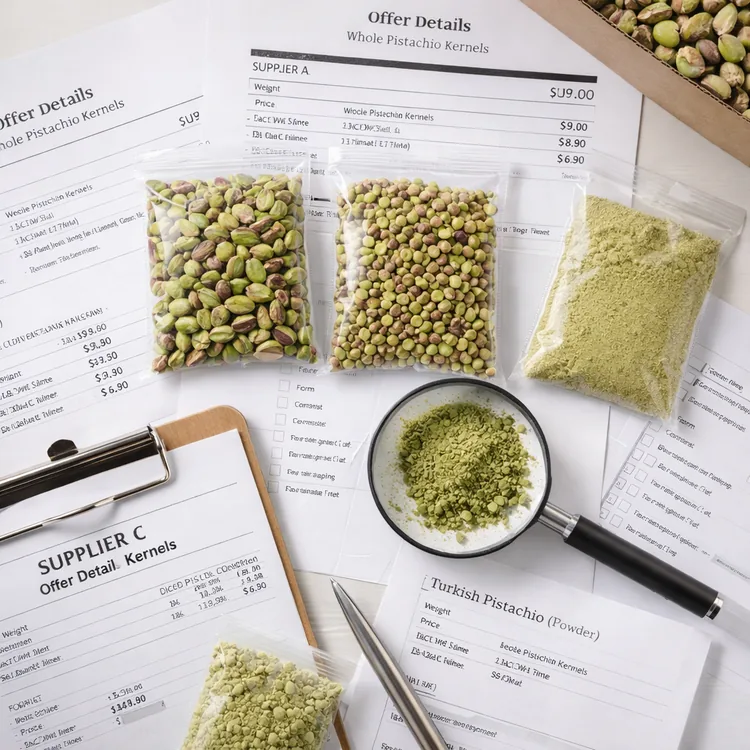
Price matters. Every serious buyer must consider cost, margins, market competitiveness and purchasing efficiency. But price becomes meaningful only after the buyer confirms that the offers are being compared on a like-for-like basis. If one supplier is quoting a more visually selected kernel, another is quoting a more commercial grade, and a third is quoting a product that is technically usable but not ideal for the intended application, the numbers are not directly comparable.
In other words, a cheap offer can look strong only because something important is missing from the comparison. That missing element may be visual consistency, packing quality, product selection, response reliability or suitability for the actual end use. Once those factors are included, the comparison often changes.
The practical lesson is simple: price should be treated as one layer of the decision, not the whole decision.
Step one: compare like for like before comparing numbers
The most common error in pistachio purchasing is comparing different products as if they were the same. Before evaluating price, the buyer should confirm that each offer is aligned across the following basic points:
- Product form: in-shell, whole kernel, split kernel, diced, powder, paste or another defined format.
- Primary use case: snack, pastry, confectionery, bakery, topping, filling, gelato, ingredient manufacturing or industrial processing.
- Visual expectation: visible premium use, application-led commercial use or process-oriented use.
- Packaging structure: bulk export pack, foodservice, industrial pack or custom/private-label pack.
- Commercial role: premium offering, standard commercial grade, application-specific grade or more price-driven offer.
If those foundations are not aligned, comparing price too early can be misleading. The correct sequence is to normalize the comparison first, then evaluate cost within that clearer frame.
Start with the final application, not the supplier pitch
The best way to compare pistachio offers is to begin with the buyer’s own use case rather than the supplier’s marketing language. The same pistachio product can perform very differently depending on where it ends up. A kernel that looks acceptable for an ingredient blend may not work for premium pastry decoration. A price-competitive cut may be ideal for industrial bakery use, but wrong for a dessert brand that depends on visible premium presentation.
That is why the first comparison question should be: what is the pistachio for? Once that is clear, the buyer can compare offers against real needs rather than attractive descriptions. Useful application questions include:
- Will the pistachio be visible to the final consumer?
- Is appearance more important than process economy, or vice versa?
- Will the product be chopped, ground, filled, baked, coated or used as garnish?
- Does the final item depend on a premium pistachio story?
- Does the product need strong repeatability across batches or across retail programs?
When buyers define the end use clearly, many confusing offers become easier to sort. Some suppliers may be strong for one application and less suitable for another. Price alone cannot reveal that.
Why product form changes value so much
Different pistachio formats create different commercial value. A whole kernel designed for visible pastry use should not be judged by the same logic as a powder for bakery systems or a paste for smooth filling applications. Each form carries different expectations for appearance, processing, handling and customer perception.
Examples:
- In-shell pistachios are often judged more heavily on snack presentation and market-facing appearance.
- Whole kernels often carry more value when visual quality and integrity matter.
- Diced kernels may be judged more by consistency of cut and suitability for filling, topping or bakery systems.
- Powder usually matters most in terms of formulation use and integration into a finished product.
- Paste is often evaluated according to how it supports cream, gelato, dessert or industrial smooth systems.
Because the value logic changes by format, buyers should avoid applying one comparison framework across all pistachio products. The correct evaluation criteria must follow the product form.
Commercial perspective: what serious buyers compare beyond price
Once the buyer confirms that the product forms are comparable, the next step is to look at the wider commercial picture. Some of the most important non-price comparison points are the ones that influence day-to-day business performance rather than the product alone.
1. Fit for the intended market level
Not every pistachio offer belongs in the same market segment. Some products are suitable for premium visible use. Others are more appropriate for practical bakery, filling or industrial applications. A cheaper product can still be the wrong choice if it does not support the level at which the buyer sells.
2. Clarity of the offer
A strong supplier does not simply send a number. A strong supplier explains what is being offered, how it should be used and why it fits the request. Clearer quotations tend to reduce confusion later and make the sourcing process more efficient.
3. Packaging and handling logic
Packaging influences product protection, internal handling and customer convenience. If one offer comes in a pack structure that better suits the buyer’s warehouse, production or resale model, that may create real value even if the nominal unit price is not the lowest.
4. Order repeatability
One good shipment is not enough in most B2B relationships. Buyers should consider whether the supplier appears capable of supplying the same type of product consistently over time. This matters especially for ongoing industrial use, distribution programs and branded products.
5. Communication quality
Clear, timely and commercially aware communication has value. Suppliers who understand the buyer’s application and answer precisely often reduce the chance of ordering the wrong grade or format. This can save more money than a small difference in headline price.
Technical perspective: what changes real product value
Technical expectations vary by customer segment. Snack buyers often focus on shell opening, roast profile and appearance. Ingredient buyers typically look more closely at kernel tone, cut size, grind consistency, purity, moisture management and performance during processing. The correct technical comparison depends on the final use, but several questions are broadly useful.
Is the grade truly aligned?
Many offer comparisons fail because the supplier descriptions use the same words for products that are not actually equivalent. Buyers should confirm whether the compared offers refer to the same commercial grade and intended standard, not just similar names.
Is the product visually appropriate?
Visual quality matters whenever pistachios are consumer-facing or brand-sensitive. A slightly cheaper product may create a weaker finished look, which can be costly in pastry, chocolate, dessert and premium retail programs.
Is the format right for the processing method?
A product that is technically usable is not always operationally ideal. For example, a format that works in theory may still be inconvenient for cutting, blending, grinding or portioning. Technical fit should be judged in relation to the real production environment.
Does the supplier understand the use case?
Suppliers that connect the offer to real applications are often easier to work with because they are less likely to recommend a mismatched product simply to win on price.
Why consistency often matters more than an attractive first sample
In pistachio trade, buyers are often shown the best-looking sample at the beginning of the conversation. Samples are useful, but a good buyer also asks how repeatable that sample standard is. Can the supplier deliver the same commercial logic, visual level and application fit across future orders?
Consistency matters because the hidden cost of inconsistency is high. It can produce variation in finished products, confuse internal production teams, create customer complaints or force the buyer to adjust processes from shipment to shipment. A slightly higher priced offer may deliver better long-term value if it is more consistent and easier to integrate into routine operations.
How packaging can change the total comparison
Packaging is sometimes treated as a secondary issue, but it can change the real value of an offer substantially. Buyers should compare not only what is inside the pack, but also whether the pack format supports their own system. Useful packaging comparison questions include:
- Is the pack suitable for bulk export, foodservice or industrial handling?
- Will the product need to be repacked after arrival?
- Does the packaging support the buyer’s warehouse and usage flow?
- Is the packaging aligned with private-label or resale needs?
If one supplier’s packaging creates more internal labor or more risk of mishandling, the apparent price advantage can shrink quickly.
Shipment planning and timing should be part of the comparison
Buyers sometimes focus so heavily on unit price that they underweight timing. Yet delivery planning often determines whether a purchase works smoothly. A competitively priced offer can become less attractive if the supplier cannot align to the buyer’s inventory cycle, launch timing or production needs.
Questions worth comparing include:
- Is the product already prepared or will it be produced against the order?
- How clearly does the supplier explain timing expectations?
- Does the supplier seem realistic about shipment planning?
- Can the supplier support staged or repeat business if needed?
Buyers who incorporate timing into their comparison make more stable sourcing decisions than those who compare only quote values.
Documentation and commercial readiness also matter
Two offers may look similar in product terms but differ in how professionally they are handled as export business. Buyers should pay attention to whether the supplier communicates clearly around documentation, commercial structure and transaction readiness. This does not need to be complicated. It is simply part of assessing how easy the supplier will be to work with.
A supplier who presents a coherent offer, answers clearly and appears commercially organized often reduces friction later in the order process. That has real value, especially for buyers working across multiple products or multiple suppliers.
Compare suppliers, not just products
When buyers compare pistachio offers, they are also comparing supplier behavior. The supplier becomes part of the product experience because product clarity, responsiveness and commercial discipline all shape the outcome. A professional supplier may help the buyer select a better-fitting product, avoid preventable errors and communicate more effectively across teams.
Useful supplier comparison points include:
- How clearly the supplier understands the request.
- Whether the supplier asks the right follow-up questions about use case and packaging.
- How consistent the supplier’s product language appears.
- Whether the supplier seems to match products to applications instead of pushing a generic stock answer.
- How easy the supplier is to communicate with during the quotation stage.
These factors are often early indicators of how the later business relationship will feel.
Why the cheapest offer can become the most expensive one
There are many ways a low-price pistachio offer can create more cost after purchase:
- More in-house sorting or handling effort.
- Lower finished-product appearance.
- Greater waste or loss in production.
- More difficult customer conversations.
- Mismatch between promised quality and delivered commercial use.
- Time lost clarifying what should have been clear at quotation stage.
None of these costs appear directly in the first quoted number, but they are still real. Buyers who think in total commercial effect rather than initial invoice value usually make stronger sourcing decisions.
How different buyer types should compare offers
Importers
Importers should compare offers with emphasis on clarity, repeatability, packaging practicality and how easily the product can be sold into their own downstream market. They often need an offer that can support more than one customer conversation, not just one shipment.
Distributors
Distributors often compare offers in terms of resale usefulness. The right product is not only technically acceptable, but also easy to position, easy to describe and consistent enough to support multiple recurring customers.
Food manufacturers
Manufacturers usually need the strongest application fit. Their comparison should focus on whether the product supports real process performance, repeatable output and smoother production rather than simply a lower input cost.
Private-label and brand owners
These buyers must compare offers against finished-product positioning. A pistachio ingredient that weakens the premium message of the final item may not be the right buy, even if it is nominally cheaper.
A practical offer comparison scorecard
Buyers can make offer comparisons more disciplined by using a simple scorecard rather than relying on instinct or lowest-price pressure. One practical method is to compare each offer across the following categories:
- Application fit – Does the product clearly suit the intended end use?
- Product clarity – Is the offer easy to understand and compare?
- Visual/commercial suitability – Is the grade aligned with the target market level?
- Packaging practicality – Does the packing suit the buyer’s operations?
- Supplier communication – Does the supplier answer clearly and usefully?
- Consistency confidence – Does the supplier appear capable of repeat business?
- Timing/logistics fit – Does the offer align with the buyer’s schedule?
- Price – Once the above points are aligned, how competitive is the quote?
This approach does not eliminate price. It simply places price in the correct position: as one important factor among several meaningful ones.
Questions buyers should ask before choosing an offer
To compare pistachio offers more accurately, buyers should ask questions that reveal fit, not just cost. Useful examples include:
- Which application is this exact offer best suited for?
- How would you position this product commercially?
- Is this a visible-use product, a more practical industrial grade or a balanced commercial grade?
- How should we compare this item to the other format we are considering?
- Is the packaging standard or customized?
- How repeatable is this offer over future orders?
- What kind of buyer usually purchases this product?
Questions like these often reveal more useful information than an extra round of price negotiation at the beginning of the conversation.
Why stronger product briefs improve offer quality
Buyers also influence the quality of the offers they receive. When the inquiry is vague, suppliers are forced to guess the intended use or offer a generic product. When the brief is clear, suppliers can respond with more relevant products and more realistic pricing. Good offer comparison therefore begins with good inquiry quality.
A helpful inquiry usually includes:
- The required product form.
- The intended application.
- The target packaging style.
- The expected quantity or order rhythm.
- Any important visual or commercial priorities.
Better briefs lead to better offers, which then makes comparison more meaningful.
Common mistakes when comparing pistachio offers
Comparing different grades as if they were equal
Offers can use similar language while referring to products that are not truly equivalent. Buyers should verify commercial alignment before comparing quoted numbers.
Ignoring the final application
A product that is fine for one use can be wrong for another. Application fit should always guide the comparison.
Focusing on unit price but ignoring total commercial effect
Sorting effort, packaging inconvenience, inconsistency and poor fit can all create costs that are not visible in the first quote.
Assuming the lowest quote reflects the best market knowledge
Sometimes the opposite is true. The stronger supplier may quote a more appropriate product and explain it more clearly, even if the number is slightly higher.
Choosing a supplier before evaluating communication quality
The quotation stage often reveals how the relationship will work later. If the supplier is unclear early on, problems may become more costly after the order is placed.
How Atlas uses this knowledge
Atlas uses academy content to make product discussions clearer and more useful. Each article supports a better understanding of product forms, applications, quality expectations and the questions buyers should ask before placing an order. In offer comparison, that means helping buyers move beyond simple price pressure and toward better commercial judgment.
Atlas approaches sourcing communication as a matching process. The goal is not only to find a pistachio offer, but to find the offer that best fits the buyer’s real use, packaging needs, commercial target and working style. That usually leads to better long-term decisions than selecting the lowest number without enough context.
Key takeaway
How to Compare Pistachio Offers Beyond Price gives buyers a stronger framework for evaluating Turkish pistachios with confidence. Better information leads to better product choices, smoother communication and more effective purchasing decisions.
The best offer is not always the cheapest. It is the one that matches the intended application, supports the buyer’s quality expectations, fits the supply model, reduces avoidable friction and can be repeated with confidence. When buyers compare offers in that broader way, they make more commercially sound decisions and build stronger sourcing relationships.
Frequently asked questions
Who is this article for?
This article is written for B2B buyers, importers, distributors, private-label buyers, brand owners and food manufacturers researching Turkish pistachio supply.
Why is comparing pistachio offers by price alone risky?
Because the lowest price may not reflect the best application fit, consistency, packaging practicality or commercial usefulness. Real value comes from the overall fit of the offer, not only the first quoted number.
What should buyers compare first?
They should first confirm that the offers refer to the same product form, application, packaging logic and commercial grade. Only then does price become truly comparable.
Why does application fit matter so much?
Because pistachio value changes according to use. A product suitable for visible premium decoration may not be the best choice for industrial filling or grinding, and vice versa.
What non-price factors matter most?
Common non-price factors include product clarity, grade consistency, visual suitability, packaging, timing, supplier communication and how well the offer matches the final use case.
Can Atlas help with sourcing?
Yes. Atlas focuses on helping buyers compare Turkish pistachio options more clearly by connecting product form, application, commercial positioning and supplier communication.
Related pages: Products, Applications, Quality Commitment, Frequently Asked Questions, Contact Atlas