In this guide
- Why product clarity matters
- What clear presentation actually means
- How to present by product format
- Why application-led selling works better
- How different buyer types read product information
- How to structure a strong product page
- A practical product sheet template
- Common mistakes to avoid
- Frequently asked questions
Introduction: why product clarity matters more than many sellers expect
In international pistachio trade, confusion usually does not begin at contract stage. It begins much earlier, when a buyer first reviews an offer and cannot immediately understand what the product actually is. A seller may describe a product as premium, export quality or suitable for food manufacturers, but those phrases alone do not explain the details that matter in a real purchasing process. Buyers need clearer signals. They want to know whether the product is in-shell or kernel, whole or diced, visual or process grade, suited for snacking or industrial use, and whether the quality level matches the intended application.
When products are presented clearly, commercial communication improves immediately. Buyers ask better questions, suppliers answer more precisely, and both sides spend less time correcting assumptions. In contrast, when product presentation is vague, the same order may require repeated clarification on size, format, packaging, color standard, intended use and consistency expectations. That slows down sourcing, weakens confidence and increases the risk of mismatch.
For Turkish Antep pistachios, clear presentation matters even more because the category includes multiple product forms and a wide range of end uses. A buyer sourcing premium visible kernels for confectionery does not evaluate the product the same way as a buyer sourcing paste feedstock for industrial filling. A good product page, quotation sheet or sales conversation should make that distinction obvious.
What “clear presentation” actually means in B2B pistachio sales
Clear presentation is not about adding more words. It is about removing ambiguity. A clear pistachio product presentation helps the buyer understand five things quickly:
- What the product is.
- What the product is best used for.
- What makes the product commercially different from similar offers.
- What quality cues the buyer should pay attention to.
- What packaging and supply structure the supplier can support.
In practice, that means a product should not be presented only as “pistachio kernel” or “premium pistachio.” It should be framed in a way that helps the buyer place it in context. Is it selected whole kernel for visible applications? Is it a more commercial kernel grade for bakery and fillings? Is it diced material for pastry, topping or industrial use? Is it powder intended for formulation, or paste intended for smooth systems? The buyer needs enough information to connect the product to a decision.
Why buyers get confused when pistachio products are described too broadly
Many product misunderstandings happen because sellers rely on broad prestige words instead of operational language. Terms such as premium, high quality, selected, export grade and top standard may sound positive, but they often mean different things to different buyers. One buyer may interpret premium as visually clean whole kernels suitable for decoration, while another may assume it refers to flavor intensity, and another may think it implies stricter sorting or lower defect tolerance.
That confusion is avoidable when the presentation focuses on product form, visual characteristics, processing level and application fit. A buyer should not have to infer what the seller means. The product description should explain it directly.
In B2B trade, clarity often creates more trust than luxury language. A simple, well-structured presentation that explains the product honestly is usually more persuasive than a polished description that leaves key questions unanswered.
Why this topic matters for Turkish Antep pistachios
Turkish Antep pistachios are used across many high-value categories: premium snacks, pastry, confectionery, chocolate, gelato, ice cream, bakery, fillings, toppings, creams and ingredient manufacturing. Because the same origin can serve such different applications, the way a product is presented becomes commercially important. Two products from the same source may differ significantly in how they should be sold, priced and evaluated.
A supplier working with Turkish pistachios should therefore avoid one-size-fits-all product language. Instead, each product should be described according to how buyers actually review it. For visible applications, appearance matters strongly. For industrial uses, form consistency and processing suitability may matter more. For premium retail or private-label business, presentation should help the buyer imagine how the product will be positioned to the next customer.
Good product clarity helps Turkish pistachio offers move from generic origin claims to more credible commercial positioning.
The first rule: present pistachios by product form, not by vague category
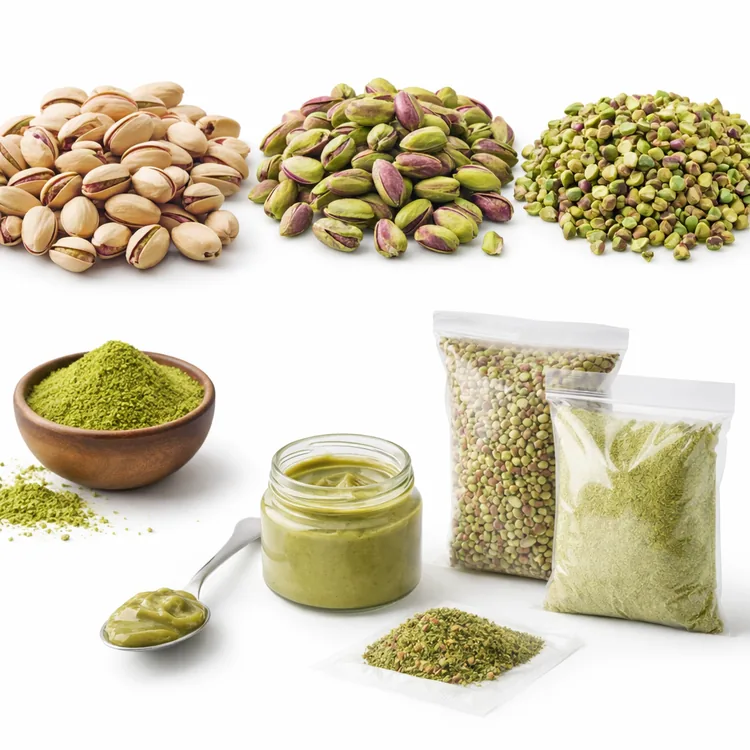
The most useful starting point for clear presentation is product form. Before discussing quality, price or commercial value, the seller should define what format the buyer is looking at. This prevents the buyer from comparing unlike products under the same label.
In-shell pistachios
In-shell pistachios should be presented with attention to snack-market expectations. The buyer typically wants to understand overall shell appearance, openness, presentation style, roasting position if relevant, packaging format and the intended market level. Retail snack buyers often think visually first, so product presentation should reflect that.
Helpful presentation language may describe whether the product is best suited to branded snack packs, foodservice snack channels or bulk resale. The more clearly the product is connected to a selling environment, the easier it becomes for the buyer to classify it.
Whole kernels
Whole kernels should be presented in a way that highlights where they fit best: visible decoration, confectionery, pastry, premium ingredient use, fillings or other applications where appearance and integrity matter. This is often one of the most commercially sensitive formats because small differences in appearance can change perceived value quickly.
When presenting whole kernels, useful information often includes whether the product is intended for visible premium use, whether consistency of look is important, and whether the buyer should think of the product as decorative, ingredient-led or multi-purpose.
Diced kernels and cuts
Diced products should be presented by cut style and intended use rather than treated as leftover fractions. Buyers want to know whether the cut is appropriate for bakery, toppings, inclusions, fillings or industrial processing. A clearer description helps position the product as functional and purposeful rather than secondary.
This also helps the supplier defend value. A buyer is far less likely to compare diced ingredients unfairly with whole kernels when the presentation makes the use case clear and commercially logical.
Pistachio powder
Powder should be presented in relation to bakery, formulation, coatings, fillings or industrial use. Buyers often need reassurance that the product has been thought through in application terms, not simply sold as a generic ground nut product.
Powder can be positioned around integration, blending convenience and system compatibility. When sellers describe powder with a clear application focus, the product becomes easier for technical teams and buyers to review together.
Pistachio paste
Paste should be described in terms of intended use such as cream systems, dessert applications, fillings, gelato, sauces or industrial blending. Here the presentation must help the buyer understand the product’s role in a finished system, not just the fact that it is paste.
Paste presentations work best when they explain smooth-system relevance, premium dessert fit and the reason a buyer should choose paste instead of kernels or powder for the target application.
The second rule: connect every product to a realistic application
Application-based presentation is one of the fastest ways to make a pistachio offer easier to understand. Buyers generally think in use cases. Even when they ask about technical details, those details are usually connected to a final application. A product page that states “suitable for pastry toppings, premium chocolate inclusions and visible dessert finishing” gives a buyer a much clearer signal than a page that only says “high-quality pistachio kernels.”
Application guidance does not have to be restrictive. It simply needs to point the buyer toward the most natural commercial use. This makes the offer easier to compare and helps avoid mismatched expectations. It also improves internal alignment for the buyer, especially when a procurement team needs to share the product with quality, R&D, sales or management colleagues.
Strong application framing answers an important buyer question before it is asked: “Where does this product make the most sense?”
The third rule: separate commercial language from technical language, but use both
One of the most useful improvements in product presentation is to distinguish commercial clarity from technical clarity. Buyers often need both. Commercial language helps them understand positioning, while technical language helps them confirm fit.
For example, a good commercial description might explain that a product is intended for premium pastry and confectionery applications where visible appearance matters. A useful technical layer might then clarify that the product is whole kernel, visually selected, packed in a format suitable for export and positioned for applications where presentation consistency is important.
When these two layers are combined well, the product becomes easier to evaluate across departments. Sales can explain it, procurement can compare it, and technical teams can review it more efficiently.
What buyers usually want to understand first
Although every buyer is different, most B2B pistachio buyers tend to review offers in a similar order. Understanding this helps sellers structure product pages and quotations more effectively.
- Product form: What exactly is being offered?
- Use case: Is it appropriate for the intended application?
- Visual quality: How will it look in a finished product or as a sold item?
- Consistency: Can it be supplied in a repeatable standard?
- Packaging: Does the pack format fit the buyer’s supply chain?
- Commercial fit: Does the offer align with the market level or product strategy?
This means the most effective product presentation often moves from what the product is, to what it is for, to what quality cues matter most.
How to present pistachio products by buyer type
Different buyers focus on different details. A product presentation should remain clear and consistent, but it should also anticipate audience priorities.
Importers and distributors
These buyers often need a product story they can resell. They want clarity on category, market position, packaging practicality and whether the product can be described simply to downstream customers. Product presentation for this audience should balance technical reliability with sales usefulness.
Importers and distributors usually benefit from concise product logic: what it is, where it sells best, how it should be described, and what level of customer it suits. Presentation that is too technical without sales framing may be less useful to them.
Food manufacturers
Manufacturers usually want application fit first. They need to know whether the pistachio format will work in a real production environment. Presentation should therefore emphasize form, intended use, processing relevance, repeatability and any practical considerations that affect formulation or line performance.
For this audience, the best product page is not the most glamorous one. It is the one that quickly reduces uncertainty and helps R&D, procurement and production teams interpret the same product in the same way.
Private-label and brand owners
These buyers often think in shelf position, storytelling and consumer expectation. For them, product presentation should help connect the ingredient to premium brand value, not just basic specification. They still need clarity, but they also need enough positioning language to understand how the product can support a branded offer.
That means product descriptions may need to explain not only application and format, but also how the ingredient contributes to a more premium finished item.
Chefs and pastry teams
This audience may think in menu use, visual effect and sensory outcome. Product presentation should therefore highlight application examples, visible quality and format suitability for finishing, filling, layering or decoration.
Helpful language for chefs often includes sensory cues, visual-use notes and examples of how the format can be used in pastry, desserts, confectionery or plated service.
Why clear presentation improves internal decision-making for buyers
A product page is rarely read by only one person. In many buying situations, the same pistachio offer may be reviewed by procurement, management, quality control, R&D or sales. If the page is vague, each reader may interpret the product differently. If the page is structured well, the same product can move through internal review with less friction.
This is one of the hidden advantages of strong product communication. It does not only help the supplier sell. It helps the buyer align internally. That becomes especially valuable when products are being evaluated for repeat orders, new product development or private-label expansion.
Essential elements every pistachio product presentation should include
A well-structured pistachio product presentation does not need to be overly technical, but it should cover the most important decision points. Useful sections often include:
- Product name: Clear, simple and format-specific.
- Product form: In-shell, whole kernel, diced, powder, paste or other defined format.
- Primary applications: The most suitable uses.
- Visual description: How the product typically presents.
- Commercial position: Premium, application-led, industrial, visible-use or other realistic positioning.
- Packaging format: Export pack, bulk pack or custom pack direction.
- Origin note: Turkish Antep pistachio positioning where relevant.
- Buyer guidance: A short note on which customer or use case the product best suits.
This structure gives buyers a faster path to understanding. It also improves consistency across a product catalog, website or quotation set.
How to structure a strong pistachio product page
For digital presentation, product pages should do more than list a product name and a short paragraph. A strong pistachio page should guide the buyer from first impression to usable understanding. A practical page structure might follow this sequence:
- Headline: A precise, format-based product name.
- Lead paragraph: A short overview explaining the product’s role and typical uses.
- Use case section: The most suitable commercial applications.
- Product clarity section: What makes this item different from other pistachio formats.
- Commercial fit section: The buyer type or market segment it best suits.
- Packaging and supply section: How it is typically handled commercially.
- Related links: Connections to applications, quality pages and contact pathways.
This structure is strong because it moves from identity to usefulness to action. It does not overwhelm the reader at the top, but it still gives enough substance for a real business conversation.
Why visuals and wording should support each other
In pistachio sales, wording and imagery work together. A visually strong product image without a clear description can still confuse buyers. Likewise, a strong text description without useful visual context may leave too much open to interpretation. The best presentations align the two.
For example, if a product is positioned for visible pastry decoration, the wording should say so, and the imagery should reflect that kind of premium visual expectation. If the product is intended for industrial use, the description should focus on fit and consistency rather than overselling cosmetic prestige.
This alignment helps buyers trust the presentation. When the language matches what they see, the product feels more coherent and more credible.
Why sellers should avoid presenting all pistachio products as “premium”
Not every pistachio product needs to be presented as premium to be valuable. In fact, using the same premium language for every format can weaken the product range. Buyers appreciate precision more than uniform prestige. A carefully presented commercial bakery cut can be just as useful as a premium whole kernel, but it should be positioned differently.
Good presentation helps the buyer understand not just that the product is good, but why it is the right level of product for a specific job. This is especially important for suppliers who offer multiple formats. A range becomes stronger when each item has its own logic and place in the portfolio.
Clear differentiation also helps prevent price-only comparisons between products that serve very different commercial functions.
How to describe pistachio products in a way buyers can compare easily
Comparison becomes easier when product descriptions use a repeatable structure. Buyers reviewing multiple options benefit from consistency. If every product page or quotation uses a different order, different level of detail and different terminology, the buyer must reconstruct the logic each time.
A repeatable comparison format may look like this:
- Product format.
- Primary use cases.
- Visual and commercial quality notes.
- Packaging and shipment orientation.
- Typical buyer profile or application match.
This kind of structure can be applied across in-shell pistachios, kernels, cuts, powder and paste, which makes the overall product range feel clearer and more professional.
How to present commercial value without sounding vague
Many sellers know their product has value, but they communicate that value in generic terms. A better approach is to connect value directly to the reason a buyer would select the format. Instead of saying only “premium pistachio product,” stronger language might explain that the format is suited for visible finishing, smooth cream systems, structured inclusions or scalable bakery use.
This makes value easier to defend because it is connected to a real buying purpose. The supplier is not simply saying the product is good. The supplier is explaining why the product is useful, where it fits best and what kind of commercial role it can play for the buyer.
Application-led examples of clear product presentation
Example: whole kernels for visible use
A clear presentation would explain that the product is intended for premium pastry, confectionery, dessert finishing and other applications where kernel integrity and visual appeal are commercially important. This immediately signals how the buyer should evaluate the product and why appearance matters.
Example: diced kernels for bakery and topping systems
A clear presentation would explain that the product is designed for fillings, bakery toppings, coatings and structured inclusions where texture and application practicality matter more than whole-kernel appearance. This gives the buyer a clear functional frame.
Example: pistachio powder for formulation
A clear presentation would explain that the product is suitable for bakery systems, coatings, dry mixes and applications where the pistachio needs to integrate smoothly rather than appear as a distinct visible inclusion. This clarifies both what the product does and what it does not aim to do.
Example: pistachio paste for smooth systems
A clear presentation would emphasize creams, fillings, gelato, dessert bases and other applications where smooth texture and integrated pistachio character are the main goals. This helps the buyer connect the format to real product development decisions.
How clear presentation improves quotations and inquiry quality
One of the strongest commercial benefits of better product presentation is that it improves the quality of incoming buyer inquiries. When buyers understand a product more clearly, they ask more precise questions. Instead of sending a broad message asking for “best price on pistachios,” they are more likely to specify the product form, application, packaging and expected volume.
This saves time on both sides. Suppliers can provide more useful quotations, and buyers can compare offers on a more realistic basis. It also reduces the risk that samples, specifications or pricing discussions begin on the wrong product category.
In this sense, strong presentation is not only marketing. It is also a practical sales-efficiency tool.
How better presentation supports faster qualification
In many B2B situations, a product must be qualified before it becomes a routine purchase. Clearer presentation helps this process by making the first review more efficient. Buyers can route the right product internally, technical teams can evaluate whether it matches use case expectations, and commercial teams can decide whether the product fits their target market.
A vague page tends to delay qualification because too much has to be explained later. A well-built page reduces that burden by answering the first set of buyer questions in advance.
What a seller should never assume the buyer already knows
Even experienced buyers do not automatically interpret product labels the same way. A seller should not assume that every buyer understands internal naming conventions, grade labels or general phrases such as export standard or selected product. If the product is worth selling, it is worth explaining.
Common assumptions that should be avoided include:
- Assuming buyers interpret “premium” the same way.
- Assuming “kernel” is enough detail on its own.
- Assuming the end use is obvious from the product image.
- Assuming all industrial buyers want the same information.
- Assuming packaging preferences are understood automatically.
Clear presentation works best when it is written for the buyer who is informed, but still needs practical clarity to make a commercial decision.
What a strong pistachio quotation should reinforce
Once the buyer moves from product page to quotation, the same clarity should continue. A quotation should not undo the work of the presentation. It should reinforce it. That means the quoted item should still be recognizable by form, intended use and packaging logic, rather than being reduced to a generic line that forces the buyer to ask what is actually included.
Strong quotations work best when they echo the product’s commercial identity. That makes the entire sourcing path feel more coherent, from discovery to quote request to commercial discussion.
A practical framework sellers can use
For suppliers building product sheets, website pages or trade presentations, the following structure is often effective:
- Name the product precisely.
- Explain its best-fit applications.
- Describe the main visual and commercial qualities.
- Clarify who typically buys it and why.
- State packaging and supply direction.
- Invite the buyer to share end-use details for accurate matching.
This framework works because it respects how buyers think. It moves from identification to usefulness to decision support.
Suggested product sheet template
Below is a practical structure suppliers can adapt directly for product pages, PDFs or internal sales sheets:
- Product Name: e.g. Whole Pistachio Kernels for Premium Visible Use
- Format: Whole kernel / diced / powder / paste / in-shell
- Best For: Pastry, confectionery, bakery, gelato, snack, industrial use
- Commercial Position: Premium visible-use / application-led / industrial / multi-purpose
- Visual Description: Brief explanation of how the product typically presents
- Use Notes: Where the product makes the most sense operationally
- Packaging Direction: Bulk export / foodservice / private-label / custom
- Buyer Note: Ask the buyer to share application details for best matching
This template is intentionally simple. Its strength comes from consistency and usability.
Common mistakes in pistachio product presentation
Using generic sales words without application context
Words like premium and top quality are not useless, but on their own they do not guide a purchase decision. Buyers need to know what the product is good for.
Presenting all products at the same prestige level
A mixed product range becomes confusing when every item is described in the same way. Different products should have distinct roles and clearer positioning.
Ignoring the buyer’s workflow
Some presentations sound attractive but do not help procurement or technical review. A better approach is to make the page useful for real decision-making, not just brand tone.
Failing to explain why a format exists
Whole kernels, cuts, powder and paste should not be presented as interchangeable. Each has a commercial purpose, and that purpose should be stated clearly.
Overloading the page with scattered details
Clarity comes from structure. Too many disconnected details can be as confusing as too little information. The presentation should lead the buyer logically through the product.
Writing only for one audience
If the page only speaks to marketers, technical buyers may find it weak. If it only speaks to technical reviewers, sales teams may struggle to use it. The strongest product pages balance both needs.
How Atlas uses this knowledge
Atlas uses academy content to make product discussions clearer and more useful. In pistachio trade, better communication often leads directly to better sourcing results. When buyers understand format, application fit, visual expectations and commercial role more clearly, they make stronger product choices and communicate more effectively with suppliers and internal teams.
That is why Atlas approaches product communication as part of the sourcing process, not as a separate marketing exercise. Good product presentation helps buyers move faster, compare more intelligently and reduce the risk of ordering a product that does not fully match the intended use.
For Turkish Antep pistachios in particular, this matters because the category is versatile. Clearer presentation helps that versatility become an advantage instead of a source of confusion.
Key takeaway
How to Present Pistachio Products Clearly for Buyers is ultimately about making commercial decisions easier. The clearer the product presentation, the easier it becomes for importers, distributors, manufacturers and brand owners to understand what they are buying, how it fits their application and what questions they should ask next.
In Turkish pistachio trade, clarity creates value. It reduces confusion, supports stronger inquiry quality, improves internal alignment and helps sellers position each product more credibly. A well-presented pistachio product is not simply easier to read. It is easier to trust, easier to compare and easier to buy.
Frequently asked questions
Why is clear product presentation important in pistachio sales?
Because buyers need to compare more than price. They need to understand the product form, intended application, visual quality, commercial position and packaging structure before they can evaluate an offer accurately.
What should a pistachio product presentation include?
At minimum, it should explain the product format, likely applications, main visual or commercial qualities, packaging direction and the type of buyer or use case the product best fits.
Why is application-based presentation better than generic descriptions?
Because buyers think in use cases. When the product is linked clearly to pastry, confectionery, bakery, snack or industrial application, it becomes easier to understand and compare.
Do all buyers need the same information?
No. Importers, distributors, private-label buyers, chefs and manufacturers often focus on different details. Strong presentation should be clear enough for commercial review while still useful for technical evaluation.
Should every pistachio product be presented as premium?
Not necessarily. Some products should be positioned for visible premium use, while others should be positioned for practical industrial or application-led use. Clear differentiation helps buyers choose more accurately.
What is the biggest mistake suppliers make?
The most common mistake is relying on broad claims without explaining product form, intended use or commercial purpose. Buyers need specific product logic, not just positive adjectives.
How can suppliers make their product range easier to compare?
They can use the same structural framework across the entire range: format, application, visual notes, commercial position, packaging and buyer guidance. Consistency makes decision-making easier.
Can Atlas help buyers evaluate Turkish pistachio products more clearly?
Yes. Atlas helps buyers connect product form, application fit, quality expectations and clearer supplier communication so sourcing conversations are more effective.
Related pages: Products, Applications, Quality Commitment, Frequently Asked Questions, Contact Atlas