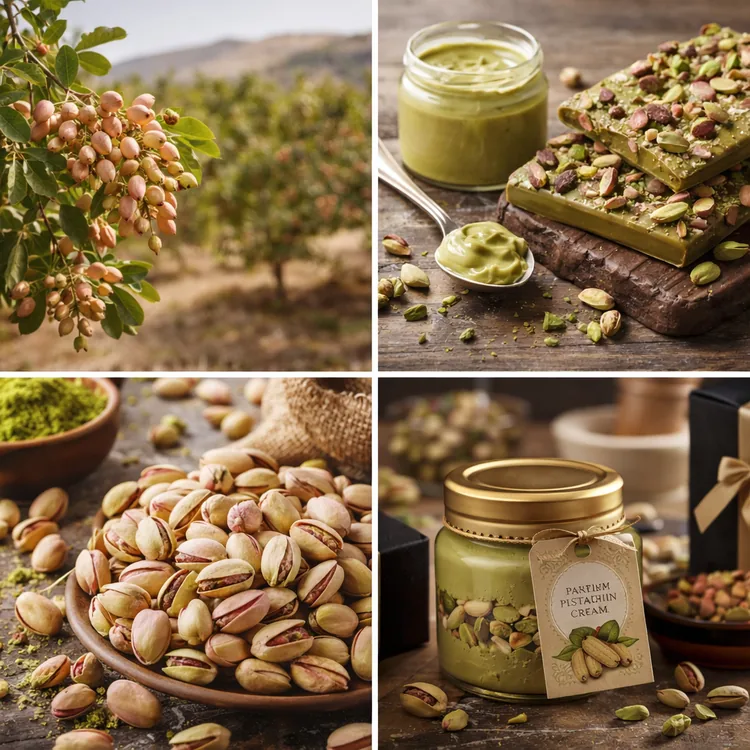
Introduction: why premium brands need more than good ingredients
Premium brands rarely succeed by offering a high-quality ingredient without context. In crowded markets, quality alone is often invisible unless the brand helps customers understand what they are seeing, tasting and paying for. This is where ingredient storytelling becomes commercially important. It gives structure to product positioning. It translates sourcing decisions into language that buyers, distributors, chefs, retailers and consumers can understand.
For pistachio-based products, storytelling has unusual power because pistachio already carries strong associations with indulgence, craftsmanship and premium dessert culture. But that advantage can also be wasted. Many brands use pistachio only as a flavor cue or color reference without building a clear identity around the ingredient itself. The result is a product that sounds premium at first glance, but does not create a deeper or more memorable impression.
Strong ingredient storytelling helps prevent that. It connects the ingredient to the product promise. It explains why the pistachio matters, what makes the offering distinctive and how the brand wants the market to interpret quality, origin and application.
What ingredient storytelling actually means
Ingredient storytelling is not a slogan. It is not just a line about premium nuts or artisanal sourcing. In a serious B2B or brand-building context, ingredient storytelling means creating a coherent commercial narrative around an ingredient’s identity and role inside the product.
For pistachio brands, that usually includes several layers at once:
- Where the pistachios come from and why that origin matters.
- How the ingredient behaves in taste, texture and appearance.
- What product forms are used and why they fit the application.
- How quality and consistency support premium positioning.
- What the ingredient communicates emotionally and commercially.
When these layers are connected clearly, a pistachio product feels intentional. It becomes easier to position, easier to sell and easier to explain across packaging, catalogs, websites, product launches and distributor conversations.
Why pistachio is one of the strongest ingredients for storytelling
Pistachio occupies a special place in premium food categories because it combines visible beauty with functional versatility. It is attractive on the surface, expressive in texture and easy to connect to culinary craft. It works in retail packs, chocolate, bakery, pastry, gelato, fillings, toppings, creams and industrial ingredient systems. Few ingredients perform so well across both visual branding and practical product development.
That combination matters because strong storytelling is easier when the ingredient already carries commercial meaning. Pistachio often signals indulgence, sophistication, celebration and elevated taste. It suggests more value than many standard nuts. It also creates a bridge between culinary tradition and modern premium product design.
For brands that want to appear refined, authentic, ingredient-led or globally aware, pistachio can act as a central storytelling anchor rather than just a supporting component.
Why Turkish Antep pistachios fit premium brand narratives so well
Turkish Antep pistachios are especially useful in premium storytelling because they connect product quality with a recognizable culinary identity. They are associated with pastry, confectionery, layered desserts, fillings and ingredient-rich food traditions that already carry premium cultural weight. This gives brands an advantage: they do not need to invent the ingredient’s importance from nothing. They can build on a strong existing foundation.
In practical brand terms, Turkish Antep pistachios offer several narrative strengths. They support an origin story. They support a craftsmanship story. They support a premium application story. They also work well across both traditional and modern formats, which allows a brand to sound rooted without appearing outdated.
For buyers and product teams, this is valuable because a strong origin-linked ingredient story can support premium pricing, reinforce perceived authenticity and create a more durable brand language across multiple products.
Storytelling begins with product truth
The best ingredient storytelling starts with what the product genuinely is. A premium pistachio brand should build its message around real strengths, not decorative language. If the product uses whole kernels for visible inclusion, that should be part of the story. If it uses paste for a smooth, rich internal profile, that should be explained clearly. If it relies on premium visual presentation, clean ingredient language or application-led quality, those are more credible storytelling foundations than generic luxury terms.
Storytelling becomes weak when the language overpromises what the product itself does not support. That happens when brands use premium origin claims but deliver visually flat products, talk about craftsmanship without explaining format or quality, or rely on broad culinary references that do not connect to the actual customer experience.
In other words, ingredient storytelling should clarify the product, not distract from it.
The main pillars of a strong pistachio ingredient story
1. Origin
Origin remains one of the most powerful storytelling tools in premium food. In pistachios, origin can signal climate, culinary tradition, regional character and product expectations. A strong origin story does not need to be exaggerated. It simply needs to help buyers understand why source matters to the identity of the finished product.
For premium brands, origin works best when it is tied to product outcomes rather than presented as a decorative label. Instead of treating “Turkish” or “Antep” as standalone prestige words, brands should connect origin to the style of use, the culinary association and the reason the ingredient fits the brand’s promise.
2. Sensory character
Customers and buyers respond more strongly when brands describe ingredients in a sensory way. With pistachios, this can include the richness of the nut, the role of visible green tones, the balance between creaminess and crunch, and the way pistachio performs in pastry, confectionery or dessert formats.
A sensory story helps the ingredient feel alive. It also creates a more specific identity than generic premium wording. A pistachio product should feel like it has a texture, appearance and culinary role, not just a marketing label.
3. Craft and process
Premium customers often want reassurance that the product is handled thoughtfully. In a pistachio context, process storytelling can include product selection, format choice, application fit, visual quality, consistency and how the ingredient is used within the final system. This is especially important in B2B categories where buyers need more than emotional language. They need reasons to trust the offer.
4. Application fit
One of the strongest forms of storytelling is explaining why a specific pistachio format is appropriate for a specific use. Whole kernels for visible decoration, diced kernels for texture, powder for bakery systems and paste for creams or gelato are not only technical distinctions. They are part of the brand’s logic. They show that the product was developed with purpose.
5. Consistency and repeatability
In premium positioning, consistency matters almost as much as the first impression. Buyers, chefs, distributors and manufacturers want to know that the story can be repeated through every order, every batch and every season of the product line. Storytelling becomes stronger when it aligns with dependable commercial behavior.
How ingredient storytelling differs by audience
Not every audience needs the same message. One of the biggest mistakes premium brands make is using the exact same pistachio narrative for every channel. Effective storytelling should be adjusted according to who is reading, buying or selling the product.
For importers and distributors
Importers and distributors want a story that helps them sell. They need language that communicates origin, premium relevance, product form and application value without becoming vague. They are often less interested in poetic copy and more interested in whether the story creates a useful sales tool for multiple downstream customers.
For this audience, the ingredient story should make product positioning easier. It should help answer questions such as:
- Why is this pistachio product premium?
- What use cases does it fit best?
- How should it be described to retailers, chefs or manufacturers?
- What is the commercial logic behind the chosen format?
For food manufacturers
Manufacturers need a story that connects directly to formulation, process and market fit. They may appreciate origin and culinary relevance, but they also need clear logic on how the ingredient supports the final product. For them, the storytelling should reinforce technical credibility.
Manufacturers respond well to narratives that explain why the ingredient suits fillings, toppings, creams, bakery systems, frozen desserts or premium retail products. In this context, storytelling becomes more persuasive when it is anchored in application.
For private-label buyers
Private-label buyers often need a story that can live across packaging, retailer expectations and category strategy. They need enough premium character to support shelf appeal, but also enough flexibility to fit retailer-specific positioning. In these cases, ingredient storytelling should be modular. It should be strong enough to carry the product, but adaptable enough to fit different commercial settings.
For chefs and menu developers
Chefs and menu teams often respond to ingredient storytelling when it helps them build menu language, plated concepts or premium dessert direction. They want the ingredient to feel evocative, but still concrete. A useful pistachio story in this context helps the chef understand not only what the product is, but how it will read on the menu and on the plate.
Why generic luxury language is not enough
Many premium food brands fall into the trap of sounding expensive rather than sounding specific. Terms such as “gourmet,” “premium,” “finest,” “artisanal” and “luxury” appear constantly across the market. On their own, they do not create a strong ingredient story. They are only effective when supported by real detail.
For pistachio brands, specificity is far more powerful. A clear explanation of product form, application, origin, sensory character and visual quality usually creates more trust than a paragraph of broad prestige language. Specificity helps premium claims feel earned.
That is especially important in B2B trade, where buyers compare multiple suppliers and can quickly recognize when a brand sounds polished but says very little.
Turning product form into story
Pistachio brands often underestimate how much storytelling power sits inside product format itself. The form of the ingredient tells the market how the brand thinks about use, quality and presentation.
Whole kernels
Whole kernels tell a story of visibility, confidence and premium appearance. They are ideal when the product needs to display the ingredient openly. This suits bakery tops, visible inclusions, premium chocolate, plated finishing and any product where the customer should immediately recognize the pistachio value.
Sliced or slivered kernels
Sliced formats communicate elegance and precision. They work well in pastry, layered desserts and decorative finishes where the visual effect should feel refined rather than rustic.
Diced kernels
Diced formats support a story of texture and structured inclusion. They are useful in fillings, coatings, bakery, bars and confectionery systems where the pistachio should be felt throughout the product rather than simply seen on top.
Pistachio powder
Powder can support a softer storytelling direction focused on integration, layering and flavor structure. It suits bakery systems, sponge, dusting, coatings and premium dry applications where pistachio is part of the overall build rather than a singular decorative element.
Pistachio paste
Paste supports a story of richness, depth and smooth delivery. It is especially useful in creams, gelato, mousse, fillings, spreads and dessert systems where pistachio needs to appear as a complete flavor base rather than a textural accent.
How storytelling supports premium positioning
Premium positioning is often fragile when it depends only on visual cues or package design. Ingredient storytelling makes it more durable because it gives customers a reason to believe the price and the promise. In pistachio categories, this is particularly useful because the ingredient already carries a premium expectation. A strong story helps direct that expectation toward the brand rather than leaving it undefined.
For example, a brand can use storytelling to frame pistachio as:
- A culinary ingredient with rooted origin and pastry relevance.
- A visible premium feature in bakery, chocolate or dessert formats.
- A carefully selected component chosen for texture, color and richness.
- A signal of care, sophistication and category expertise.
Each of these directions can support a premium product, but the strongest brands choose one or two clearly and build around them consistently.
Ingredient storytelling across different product categories
Bakery and pastry
In bakery and pastry, pistachio storytelling usually works best when it emphasizes visible quality, texture contrast and ingredient richness. Here the brand can connect pistachio to finishing, filling, layered pastry traditions and artisanal detail. The ingredient story should help the customer believe that the product is more than an ordinary sweet item with a premium-colored topping.
Chocolate and confectionery
In chocolate, pistachio can support luxury, gifting and indulgence. The story may focus on contrast between smooth chocolate and structured nut texture, or on the elevated feeling pistachio brings to filled pralines, bars and coated products. In this category, pistachio often acts as a high-value signal that strengthens both taste expectations and presentation.
Gelato and frozen desserts
In frozen categories, pistachio storytelling tends to revolve around flavor depth, creaminess and premium dessert identity. The strongest narratives often link pistachio to authenticity, richness and a more sophisticated alternative to generic dessert flavors.
Ingredient systems and industrial foods
For food manufacturers and ingredient buyers, storytelling should become more application-led. Here the product story must connect premium identity to format suitability, process relevance and consistency. This is less about emotional language and more about explaining why the pistachio helps build a better final product.
Why consistency is part of the story
A premium ingredient story does not end with launch copy. It has to survive repeated orders, repeated batches and repeated customer experiences. That is why consistency belongs inside the storytelling framework. When the product is visually unstable, difficult to position or inconsistent in its application performance, the story weakens over time.
In practical terms, brands should aim for consistency in:
- How the product is described.
- What visual standard the product delivers.
- How the pistachio behaves in the target application.
- How trade partners understand and resell the product.
This matters because strong brands are built not only on first impressions, but on repeat confidence.
What premium pistachio brands should avoid
Overclaiming origin
Origin is valuable, but it should not be used as a shortcut for quality explanation. Simply naming a place does not tell the market why the product deserves attention. Premium brands should connect origin to real product meaning.
Using vague premium language
Customers and buyers quickly notice when a brand sounds polished but lacks substance. Generic prestige wording without application, sensory or format detail weakens trust.
Separating story from product reality
A brand cannot sustain a premium narrative if the product form, presentation or use case does not support it. The more visible the difference between the story and the product, the weaker the long-term value of the brand becomes.
Ignoring the buyer’s language
Many brand stories are written only for the final consumer, even when the real sales process depends on importers, distributors, chefs or manufacturers. Premium pistachio brands need language that works at every stage of the chain.
How to build a stronger pistachio brand story in practice
For teams building or refining a premium pistachio product line, the most useful starting point is to define the ingredient story through a practical set of questions:
- What role does pistachio play in the product: visible hero, flavor base, texture layer or premium cue?
- Which product form best supports that role?
- What should the customer understand immediately about the ingredient?
- What culinary or commercial associations strengthen the offer?
- How can the story be repeated consistently across sales, packaging and digital content?
These questions push the story toward clarity. They help teams avoid writing beautiful copy around a product that has not yet been positioned properly.
Messaging directions premium brands can use
Different pistachio brands may choose different storytelling directions depending on product line, audience and market. Common strategic directions include:
Origin-led storytelling
This direction focuses on Turkish Antep pistachios as a meaningful source identity. It works well when the brand wants to emphasize region, culinary heritage and authenticity.
Craft-led storytelling
This direction emphasizes thoughtful product development, premium use, careful format selection and refined application. It is useful in pastry, dessert and chocolate-driven products.
Ingredient-led storytelling
This direction places pistachio at the center of the brand’s value proposition. It is especially effective when the product relies on visible kernels, pistachio-rich fillings, premium creams or clearly identifiable pistachio character.
Application-led storytelling
This direction explains why the pistachio format fits the intended use. It is highly useful in B2B trade, industrial ingredients and private-label categories.
How Atlas approaches the topic
At Atlas, the purpose of academy content is practical. We use topics like ingredient storytelling not as abstract branding language, but as a bridge between sourcing decisions and market communication. Buyers often know that pistachio can support a premium position, but they do not always know how to describe that value clearly or how to match format, application and narrative in a consistent way.
By translating product knowledge into clearer commercial language, Atlas helps buyers, distributors and product teams make better use of Turkish pistachios in real business settings. That includes understanding product form, application fit, commercial expectations and how ingredient identity influences perception across the supply chain.
Commercial perspective: why this matters to buyers
From a buying perspective, ingredient storytelling is not only a marketing issue. It affects how products are positioned, how easily they move through distribution and how clearly their value is communicated to the next customer. A premium pistachio brand with weak storytelling may still have a good product, but it will often be harder to place, harder to explain and harder to differentiate.
Better storytelling improves commercial clarity. It helps buyers compare products beyond headline price. It also helps them determine whether the pistachio offer actually fits the intended market, whether that market is retail, foodservice, dessert manufacturing, private label or ingredient distribution.
Technical perspective: why clarity still matters in premium branding
Although storytelling sounds like a brand topic, it is closely linked to technical product logic. Premium language works best when it reflects real product structure. That means format, application, visual standard, texture role and consistency should all support the story being told.
For example, if a brand emphasizes indulgent pistachio richness, it should choose a format that delivers that experience. If it emphasizes visible premium finish, the form of the kernel should support that claim. If it emphasizes clean ingredient-led pastry identity, the product should look and behave accordingly. Storytelling becomes more persuasive when the technical and commercial sides point in the same direction.
Key takeaway
Ingredient storytelling for premium pistachio brands is most effective when it is specific, credible and rooted in real product choices. Turkish Antep pistachios provide a strong foundation for that kind of storytelling because they connect premium perception, culinary relevance and broad application potential. But a good ingredient story does not happen automatically. It must be shaped deliberately through product form, positioning, language and consistency.
For importers, distributors, private-label buyers and food manufacturers, the real value of storytelling is clarity. It helps explain what makes the product special, why it fits a premium use case and how it should be presented to the market. When that clarity is strong, pistachio becomes more than an ingredient. It becomes a defining part of the brand.
Frequently asked questions
What is ingredient storytelling in a pistachio brand context?
It is the way a brand explains why its pistachio ingredient matters. It connects origin, sensory character, product form, use case and premium value into one coherent commercial message.
Why does ingredient storytelling matter for premium pistachio products?
Because premium products need more than attractive design. Customers and trade buyers want to understand what makes the product distinctive and why the pistachio justifies a premium position.
Why are Turkish Antep pistachios useful in storytelling?
They connect strongly to pastry, confectionery, premium culinary use and origin-led positioning. That gives brands a meaningful foundation for premium communication.
Does storytelling replace technical product information?
No. Strong storytelling should reinforce technical clarity. The most effective premium brands connect narrative to product format, application logic and commercial consistency.
Who is this article for?
This article is written for brand owners, importers, distributors, private-label buyers, food manufacturers and product teams researching Turkish pistachio sourcing and premium market positioning.
Can Atlas help with sourcing?
Yes. Atlas helps buyers connect product form, application, quality expectations and clearer commercial positioning when evaluating Turkish pistachio supply.
Related pages: Products, Applications, Quality Commitment, Contact Atlas