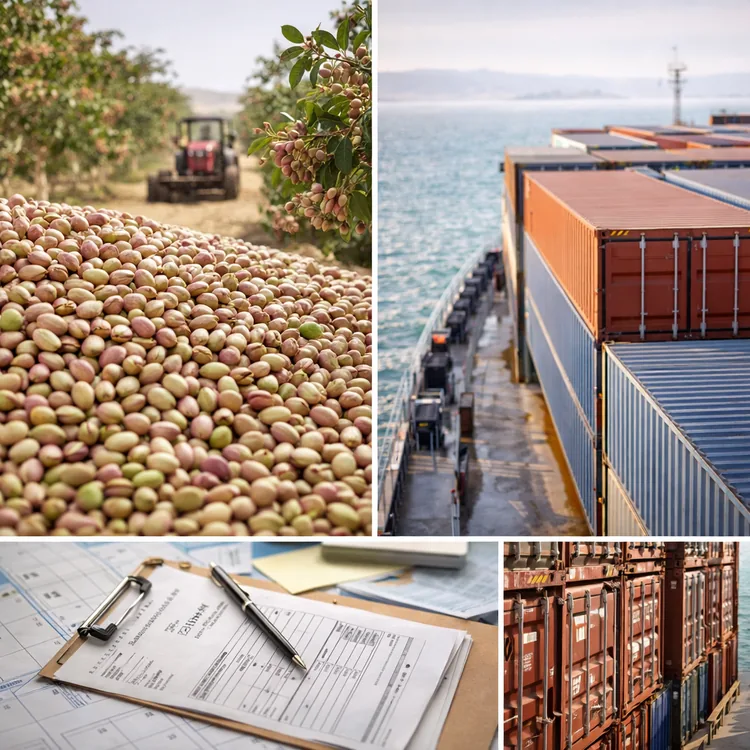
Introduction: why timing is a commercial issue, not just a logistics detail
In pistachio trade, timing influences much more than transport. It affects procurement decisions, customer commitments, production planning, packaging schedules and commercial credibility. A supplier may offer an attractive product and a competitive price, but if the lead time does not match the buyer’s market window, the offer may still fail commercially.
This is especially important in B2B trade, where pistachios often move through multiple stages before reaching the end customer. Importers need to align stock arrival with warehouse planning and sales cycles. Food manufacturers need materials to arrive before production runs. Distributors need consistent supply to support recurring customer orders. Private-label programs often depend on exact launch timing. In each of these cases, shipment planning starts long before the goods leave Turkey.
That is why buyers should not treat lead time as a last-minute operational question. It should be part of the sourcing conversation from the beginning.
Why harvest cycles matter in pistachio procurement
Pistachios are agricultural products, which means availability is shaped by seasonality at the raw material level. Buyers do not purchase from a continuously manufactured input stream. They purchase from a crop that moves through harvest, primary handling, processing, sorting, packing and export preparation.
Understanding the harvest cycle helps buyers interpret supplier answers more accurately. It explains why some products may be offered quickly at one point in the year, while other products require more lead time. It also helps buyers understand the difference between fresh crop availability, processed inventory readiness and shipment readiness.
Even when a product is technically “available,” it may still need to move through cleaning, grading, shelling, optical sorting, packing or documentation stages before it is actually ready to ship. That distinction matters in real purchasing situations.
What buyers often misunderstand about availability
One of the most common misunderstandings in pistachio sourcing is the assumption that availability means immediate shipment. In practice, there are several levels of availability:
- Harvest availability – raw material exists in the supply chain.
- Processing availability – product can be prepared into the requested format.
- Packed availability – goods are already packed or can be packed in the required presentation.
- Shipment availability – cargo space, export documents and dispatch timing are aligned.
A supplier may be able to confirm that kernels, diced material or in-shell product are available in principle, but the actual shipment lead time still depends on how those goods need to be processed and presented. Buyers who understand this distinction communicate more effectively and avoid unnecessary frustration.
Lead time starts before the factory floor
When buyers hear the term lead time, they often think only about the period between order confirmation and departure. In reality, commercial lead time begins much earlier. It includes the time required to confirm specifications, align product form, validate packing requirements and decide the shipment structure.
For example, a buyer requesting standard bulk kernels in familiar packaging may move more quickly than a buyer requesting a custom specification, private-label structure, split shipments, special carton requirements or multi-format loads. The more complex the commercial request becomes, the more important early coordination becomes.
This is why good pistachio procurement planning begins with a complete order brief rather than a simple question about price per kilogram.
Key stages that influence pistachio lead times
1. Specification alignment
Lead time risk often starts with unclear product definitions. If a buyer asks for “premium pistachio kernels” without defining color expectation, cut style, visual standard, packaging format or intended application, the supplier may still respond with a price, but the real delivery schedule remains uncertain. A clear brief reduces back-and-forth and shortens decision time.
2. Product preparation
Different pistachio formats require different handling steps. In-shell pistachios, kernels, diced formats, powder and paste are not interchangeable from a processing perspective. Some require additional shelling, grading, sorting or blending steps. Some may need more quality controls before packing.
3. Packing and presentation
Packaging can significantly affect timing. Bulk export packaging is usually simpler to schedule than custom retail presentation, special labeling or customer-specific carton structures. Buyers should confirm whether the requested packaging is standard or custom, and whether materials need to be prepared before loading.
4. Documentation and export readiness
Commercial invoices, packing lists, certificates and shipping documents are a routine part of export trade, but documentation still takes coordination. Different destinations and buyers may request different document sets, and these requirements should be aligned early rather than close to dispatch.
5. Freight booking and dispatch window
Shipment timing is not determined only by product readiness. Space booking, route selection, consolidation decisions and transport mode all affect when cargo can actually depart. Buyers who leave shipping decisions until the last moment usually lose flexibility.
Why product type changes the timeline
Not all pistachio products move at the same speed. A realistic lead-time discussion should always be linked to the actual product being purchased.
In-shell pistachios
In-shell products may appear straightforward, but they still require grading, presentation control and packing coordination. Premium snack programs may require more attention to appearance, shell openness and lot consistency than more standard commercial business.
Kernels
Kernel orders often need more precise sorting and grading than in-shell programs. Buyers frequently care about color, purity, visible cleanliness and application fit. This can increase the importance of pre-shipment alignment.
Diced kernels and cuts
Diced and cut products are especially application-driven. Cut size, piece consistency and packaging needs should be agreed before production planning. These products are often linked to bakery, confectionery and ingredient manufacturing, where timing is tied closely to production schedules.
Powder and paste
Powder and paste formats often support industrial use and may depend on more specific processing parameters, packing methods and end-use expectations. Buyers should avoid assuming that all secondary processed pistachio products are available on the same timeline as standard raw formats.
Fresh crop planning versus ongoing supply planning
Buyers often speak about harvest as if it were the only important timing factor. In reality, there are two separate planning questions:
- How to position around fresh crop supply.
- How to maintain reliable supply throughout the rest of the commercial cycle.
Fresh crop interest can be important for certain buyers because it relates to seasonality, planning confidence and commercial messaging. But many B2B buyers care just as much about ongoing supply continuity, especially if they support recurring contracts, private-label programs or continuous manufacturing runs.
The most useful planning approach is not simply to ask when the harvest happens. It is to ask how harvest timing translates into product readiness, order windows, packing schedules and shipment availability across the year.
How importers should think about shipment planning
Importers sit between origin and destination-market commitments. For them, shipment planning should balance three realities: supplier readiness, transit timing and internal stock strategy. A purchase that looks efficient at origin can become inefficient if it creates stock gaps, excessive buffer inventory or poorly timed arrivals.
Importers should think in terms of a full chain:
- When must the product be available for sale or production after arrival?
- How much time is needed for customs, receiving and local distribution?
- What safety buffer is required in case of timing variation?
- Will the order be a single bulk arrival or part of a staged replenishment plan?
These questions help turn a simple shipment discussion into a working inventory strategy.
How distributors should think about lead times
Distributors often carry the timing risk of multiple customer types at once. Some customers place repeat orders predictably, while others buy in shorter cycles or demand quick replenishment. This means distributors should not assess lead times only at order level. They should assess them at portfolio level.
For example, a distributor may need:
- Steady supply for standard items.
- More flexible planning for premium or seasonal items.
- Backup timing assumptions for high-demand periods.
- Clear communication with suppliers on split loads or replenishment frequency.
Strong shipment planning helps distributors protect service levels without holding unnecessary inventory.
How food manufacturers should think about lead times
Manufacturers tend to experience lead-time risk more directly than merchants because their production schedules can be disrupted by late ingredient arrivals. A pistachio delivery that slips even slightly may affect batch planning, labor scheduling, packaging allocation and customer commitments for finished goods.
That is why manufacturers should match order timing to production reality, not just market price. Key questions include:
- How many weeks of raw material cover are needed?
- Can the production line tolerate supply variation?
- Are there launch dates, promotional windows or contract deadlines tied to the order?
- Does the application require a specific grade that needs extra preparation time?
In many cases, the cheapest buying moment is not the most efficient operating choice if it increases the risk of material disruption.
Shipment planning is also about communication quality
Many avoidable delays do not come from harvest or freight constraints alone. They come from incomplete communication. A supplier cannot plan properly if the buyer has not defined product form, packaging expectations, delivery target and destination requirements clearly. Likewise, a buyer cannot plan properly if the supplier provides a general shipment promise without explaining what it actually depends on.
The strongest sourcing relationships are built on operational clarity. Instead of treating timing as a vague estimate, both sides should define the main planning stages and the assumptions behind them.
Questions buyers should ask about timing before confirming an order
Before placing an order, buyers should aim to understand not just the quoted lead time, but what sits behind it. Useful questions include:
- Is the product already prepared, or will it be produced against the order?
- How does the requested product format affect preparation time?
- Is the packaging standard or custom?
- What documents will be issued for the shipment?
- What booking or dispatch assumptions are built into the timing estimate?
- Are partial shipments possible if timing changes?
- What are the main variables that could extend the schedule?
These questions help buyers compare offers more intelligently and reduce surprises later.
Planning by commercial scenario
Scenario 1: routine replenishment business
In routine replenishment, the main goal is continuity. Buyers want dependable supply, predictable shipment rhythm and clear communication. In this scenario, the most important advantage is often not absolute speed, but repeatability.
Scenario 2: seasonal launch or promotional demand
For seasonal demand, timing becomes more sensitive. A late shipment may lose much of its value if it misses the promotional window. Buyers in this category should plan earlier and confirm every timeline dependency in advance.
Scenario 3: new product development or qualification
When a buyer is still qualifying a product, the timeline may need to include internal testing, sample review and commercial sign-off. The shipment plan should account for approval stages, not only physical preparation.
Scenario 4: private-label or custom packing
Custom projects usually need the most coordination. Artwork, packaging materials, carton structure, labeling and shipment composition all affect readiness. These orders benefit most from early planning and disciplined milestone tracking.
How harvest cycles affect pricing conversations
Even when the main topic is timing, buyers should remember that harvest timing also shapes commercial behavior. Supply availability, buying momentum and planning confidence often shift across the cycle. That does not mean buyers should speculate on timing alone, but it does mean timing should be part of the commercial discussion.
Buyers who understand harvest-linked planning are often better positioned to:
- Ask more realistic questions about availability.
- Avoid rushed purchases driven by poor preparation.
- Coordinate pricing conversations with actual delivery needs.
- Distinguish between immediate offers and program-based supply planning.
Why “urgent” orders are often planning failures
Urgency is sometimes unavoidable, but in pistachio trade it is often a symptom of poor planning rather than true market necessity. Last-minute purchasing typically creates pressure on product selection, shipment mode, cost control and documentation coordination.
Urgent orders may still be possible, but they reduce flexibility. Buyers may have fewer choices on grade, packaging or dispatch schedule. They may also be forced into commercial compromises that could have been avoided with earlier coordination.
The lesson is simple: the earlier the planning conversation begins, the more options remain open.
Building a better pistachio procurement calendar
For many B2B buyers, the best improvement is to move from order-by-order thinking to calendar-based thinking. Instead of reacting to stock pressure, buyers should map their pistachio needs across the year and link them to likely procurement and shipment windows.
A more structured procurement calendar usually includes:
- Expected product categories by quarter.
- Approximate replenishment points.
- Seasonal peaks in customer demand.
- Internal production or sales deadlines.
- Buffer periods for logistics variability.
- Decision points for custom versus standard packing.
This kind of planning does not require perfect forecasting. It simply creates a stronger framework for communication and reduces avoidable timing pressure.
What good shipment planning looks like in practice
Good shipment planning is not just about moving product quickly. It is about matching the shipment structure to the buyer’s actual needs. In practice, that often means the buyer and supplier have aligned on:
- The exact product format and commercial grade.
- The intended application and quality priorities.
- The packing format and load structure.
- The target shipment window rather than a vague urgency statement.
- The key documents and export requirements.
- A communication plan if timing changes.
When these points are clear, lead times become easier to manage because the order is defined operationally, not just commercially.
What buyers should include in an inquiry
To get more accurate timing answers, buyers should send more complete inquiries. A useful pistachio shipment inquiry typically includes:
- Product form: in-shell, kernel, diced, powder, paste or custom format.
- End use: snack, bakery, confectionery, gelato, filling, topping or industrial manufacturing.
- Packaging requirement: bulk, foodservice, retail or custom.
- Target quantity and repeat frequency.
- Preferred shipment window or required arrival period.
- Destination market and any known document requirements.
- Whether the order is standard replenishment, launch-related or urgent.
The better the inquiry, the better the supplier can estimate timing with commercial realism.
Risk planning: what can extend lead times
Lead times can change for many reasons, and strong buyers build that possibility into their planning. The goal is not to assume problems, but to avoid fragile schedules. Timing can be influenced by:
- Late specification changes.
- Custom packaging or labeling adjustments.
- Changes in load composition.
- Split-shipment requests.
- Documentation alignment delays.
- Freight booking limitations.
- Compressed customer deadlines at destination.
Most of these risks can be reduced through earlier coordination, clearer briefs and better internal planning.
Why timing discipline supports better supplier relationships
Timing discipline benefits both sides of the trade relationship. Suppliers can allocate production and packing more efficiently when buyers communicate earlier and more clearly. Buyers gain more reliable delivery planning and more credible commitments to their own customers.
Over time, this improves more than logistics. It improves trust. A supplier is more useful when it can speak honestly about timing constraints, and a buyer is easier to support when it plans with realistic lead-time expectations rather than relying on last-minute pressure.
How Atlas uses this knowledge
Atlas uses academy content to turn broad sourcing topics into practical commercial guidance. With pistachios, discussions about quality and price are important, but timing often determines whether a program runs smoothly in the real world. That is why shipment planning, harvest awareness and lead-time discipline belong in the same conversation as grade, application and packaging.
By helping buyers think more clearly about when they need product, how it should be prepared and how the shipment should be structured, Atlas supports more accurate sourcing discussions and better-prepared B2B communication.
Key takeaway
Lead times, harvest cycles and shipment planning are not background details in Turkish pistachio trade. They are core parts of a successful buying strategy. Buyers who understand the difference between crop availability, product readiness and shipment readiness are better equipped to source with confidence, protect their internal timelines and avoid unnecessary urgency.
The most effective pistachio purchasing decisions come from combining commercial clarity with timing discipline. When buyers define their needs early, match shipment plans to real inventory or production requirements, and communicate with suppliers in a structured way, they create stronger outcomes across the entire supply chain.
Frequently asked questions
Why do lead times matter so much in pistachio sourcing?
Because lead times affect when goods can be processed, packed, shipped, received and used. In B2B trade, timing problems can disrupt production, retail launches, replenishment cycles and customer commitments.
Does harvest timing influence commercial availability?
Yes. Harvest timing helps determine when new crop material enters the processing and export pipeline. But commercial availability also depends on sorting, packing, documentation and freight coordination.
Are all pistachio products available on the same timeline?
No. In-shell pistachios, kernels, diced material, powder and paste can require different preparation and packing steps. Custom requests often need more planning than standard bulk business.
What should buyers ask before confirming an order?
Buyers should confirm the product format, packaging structure, shipment window, export documentation assumptions, loading plan and the main factors that influence the quoted lead time.
Why is early planning better than urgent purchasing?
Early planning usually gives buyers more flexibility on specification, packing, shipment timing and commercial coordination. Urgent orders can still be possible, but they often reduce options and increase pressure.
Can Atlas help with sourcing?
Yes. Atlas helps buyers connect product form, application, timing expectations and supply planning more clearly in Turkish pistachio sourcing conversations.
Related pages: Products, Applications, Quality Commitment, Contact Atlas