Introduction: why processing technology matters more than many buyers expect
When buyers first compare pistachio suppliers, the conversation usually starts with origin, grade, price and packaging. Those variables are important, but they do not fully explain why two shipments that look similar on paper can perform very differently in the market or in production. The missing link is often processing capability.
In-shell snack pistachios, premium kernels, diced kernels, powder and paste all depend on process control. A strong processing line improves visual cleanliness, supports better grading consistency, reduces the presence of shells and foreign material, lowers visible defect rates and helps create a more repeatable product. A weak line can lead to wider variation from lot to lot, more sorting effort at the customer side, increased complaints and avoidable waste in downstream manufacturing.
Optical sorting is one of the most visible signs of a more advanced processing system, but it should be understood as part of a complete line rather than a single magic solution. The best outcomes come from the combination of raw material management, cleaning, drying, sizing, shell removal where relevant, optical inspection, packaging discipline and documented quality control.
Why this topic is especially relevant for Turkish Antep pistachios
Turkish Antep pistachios occupy an important position in premium confectionery, pastry, ice cream and ingredient applications. Buyers often value them for their flavor intensity, aromatic profile and suitability for high-value formulations. At the same time, premium applications are less tolerant of visual inconsistency and foreign matter. A kernel intended for luxury chocolate filling, artisanal gelato, pistachio cream, baklava production or premium topping use must meet tighter expectations than a standard bulk snack ingredient.
That is why processing quality becomes central to commercial performance. Even excellent agricultural raw material can lose value if sorting is inconsistent. Conversely, a processor with a disciplined modern line can present Turkish pistachios more effectively for demanding B2B channels by improving lot cleanliness, kernel appearance and specification repeatability.
What buyers really want from a modern pistachio processing line
From a buyer’s point of view, a modern processing line is not just about having impressive machinery. It is about outcomes. The most important outcomes typically include:
- More consistent visual appearance from shipment to shipment.
- Lower levels of shell pieces, foreign material and visibly defective product.
- Better separation of premium product from lower-value fractions.
- Stronger alignment between customer specifications and packed goods.
- More reliable performance in industrial applications such as cutting, grinding, paste production and topping use.
- Better documentation, traceability and process discipline.
For snack products, this may translate into cleaner presentation, more uniform shell appearance and improved shelf appeal. For ingredient buyers, it more often translates into tighter kernel color control, cleaner cuts, fewer shell fragments, better grind behavior and lower rejection rates on incoming inspection.
A practical overview of a modern pistachio processing line
Although exact line design differs by processor, product type and market focus, a modern pistachio processing line commonly includes several linked stages. Understanding these stages helps buyers ask better questions and interpret offers more accurately.
1. Raw material intake and lot segregation
The first control point is not the optical sorter. It is raw material intake. Good processors separate incoming product by harvest condition, variety characteristics, moisture condition, field lot or supplier lot where relevant, and target product category. This matters because the more mixed the incoming product is, the harder it becomes to produce uniform finished goods later.
At intake, a processor may review factors such as visible cleanliness, damage levels, moisture condition, general defect load and suitability for a given finished grade. Better segregation at the beginning allows more efficient processing and more accurate product routing later.
2. Pre-cleaning and foreign material removal
Pre-cleaning usually removes dust, leaves, stems, stones, loose debris and other unwanted materials before the product enters more precise handling stages. Depending on the plant design, this may involve screens, aspiration, air separation, destoning and magnetic or metal-detection steps. While these operations may sound basic, they are essential because upstream cleaning reduces the burden on later sorting stages and supports better machine accuracy.
A line that skips or underperforms in this stage may still claim to use optical sorting, but the final result often suffers because excessive debris or unstable feed conditions make precision separation more difficult.
3. Drying and moisture stabilization
Moisture control is a critical part of pistachio handling. Overly wet product may create food safety and storage risks, while uneven moisture can influence shell behavior, kernel texture, breakage levels and overall processing stability. Modern lines typically aim for controlled drying and stabilization so product enters sorting and packaging in a more predictable condition.
For buyers, this matters because moisture management influences shelf life, texture and how the product behaves during roasting, chopping, grinding or paste production. A product that looks acceptable visually may still process poorly if moisture is not well managed.
4. Size grading and physical separation
Before fine sorting, pistachios are often graded by size. This is commercially important because size affects appearance, packing profile, roasting performance, kernel yield expectations and downstream application suitability. More uniform size ranges generally process more predictably and look more professional in retail or industrial use.
For in-shell products, the line may also separate closed shell, open shell and off-spec fractions. For kernel programs, shelling and kernel recovery steps become important, followed by additional cleaning and grading to separate whole kernels, broken kernels, cuts and smaller fractions.
5. Shelling and kernel preparation
In kernel-focused operations, shell removal must be controlled carefully to avoid excess breakage and shell fragment carryover. Processors then route material into categories such as whole kernels, split kernels, diced kernels, granules, powder feedstock or paste feedstock. At each step, the target customer specification should guide how material is handled.
A processor serving premium confectionery customers will usually pay closer attention to appearance, kernel integrity and color uniformity than one focused only on lower-value commodity channels.
6. Optical sorting and visual defect rejection
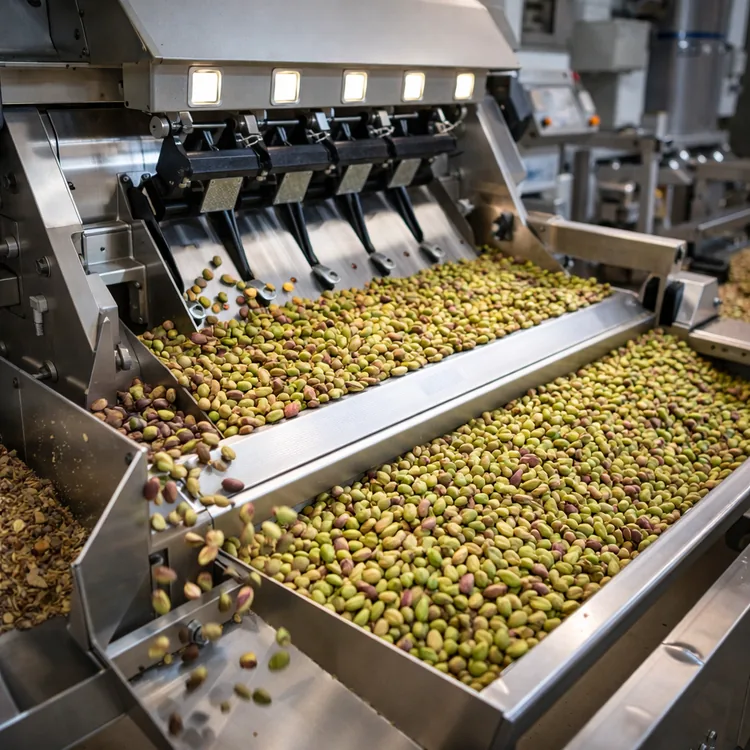
This is the stage that attracts the most buyer interest. Optical sorters use cameras, specialized lighting and software to evaluate product at high speed. Individual nuts or kernels move through the machine, are photographed or scanned, and are classified according to defined visual parameters. Air jets or mechanical rejection systems then remove pieces identified as defective or off-spec.
The exact setup varies depending on whether the product is in-shell, shelled kernel, diced kernel or another fraction. Premium kernel lines often rely heavily on optical sorting because small visual differences matter commercially.
7. Final inspection, metal detection, packing and traceability
After primary sorting, the product may pass through final inspection, metal detection and packaging stages. Packaging conditions should protect product integrity, support transport requirements and preserve traceability. In better-run facilities, each packed lot is linked back to internal process records, production date, raw material lot and inspection results.
For serious B2B buyers, traceability is not just a compliance phrase. It supports complaint handling, internal release procedures and confidence in the supplier relationship.
What optical sorting actually does
Optical sorting is often described broadly, but buyers benefit from a more practical explanation. In simple terms, optical sorting allows a processor to separate product based on what the machine sees. Instead of relying only on human pickers or basic mechanical grading, the system evaluates color, contrast, shape and visible surface differences at high speed.
Depending on the product and machine configuration, optical sorting may help identify:
- Discolored kernels.
- Dark or stained shell surfaces.
- Shell fragments in kernel lots.
- Visibly shriveled or damaged pieces.
- Foreign material with different visual characteristics.
- Pieces outside the intended visual standard for a premium grade.
In higher-value programs, this can make a major difference. A buyer producing pistachio cream, premium pastries, fillings or decorative toppings may care greatly about the proportion of bright, clean, attractive kernels because appearance affects perceived quality in the finished food.
Why optical sorting matters commercially
For many processors, the most important value of optical sorting is not only defect reduction. It is value optimization. By separating more attractive product from lower-value fractions, a processor can create better-defined grades and match them more accurately to different customer segments.
That can support a more rational product portfolio such as:
- Premium whole kernels for visible inclusion and decoration.
- Good commercial kernels for confectionery and bakery use.
- Selected cuts for fillings, toppings or industrial blending.
- Lower visual grades still suitable for grinding, paste or internal industrial use depending on customer requirements.
For buyers, the commercial benefit is clearer product matching. Instead of overpaying for a premium grade that is not required, or receiving a grade that is too variable for the intended application, the buyer can source closer to actual need.
Why optical sorting matters technically
From a technical standpoint, optical sorting helps narrow visual variation. That matters because visual variation usually correlates with other practical issues such as breakage, uneven presentation, inconsistent topping appearance and harder incoming quality inspection at the customer side.
In ingredient manufacturing, every unnecessary shell fragment, discolored piece or visibly defective kernel can create extra handling, slower line speed, more in-house sorting or more waste. Cleaner incoming material can improve operational efficiency even if the per-kilogram purchase price is slightly higher.
This is especially relevant in applications where pistachio is a visible hero ingredient. When consumers can see the pistachio, the tolerance for inconsistency usually drops sharply.
Defects and quality issues a modern line tries to reduce
No processing line can change the agricultural nature of the raw crop, but a strong line can remove or reduce the impact of many visible and mechanical quality issues. In practice, processors often work to manage the following:
Visual defects
- Discoloration or uneven color.
- Surface staining.
- Darkened kernels that weaken the visual profile of a premium lot.
- Mixed appearance that prevents a clean premium presentation.
Physical contamination concerns
- Shell fragments in shelled kernel products.
- Small foreign particles.
- Plant debris or field residue not removed adequately upstream.
- Metal risk managed by later detection steps.
Product condition concerns
- Excess breakage.
- Shriveled or poorly formed pieces.
- Mixed fractions that do not fit the intended specification.
- Too much deviation from agreed visual standard.
Buyers should note that the best results come when defect management starts before optical sorting. Machines work best when the incoming stream is already relatively controlled through good intake selection, cleaning and product routing.
Where optical sorting is most valuable in pistachio products
In-shell pistachios
For snack markets, optical sorting helps improve shelf presentation by reducing visibly unattractive shells, stain-heavy pieces and some obvious off-spec material. This is valuable for branded snack packs and retail programs where first visual impression strongly affects purchase behavior.
Whole kernels
This is often where optical sorting becomes especially important. Whole kernels used in visible applications must meet tighter expectations for color, cleanliness and consistency. Premium confectionery brands and pastry manufacturers may place substantial weight on these criteria.
Diced kernels and granules
Even though the product is cut, visual consistency still matters. Decorative topping mixes, bakery applications and premium filling systems benefit from a cleaner and more controlled cut profile with fewer shell fragments and fewer visibly dark pieces.
Powder and paste feedstock
Some buyers assume that once pistachios are ground, visual quality no longer matters. In reality, raw material quality still affects paste tone, powder appearance and general product consistency. Optical sorting can help protect the visual and sensory profile of the input stream, especially for higher-end formulations.
Limits of optical sorting: what buyers should understand clearly
Optical sorting is important, but it has limits. A sophisticated machine is not a substitute for total quality management. Buyers should be cautious of suppliers who present optical sorting as the only proof of processing excellence.
Some critical points to keep in mind:
- Optical sorting mainly addresses what can be seen and classified visually.
- It does not replace good agricultural sourcing, careful drying or disciplined sanitation.
- It does not replace a structured food safety plan.
- It does not eliminate the need for laboratory controls and documented release criteria.
- It works best when the rest of the processing line is well designed and well managed.
In other words, a modern processor is not defined by one machine, but by the consistency of the whole system.
Optical sorting and food safety: important but not the whole answer
In food ingredients, food safety assurance must always go beyond appearance. A professional pistachio processor should combine optical sorting with broader controls such as documented cleaning procedures, lot traceability, moisture management, separation of product streams where appropriate, metal detection and laboratory testing protocols relevant to the product and market.
For buyers, the key message is simple: ask how the supplier’s process is structured overall. A polished machine list is less useful than clear evidence of disciplined operating practice.
Optical sorting can help reduce visible defects and improve line cleanliness outcomes, but it should be presented as one control measure within a larger quality assurance system.
How modern processing supports premium Turkish pistachio positioning
Turkish pistachios compete not only on origin but on how well they are presented to the market. For higher-value international buyers, premium positioning depends on repeatability. A buyer may accept natural crop variation, but still expect the supplier to minimize unnecessary inconsistency through sound processing.
Modern processing supports premium positioning in several ways:
- Better visual presentation of finished lots.
- Cleaner separation between premium grades and standard commercial grades.
- More credible communication around product categories and suitability.
- Stronger alignment between buyer specifications and delivered goods.
- Improved confidence in the supplier’s operational discipline.
This matters because international B2B buyers are not just purchasing pistachios. They are purchasing reliability, market fit and lower downstream friction.
What importers and distributors should evaluate
Importers and distributors often need product that will satisfy multiple downstream customers. For that reason, they should look beyond simple price comparison and evaluate whether the supplier can maintain stable commercial quality over time.
Useful evaluation questions include:
- How is raw material segregated before processing?
- What cleaning, grading and visual sorting stages are used?
- How does the processor define premium versus standard grades?
- How is shell fragment risk reduced in kernel products?
- How are lots documented and traced?
- How are customer claims investigated if a shipment issue arises?
- Can the supplier describe which product grade fits which application?
A supplier who can answer these questions clearly is often easier to work with than a supplier who focuses only on headline price and broad product claims.
What food manufacturers should evaluate
Food manufacturers usually need more than attractive product. They need process compatibility. The right pistachio grade for a retail snack pack may be the wrong grade for industrial paste, and the right grade for paste may be unsuitable for visible decoration. Manufacturers should therefore assess the supplier against application-specific performance criteria.
For example:
- Bakery and pastry users may prioritize visual cleanliness, cut consistency and shell-fragment control.
- Confectionery producers may focus on color, flavor protection and premium appearance.
- Ice cream manufacturers may care about particle behavior, color tone and stable sensory profile.
- Paste and cream producers may evaluate input cleanliness, color influence and consistency under grinding.
The stronger the processor’s understanding of end use, the more precisely they can guide the buyer toward the right product form and sorting level.
Application-specific view: not every buyer needs the same sorting standard
One of the most common sourcing mistakes is paying for a grade that is misaligned with the final application. Optical sorting adds value, but the commercial value depends on use case.
When premium visual sorting is often worth it
- Visible topping applications.
- Premium whole kernel inclusion.
- Luxury confectionery.
- High-end pastry and dessert finishing.
- Retail products where pistachio appearance influences consumer perception directly.
When a balanced commercial grade may be enough
- Blended fillings.
- Industrial bakery use with lower visual exposure.
- Some grinding or paste applications, depending on the target profile.
- Products where taste and functionality matter more than visible piece presentation.
The right question is not “Does the supplier have optical sorting?” The better question is “How does the supplier use sorting capability to build the most suitable grade for our application?”
The economics of better sorting
Some buyers hesitate when better-processed product carries a higher price. That concern is understandable, but the calculation should include total landed and operating value, not only invoice price. Better sorting can reduce hidden costs such as:
- Extra receiving inspection time.
- In-house re-sorting labor.
- Production interruptions caused by shell fragments or inconsistent feedstock.
- Higher waste or trim loss.
- Customer complaints related to appearance or contamination.
- Brand damage in premium retail or foodservice channels.
For many buyers, especially in premium segments, a cleaner and more consistent product can produce better commercial results even when the nominal unit price is higher.
How to read supplier claims more intelligently
In B2B sourcing, broad claims such as “advanced technology,” “premium quality” or “modern factory” are common. Buyers should translate those claims into practical questions. Instead of asking only whether a processor has optical sorting, consider asking:
- What product categories are optically sorted?
- At what stage of the line does sorting occur?
- How are premium lots separated from standard lots?
- What visible defects is the system intended to reduce?
- How does the processor manage shell fragment risk in kernels and cuts?
- What final inspection or detection stages follow optical sorting?
- How does the supplier verify consistency between lots?
These questions help move the conversation from marketing language to operational reality.
Buyer checklist for evaluating a modern pistachio processor
When reviewing a Turkish pistachio supplier for export business, the following checklist can be useful:
- Clear understanding of the final application.
- Well-defined product grades, not vague general categories.
- Evidence of structured cleaning and sorting stages.
- Modern optical sorting capability where relevant to the product type.
- Attention to shell-fragment reduction in shelled products.
- Lot traceability and release discipline.
- Ability to explain quality differences commercially and technically.
- Packaging options aligned with export handling and customer needs.
- Realistic positioning of premium versus standard grades.
- Good communication around repeatability, not just first-sample presentation.
Questions buyers should send before requesting a quote
To speed up sourcing discussions and receive more accurate offers, buyers should provide context up front. Useful request details include:
- Product form: in-shell, whole kernel, split kernel, diced, powder, paste or custom format.
- End use: snack, confectionery, bakery, gelato, filling, topping or ingredient manufacturing.
- Color expectation: premium visual grade, standard commercial grade or process-oriented grade.
- Preferred size or cut profile.
- Packaging format and unit weight.
- Destination market and any import documentation requirements.
- Expected order volume and order frequency.
- Any critical quality concerns such as shell fragments, visible defects or consistency of appearance.
The clearer the buyer brief, the easier it becomes for the supplier to recommend the appropriate processing and sorting level.
How Atlas uses this knowledge in supplier and buyer conversations
At Atlas, the purpose of academy content is practical. We believe buyers make better decisions when technical processing information is translated into clear commercial language. Many sourcing conversations fail because one side speaks in generic sales terms while the other side is trying to solve a specific production or market problem.
By understanding how optical sorting and modern processing lines work, buyers can ask more focused questions, compare offers more fairly and avoid mismatched purchases. That is especially valuable in Turkish pistachio sourcing, where application fit, visual standard, grade definition and repeatability often matter as much as the origin story itself.
Common misconceptions about optical sorting
“If the processor has an optical sorter, all quality risks are solved.”
Not true. Optical sorting is valuable, but it is only one part of an integrated process.
“Optical sorting only matters for snack products.”
Not true. It can be just as important for kernels, cuts and raw material intended for premium ingredient production.
“Industrial users do not need visually sorted pistachios.”
Not always true. Some industrial applications still need controlled color, lower visible defect levels and good purity to achieve the target finished result.
“The lowest price for the same grade description is the best buy.”
Grade descriptions are not always defined equally across suppliers. The actual sorting and processing standard behind the label may differ significantly.
Final takeaway
Optical sorting and modern pistachio processing lines matter because they directly affect how Turkish pistachios perform in real business use. For premium snack programs, they support cleaner presentation. For ingredient buyers, they support better purity, more consistent appearance and lower downstream friction. For importers and distributors, they improve confidence that a given grade can be sold and repeated successfully.
The most important point is this: buyers should not evaluate pistachios only as an agricultural commodity. They should evaluate them as a processed food ingredient shaped by the quality of the processing line behind them. When suppliers manage intake, cleaning, drying, grading, optical sorting, inspection and packaging in a disciplined way, the result is not just a cleaner product. It is a more reliable commercial offer.
If your business depends on Turkish pistachios for retail, industrial or private-label channels, understanding processing technology is one of the most practical ways to buy with greater confidence.
Frequently asked questions
Who is this article for?
This article is written for importers, distributors, private-label buyers, brand owners and food manufacturers evaluating Turkish pistachio supply for commercial or industrial use.
Does every pistachio product need the same sorting intensity?
No. The right level of sorting depends on the final application, customer expectation and price-positioning strategy. Visible premium uses usually require stricter visual control than lower-visibility industrial uses.
Does optical sorting improve taste?
Optical sorting mainly improves visual and physical consistency, but by helping create cleaner, better-defined lots, it can indirectly support a stronger overall product presentation and more predictable use in finished applications.
Can optical sorting replace human quality control?
No. It improves speed and precision in visual sorting, but it should work alongside documented quality procedures, trained personnel, final inspection and broader food safety controls.
Why is this especially important for kernels and ingredient formats?
Because shell fragments, visual inconsistency and defect visibility become more commercially sensitive once the pistachio is sold as a prepared ingredient rather than as raw in-shell product.
Can Atlas help buyers evaluate Turkish pistachio offers?
Yes. Atlas supports buyers with practical guidance on product form, application fit, quality expectations and supplier communication so sourcing decisions are more informed and more efficient.
Related pages: Products, Quality Commitment, Applications, Contact Atlas