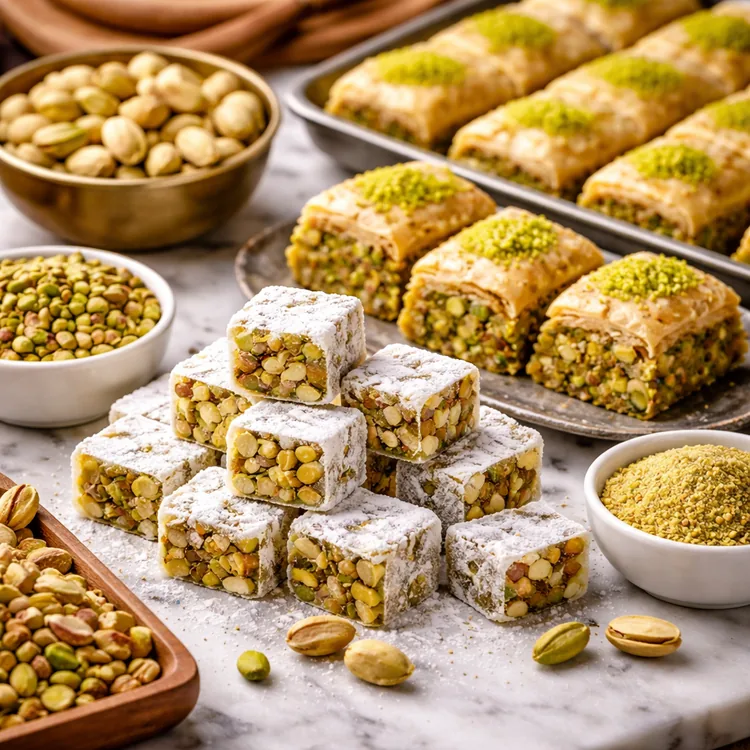
Introduction: why pistachios matter so much in Turkish delight
In Turkish delight production, pistachios do more than add nut content. They help define the product category itself. A pistachio lokum is often judged first by how generous the nut inclusion looks, how attractive the pistachio color appears through the cut surface and how convincingly the product signals quality to the buyer or consumer. This means pistachios function as both a flavor ingredient and a visible marker of commercial value.
That role is especially important in premium and gifting-oriented Turkish delight, where the pistachio content can influence shelf appeal, box presentation, export suitability and final price perception. In some products, the pistachio is the main reason the consumer sees the item as premium at all. For that reason, lokum producers and buyers should evaluate pistachio format with far more care than a generic nut ingredient purchase would usually require.
For B2B buyers, the real question is not simply whether pistachios are included, but how they are included, what visual and sensory role they play and whether the selected format matches the product’s market position.
What makes Turkish delight a distinct pistachio application
Turkish delight differs from many other confectionery products because the pistachio often remains clearly visible in the finished product. Unlike a fully blended filling or a hidden ingredient system, lokum frequently showcases the nut. This means kernel size, cut style, color and distribution directly affect product appearance. The consumer sees the pistachio immediately, and that visual experience shapes their quality expectation before tasting begins.
This visible role changes sourcing logic. A pistachio format that works well in a bakery filling or a chocolate interior may not create the same commercial value in Turkish delight. In lokum, the pistachio must support both texture and presentation. It may need to appear abundant, evenly distributed, premium in tone and appropriate to the product’s box style or gifting position.
That is why Turkish delight producers benefit from thinking about pistachios in application-specific terms rather than generic nut category terms.
Why product positioning comes first
Before choosing pistachio format, buyers should define what kind of Turkish delight they are actually producing. Is the product a mainstream boxed confection, a premium gifting item, an artisanal specialty line, a traditional export product or a private-label supermarket range? The answer influences how pistachios should be selected.
A premium lokum line may require stronger visual pistachio presence, cleaner-looking kernels, more deliberate cut style and tighter inclusion consistency. A broader commercial line may prioritize a different balance between appearance and cost control. Neither approach is automatically better. The important point is that the pistachio format should match the actual market role of the finished product.
When product positioning is defined clearly, sourcing conversations become more practical. The buyer can compare pistachio offers in relation to the real commercial goal instead of treating every format as interchangeable.
Common pistachio formats used in Turkish delight
Turkish delight producers may use several pistachio formats depending on the intended appearance, bite and market position of the product. The most common include:
- Whole kernels for stronger visible premium identity and generous nut presentation.
- Split kernels for visible structure with somewhat more controlled distribution.
- Chopped pistachios for balanced inclusion, more frequent nut distribution and broader commercial flexibility.
- Granules or smaller cuts for fine-textured inclusion or certain decorative and filling-adjacent uses.
- Selected decorative cuts where a more refined premium visual effect is desired.
Each format creates a different finished product effect. The best choice depends on how prominent the pistachio should be, how the product will be cut and presented and what type of price position the final lokum must support.
Whole kernels in premium Turkish delight
Whole kernels are often associated with more premium Turkish delight because they create a strong visual message of generosity and ingredient richness. When consumers see clearly recognizable pistachio kernels inside the lokum, they tend to interpret the product as more valuable and more indulgent. This makes whole kernels especially relevant in gift boxes, premium assortments and higher-end retail formats.
However, whole-kernel use should be chosen deliberately. It is most effective when the finished product is positioned to benefit from that stronger nut identity. In premium ranges, whole kernels can help justify higher pricing and stronger gifting appeal. In other ranges, a more controlled cut may create better commercial efficiency without weakening the product concept too much.
Split kernels and controlled visibility
Split kernels can offer a useful middle ground between full-kernel premium appearance and the more distributed look of chopped formats. They still allow the pistachio to remain recognizable, but they may fit more easily into certain product styles where the producer wants visible nut character without the exact look of full kernels.
This can be especially useful in products where the pistachio should still feel abundant and premium, but the manufacturer wants a more balanced structure in the cut face of the lokum. Split kernels can also help the buyer manage product appearance more consistently across repeated production runs when a fully whole-kernel look is not essential.
Chopped pistachios in Turkish delight production
Chopped pistachios are one of the most versatile formats in Turkish delight because they create more frequent inclusion across the piece and can help deliver a more even product experience. Instead of one or two large nut visuals, chopped pistachios can distribute the nut identity more broadly through the confection. This can make the product feel well-filled and commercially satisfying, especially in widely distributed or mid-to-premium boxed ranges.
Chopped formats can also support more consistent portioning and broader visual coverage. That does not automatically make them less premium. In some lokum concepts, evenly distributed chopped pistachio can look more refined and better controlled than inconsistent whole-kernel placement. The correct choice depends on the finished product style and brand promise.
Granules and smaller cuts
Smaller cuts and granules may be used when the goal is a finer pistachio presence rather than a large visible kernel statement. These formats can be relevant in products that aim for smoother bite integration, more widespread distribution or specific textural goals. They may also appear in layered confectionery concepts related to Turkish delight or in products that blend lokum tradition with more modern confectionery presentation.
From a commercial perspective, smaller cuts should still be chosen according to end use. If the market expects a visibly rich pistachio lokum, overly fine cuts may weaken premium perception. If the product is designed for broader distribution or a different consumer expectation, smaller cuts may be more commercially efficient.
Why kernel color matters in Turkish delight
Color is especially important in Turkish delight because the pistachio often remains exposed in the finished product and becomes part of the visual design. A clearer, more attractive pistachio tone can make the confection feel fresher, more premium and more giftable. This matters at retail and in export because the product is often sold partly through visual appeal.
In products cut into cubes or bars, the visible pistachio pattern and tone help define the product’s character. Buyers evaluating samples usually notice this immediately. That is why color often becomes part of the commercial discussion even before detailed pricing begins. It is not just an aesthetic issue. It directly supports how the product is perceived in the box, on the shelf and in gifting environments.
Texture and bite in lokum applications
Pistachios also shape texture. In Turkish delight, the contrast between the soft confection base and the nut bite is part of the product’s appeal. Whole kernels create a stronger and more pronounced nut experience. Chopped formats create a more distributed texture. Smaller cuts create a finer and often more controlled mouthfeel. These differences affect how the product is experienced and which consumer segment it may suit best.
Manufacturers should therefore think about pistachio format not only visually, but texturally. A premium artisan-style lokum may benefit from a bolder nut presence. A more broadly accessible boxed product may benefit from a smoother and more evenly distributed texture. Again, the right answer depends on the commercial goal.
Distribution of pistachios inside the confection
One of the most important technical-commercial questions in Turkish delight production is how evenly the pistachios are distributed throughout the piece. A product that looks generous in one cut piece and empty in another can create inconsistency in both appearance and consumer experience. That is why buyers and producers often think carefully about not only which pistachio format is used, but how that format supports repeatable visual distribution.
Formats that distribute more evenly may sometimes create better commercial performance than formats that look more impressive in only a few pieces. Especially in boxed export products, consistency of cut-face appearance can influence buyer confidence and retail acceptability.
Surface presentation and dusting compatibility
Turkish delight is often finished with starch, powdered sugar or other outer treatments depending on style and market. Pistachio format must still work visually within that system. The nut should remain identifiable and attractive even when the product is coated or boxed. In premium products, buyers often look at how the pistachio reads through the final finishing style and whether it still supports the desired premium identity.
This is another reason why sample evaluation should happen in realistic finished format rather than through loose ingredient viewing alone. The final effect matters more than the isolated raw pistachio appearance.
Traditional style versus modern commercial adaptation
Not all Turkish delight products aim for the same style. Some emphasize traditional premium presentation and visible whole-kernel generosity. Others adapt the format for modern retail, export practicality or broader commercial pricing. Pistachio selection should reflect which direction the product is taking.
Traditional-style products may lean more heavily on strong visual nut identity, premium cuts and a richer gifting message. Modern commercial adaptations may focus more on consistency, box economics, scalable production and broader consumer access. Both can be valid and profitable. The key is not to mix the sensory and visual expectations of one model with the cost structure of another.
Premium gifting and export appeal
Pistachio lokum is often sold not just as confectionery, but as a giftable or culturally premium product. In these channels, appearance matters heavily. The pistachio helps create perceived richness, authenticity and premium value. Buyers in gifting and export segments therefore tend to pay closer attention to visible nut quality, cut-face attractiveness, color and consistency across the box.
For these applications, the pistachio format often does part of the branding work. It helps the product feel more luxurious before the consumer even tastes it. This is why sourcing decisions for premium export lokum usually deserve more format precision than generic confectionery purchasing.
Private-label Turkish delight programs
Private-label lokum projects require especially careful pistachio selection because the product represents the buyer’s brand directly. In these cases, consistency becomes as important as first-sample attractiveness. The buyer needs confidence that visual nut distribution, cut style and overall product look can be repeated across future orders.
Private-label teams should therefore define the pistachio role clearly from the beginning. Is the product intended as an affordable premium gift box, a gourmet specialty food item or a mainstream confectionery line with pistachio identity? That choice affects what pistachio format makes commercial sense and how it should be specified.
Packaging and format strategy
Packaging matters because Turkish delight is often sold in presentation-oriented formats. The pistachio must support the pack story. A visible premium nut inclusion may work especially well in windowed packs, gift cartons and curated assortments. More distributed chopped pistachio formats may support broader pack styles where consistency across pieces matters more than dramatic individual visual statements.
This means packaging and pistachio format should be discussed together. A product with strong nut visuals may benefit from packaging that showcases the cut pieces more clearly. A more commercially broad format may depend more on overall box design and less on dramatic individual piece display.
How buyers should compare pistachio offers for lokum production
Buyers should compare offers through the logic of the finished Turkish delight product rather than through ingredient price alone. A more useful comparison framework includes:
- the intended product position,
- whether the pistachio should appear whole, chopped or more finely distributed,
- the importance of color and visible premium appeal,
- texture role in the finished confection,
- consistency of distribution and cut-face appearance,
- packaging and gifting logic, and
- repeatability across future production runs.
Once those factors are clear, price becomes easier to understand because the offers being compared are serving the same commercial purpose.
Sample review should happen in finished product form
For Turkish delight, ingredient samples alone are not enough. Buyers should ideally review the pistachio within an actual or realistic finished lokum application. The way the pistachio appears once distributed through the confection, cut and dusted can differ significantly from how it looks as a loose raw sample. Commercial decisions become more reliable when samples are reviewed in their true product context.
This is especially important in export, gifting and private-label projects where finished appearance often influences buyer approval as much as taste or technical suitability.
Common buying mistakes in this category
Several repeat mistakes reduce sourcing efficiency in Turkish delight projects:
- choosing pistachio format before defining the product’s market position,
- comparing whole-kernel and chopped offers only by price,
- ignoring the importance of cut-face appearance,
- underestimating the role of color in gifting and export formats,
- treating all Turkish delight products as if they need the same pistachio logic,
- approving raw ingredient samples without testing finished product appearance, and
- overlooking repeatability for private-label and recurring export orders.
Most of these problems come from incomplete product definition rather than poor ingredient potential.
Questions buyers should answer before requesting quotations
Before asking for a commercial offer, buyers should ideally answer the following:
- Is the Turkish delight product mainstream, premium, gourmet or gifting-oriented?
- Should the pistachio be visibly bold or more evenly distributed?
- Is whole kernel appearance important to the product concept?
- How important are color and visual premium cues?
- What type of bite should the final lokum create?
- Will the product be private label or sold under an existing brand?
- How visible will the pieces be inside the final pack?
- What degree of consistency is required from one order to the next?
- How will the product be presented in gifting or export packaging?
- What information will help the supplier recommend the best pistachio format?
Suggested buyer brief for Turkish delight production
A strong supplier brief often includes:
- destination market and sales channel,
- whether the product is mainstream, premium, artisanal or gift-oriented,
- the preferred pistachio format such as whole kernels, splits or chopped cuts,
- whether visible premium appearance is a high priority,
- packaging style and presentation logic,
- estimated volume or production rhythm,
- private-label requirements if relevant, and
- any expectations around visual consistency and repeat supply.
Clearer briefs lead to more relevant offers and better sample comparison.
Commercial summary table
| Application Area | Why It Matters | What Buyers Should Check |
|---|---|---|
| Whole Kernels | Create strong premium and generous nut identity | Use when gifting appeal and visible luxury matter strongly |
| Split Kernels | Balance recognizability with more controlled distribution | Choose when visible nut character is important but full-kernel styling is not essential |
| Chopped Pistachios | Support more even distribution and broader visual coverage | Use when consistent inclusion and balanced nut presence matter |
| Color | Shapes premium appearance and gifting value | Review how the pistachio tone looks in the finished cut-face of the lokum |
| Texture | Determines the balance between soft confection and nut bite | Match pistachio size and format to the intended eating experience |
| Packaging Fit | Pistachio appearance should support the pack story | Consider how the nut inclusion will look in export boxes, window packs or gift assortments |
| Repeatability | Critical for private label and recurring export programs | Ask how consistently the chosen pistachio format can be supplied across future runs |
Atlas perspective
At Atlas, academy content is designed to help buyers move from general product interest to more useful sourcing decisions. Turkish delight is a strong example of why application-specific thinking matters. Pistachios in lokum are not simply ingredient inputs. They help create the visible character, premium identity and commercial value of the finished confection.
When buyers define the role of pistachios clearly, compare formats according to the real product position and review samples in finished form, sourcing conversations become much more practical. Better definition usually leads to better finished products and better long-term commercial results.
Final takeaway
Pistachio applications in Turkish delight production should be evaluated through the lens of final product role, not ingredient price alone. Whole kernels, split kernels and chopped pistachios each create different visual, textural and commercial outcomes. The best format depends on whether the product is designed for premium gifting, mainstream confectionery, private label, specialty retail or export presentation.
For buyers working with Turkish Antep pistachios, stronger sourcing decisions come from connecting pistachio format to visible quality, consistency, packaging and the intended market position of the lokum. Better product definition leads to better sample approval, better supplier comparison and more convincing finished Turkish delight products.
Frequently asked questions
Who is this guide written for?
This guide is intended for importers, confectionery producers, lokum manufacturers, distributors, private-label teams and other B2B buyers researching Turkish pistachio supply.
Why are pistachios so important in Turkish delight?
Because they influence visible quality, premium perception, bite, gifting appeal and the overall commercial identity of the finished product.
Which pistachio format is best for Turkish delight?
There is no single best format. The right choice depends on whether the product needs premium whole-kernel identity, balanced split-kernel visibility or more evenly distributed chopped pistachio inclusion.
Does color matter in pistachio lokum?
Yes. Because pistachios often remain visible in the finished confection, color can strongly affect premium appearance and buyer perception.
Should buyers compare offers only by price?
No. Buyers usually make better decisions when they compare format, appearance, cut-face impact, texture, packaging fit and consistency together.
Why should samples be reviewed in finished product form?
Because the real commercial effect of the pistachio only becomes clear once it is distributed through the lokum, cut and presented in its finished form.
What should a buyer include in an inquiry?
A strong inquiry should mention the product position, desired pistachio format, visual priorities, packaging style, estimated volume and any private-label or export requirements.
How can Atlas help?
Atlas helps buyers define pistachio requirements more clearly and connect Turkish delight application needs with suitable Turkish pistachio supply options.