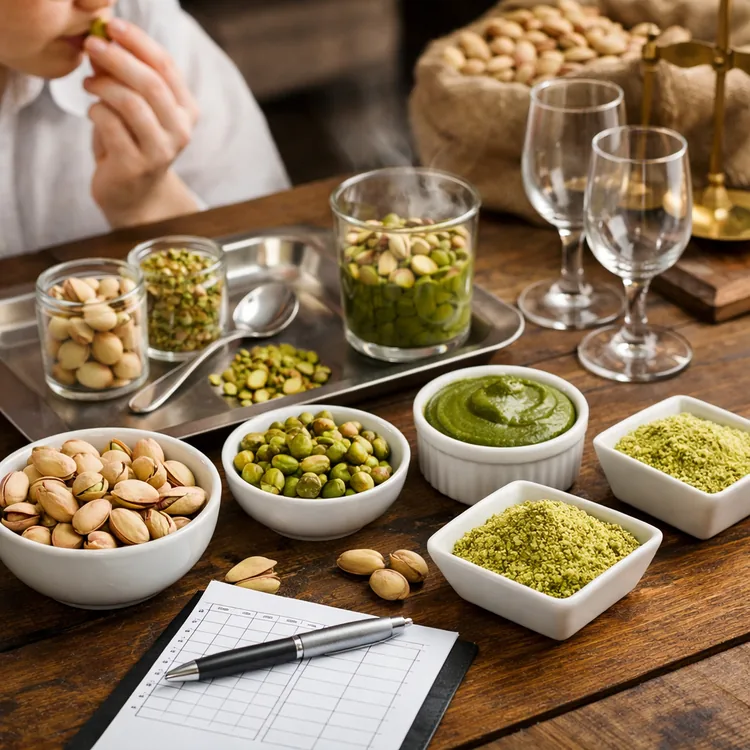
Introduction: why aroma matters in commercial pistachio buying
In B2B food trade, many product discussions begin with visual grade, pack format or headline price. Yet the moment a buyer opens a sample, aroma often becomes the first decisive signal. It immediately influences how fresh, natural, premium or commercially suitable the pistachio seems. In categories such as roasted snacks, bakery ingredients, confectionery, dessert applications and premium retail formats, that first sensory impression can shape the entire evaluation.
This is especially relevant in pistachios because aroma is tied closely to freshness, processing style, roast development, storage condition and product identity. Buyers do not only want pistachios that look right on paper. They want pistachios that smell commercially convincing, match the intended use and support the promise of the finished product. When aroma falls short, the buyer may question everything else, even if the written specification appears acceptable.
That is why aroma should not be treated as a vague afterthought. It should be understood as part of the commercial specification logic that connects sample review to final application.
What “sensory expectations” means in B2B sales
Sensory expectations are the practical expectations buyers bring to a product before they approve it for further discussion, testing or procurement. In pistachio trade, these expectations usually include aroma, taste, freshness perception, texture, appearance and how well the product aligns with the target application. They may differ by buyer type, but they always influence the buying decision.
In practical B2B terms, sensory expectations are rarely random. A snack buyer expects a more appetizing and consumer-friendly aroma profile. A bakery manufacturer may expect a clean nut character that works inside fillings or toppings. A premium confectionery buyer may look for a refined, attractive profile that supports gourmet positioning. An industrial ingredient user may focus more on stability and application fit than on dramatic aroma intensity. The point is that sensory expectations should match the business model behind the purchase.
When suppliers and buyers understand that connection, product conversations become far more precise and much more commercially useful.
Why aroma is often a trust signal
Aroma is not only a product characteristic. It is also a trust signal. When a buyer opens a sample and immediately gets a clean, appealing and commercially appropriate aroma impression, confidence increases. The buyer begins to assume that the product has been selected, handled and presented with care. When the aroma is flat, unclear or disappointing, confidence can drop quickly, even before the product is used in a real application.
This matters especially in international trade, where the buyer may be evaluating a new supplier from a distance. In those cases, the sample experience is not just about product quality. It is also about whether the supplier seems reliable, commercially aware and able to understand real buyer expectations. Aroma plays a larger role in that impression than many people first realize.
Freshness perception begins with smell
One of the most immediate things aroma communicates is freshness perception. Buyers often interpret a clean and appealing pistachio aroma as a sign that the product is commercially alive, well handled and suitable for serious use. This does not mean aroma alone proves freshness in a technical sense, but it strongly shapes first impression and perceived product confidence.
In snack, retail, bakery and dessert applications, this matters a great deal because freshness perception directly influences whether the buyer feels the product can support a premium or commercially credible finished item. A strong visual sample with a weak aroma can still feel disappointing. A well-balanced aromatic profile, by contrast, helps the whole offer feel more convincing.
Why buyers should not evaluate aroma in isolation
Although aroma matters, it should never be assessed alone. In B2B pistachio sales, the real question is whether the aroma profile fits the intended product format, the application and the commercial target. A lighter and cleaner aroma may be perfectly suitable for one use case and too subtle for another. A stronger roast-driven aroma may work well in a snack format but be less relevant in a more neutral ingredient system.
This is why aroma should always be reviewed together with format, appearance, processing style, application role and expected finished product profile. Good buying decisions come from combined sensory and commercial thinking, not from single-attribute judgment.
Different product formats create different aroma expectations
Not all pistachio formats should smell the same. In-shell roasted pistachios, raw kernels, chopped ingredients, powder, paste and application-specific processed forms each create different buyer expectations. A roasted in-shell pistachio sample may be expected to deliver a more appetizing and snack-oriented aroma. A kernel for bakery use may be expected to show a clean nut character without aggressive roast notes. A paste may be evaluated more in terms of how it fits the intended concept rather than on standalone intensity alone.
This is why suppliers and buyers should talk about aroma with format awareness. The correct aromatic profile depends on what the product is and what the product is supposed to become.
Snack applications and aroma expectations
In snack-oriented pistachio sales, aroma is often highly influential because the product is being evaluated as a direct consumer experience. Buyers usually want the product to feel appetizing, fresh and commercially ready. This is especially true in roasted and salted in-shell programs, premium snack packs, private-label retail and gourmet formats where sensory appeal is central to repeat purchase.
For snack buyers, aroma often works together with shell appearance, roast profile, salt balance and overall visual appeal. A weak aroma may make the product feel less lively or less premium. A stronger, cleaner and more attractive profile may reinforce the impression that the product is ready for retail channels.
Ingredient applications and aroma expectations
Ingredient buyers often assess aroma more functionally. They still care about quality, but they are usually thinking about how the product will perform in bakery, confectionery, dessert, chocolate, ice cream or other manufacturing systems. In these cases, aroma is judged according to fit. The main concern is whether the pistachio contributes the right sensory character to the final product, not simply whether it is aromatic in a broad sense.
This means ingredient buyers often interpret aroma in relation to other variables such as kernel color, cut size, grind suitability, paste profile, texture and application role. A commercial sample review should reflect that complexity rather than relying only on a general “smells good” reaction.
Raw versus roasted sensory expectations
One of the clearest distinctions in pistachio aroma evaluation is the difference between raw and roasted products. Raw pistachios are usually judged more on cleanliness, natural nut character and overall suitability for downstream use. Roasted products are judged more on aroma development, appetizing snack appeal and the success of the roasting process in creating a richer finished product impression.
Because of this, buyers should never compare raw and roasted products through the same sensory framework. The right standard depends on where the product sits in the supply chain and what role it will play next. Good commercial conversations become easier when everyone involved uses the right sensory language for the right product stage.
Roasting changes aroma, but does not solve every problem
Roasting can amplify and shape aroma significantly, but it does not automatically rescue weak raw material. In fact, roasting may sometimes make inconsistency or poor sensory balance more obvious. That is why snack buyers and roasters should assess aroma development together with the underlying quality of the product rather than treating roast aroma as a complete substitute for raw material quality.
This is an important commercial point because some buyers assume that sensory issues can be hidden through processing. In practice, a product that begins from a weak base may still struggle to achieve the right final impression, even after roasting. Strong roasted products usually begin with strong raw selection.
Aroma in visible premium categories
In premium visible categories such as gourmet snacks, chocolate inclusions, dessert toppings, retail baking ingredients or high-end confectionery, aroma becomes even more commercially sensitive because the buyer often expects several premium cues to work together. Appearance, format, color, aroma and overall sensory credibility all reinforce the idea that the product belongs in a higher-value segment.
If the aroma feels weak or mismatched, the premium position can become harder to support. That is why buyers in these segments often place more weight on sensory impression during sample approval than buyers in deeper industrial or more blended-use systems.
How application changes the “right” aroma profile
The right aroma profile depends on what the pistachio is supposed to do in the finished product. A chocolate manufacturer may want pistachio aroma that supports but does not fight with the cocoa system. A bakery producer may want an aroma profile that feels clean and compatible with pastry applications. A frozen dessert developer may want a recognizable premium pistachio note that supports indulgent perception. A snack importer may want a stronger and more immediately appetizing aromatic impression.
This is why sensory review should always be application-led. The same aromatic profile may be ideal in one category and commercially weak in another. Buyers who define the final use clearly tend to make better sensory decisions and better sourcing decisions overall.
Sample review should be structured, not casual
In many B2B sales settings, sample evaluation is treated too casually. Someone opens the bag, takes a quick smell and declares the sample good or not good. That approach can miss important commercial signals. A better approach is to review samples against a simple structure: first aroma, then appearance, then product form, then likely application fit, then overall commercial usefulness.
For companies with cross-functional teams, it can also be useful to involve more than one perspective. Procurement may focus on consistency and fit with the brief. Technical or quality teams may focus on product integrity. Sales or brand teams may focus on whether the sensory profile supports the intended market position. This often leads to a more grounded decision than a single informal impression.
What buyers should listen for during sample evaluation
When reviewing pistachio samples, buyers usually benefit from asking practical sensory questions such as:
- Does the aroma feel clean and commercially convincing?
- Does it match the intended application?
- Does the product seem fresh and well handled?
- Does the aroma fit the visual profile and product form?
- Would this sensory profile support the intended finished product?
- Does the sample create confidence or hesitation?
These questions are more useful than abstract quality language because they tie sensory judgment to real buying outcomes.
Why sensory language should become more specific
One common problem in B2B pistachio sales is that buyers and sellers use sensory language too loosely. Words like fresh, premium, natural or strong are often used without enough precision to guide a commercial decision. More specific language leads to better alignment. Instead of speaking only in broad terms, buyers can describe whether they want a profile better suited to snack use, bakery use, premium visible use, neutral ingredient use or roast-led consumer use.
This does not require scientific vocabulary. It simply requires commercial clarity. Once the intended use is described properly, sensory expectations become easier to communicate and easier to evaluate.
Why aroma and consistency belong together
A good sample is useful, but repeatability is what makes a supply program commercially viable. This is especially true in branded retail, private label, premium ingredient lines and recurring industrial production. A sample with a strong sensory impression can still become a weak commercial choice if the supplier cannot provide a similar profile over time.
That is why buyers should ask not only whether the aroma seems attractive today, but whether the product standard and supply model can realistically maintain a similar impression across repeat lots. Consistency is often just as important as initial appeal.
Aroma and market positioning
Sensory profile can affect where a product belongs in the market. A more expressive and appetizing roast-led aroma may support premium snacking or impulse purchase categories. A cleaner and more controlled profile may work better in ingredient systems where the pistachio needs to integrate into another product. A more refined aromatic character may be relevant in gourmet or specialty applications where the buyer expects premium sensory signals without excessive intensity.
In other words, aroma is not just about whether the product is good. It helps indicate what type of commercial role the product can realistically support.
How importers and distributors should use sensory information
Importers and distributors often serve several different customer groups, so sensory evaluation can help them segment offers more effectively. Instead of describing all pistachios in the same way, they can explain which profiles suit snack buyers, which suit industrial users and which are better matched to premium or visible applications. This makes pricing easier to explain and helps customers feel that the supplier understands their real needs.
Sensory information can therefore become a commercial tool rather than only a quality note. It helps distributors align product offers with customer expectations and reduce mismatch in the sales process.
Common mistakes in sensory-led buying
Several avoidable mistakes appear regularly in pistachio sample evaluation:
- judging aroma without defining the intended application,
- using the same sensory standard for raw and roasted products,
- focusing on price before reviewing sample fit,
- treating one strong sample as proof of future consistency,
- ignoring how aroma interacts with visual profile and product format, and
- using vague language that does not help the supplier understand the real expectation.
Most of these errors come from incomplete product definition rather than from the product itself.
Questions buyers should answer before discussing sensory preferences with suppliers
Before going deep into sample comparison, buyers should try to clarify the following:
- What is the exact end use of the pistachio?
- Is the product raw, roasted or further processed?
- Will the pistachio be consumed directly or used as an ingredient?
- How important is immediate aroma appeal to the finished product?
- Is the product intended for premium visible use or deeper industrial use?
- How much does the buyer want the pistachio to stand out aromatically?
- What role do freshness perception and sample confidence play in approval?
- How important is repeatability across future shipments?
- What other factors must be evaluated alongside aroma?
- What commercial outcome should the sensory profile support?
Suggested buyer brief for aroma-sensitive sourcing discussions
A stronger supplier conversation usually begins when the buyer shares a short brief that includes:
- destination market and end-use category,
- whether the product is for direct consumption or ingredient use,
- whether the product is raw, roasted or application-specific processed format,
- what kind of sensory profile is expected commercially,
- the target market position such as mainstream, premium or gourmet,
- whether the pistachio will remain visible in the finished product,
- packaging or handling preferences, and
- how important repeatability is for the program.
Clearer briefs help suppliers respond with more relevant samples and more commercially useful proposals.
Commercial summary table
| Sensory Area | Why It Matters | What Buyers Should Check |
|---|---|---|
| Aroma | Shapes first impression and freshness perception | Review whether the aroma feels clean, commercially convincing and suitable for the application |
| Application Fit | Different uses require different sensory logic | Define whether the pistachio is for snack, bakery, confectionery, dessert or industrial use |
| Raw vs Roasted | Processing stage changes the correct evaluation standard | Do not compare raw and roasted products through the same aroma expectations |
| Freshness Perception | Affects buyer confidence during sample review | Assess whether the sample creates trust and supports the intended market position |
| Consistency | Strong samples must also be repeatable | Ask how realistic it is to maintain a similar sensory profile across repeat supply |
| Commercial Position | Sensory appeal should support the final business model | Clarify whether the product is mainstream, premium, private label or gourmet-oriented |
| Buyer Communication | More specific language improves product matching | Describe the intended use and desired profile instead of using vague quality terms alone |
Atlas perspective
At Atlas, academy content is designed to help buyers turn broad product impressions into more practical sourcing language. Aroma is a strong example of an area where commercial clarity matters. Buyers often know when a sample feels right or wrong, but the more useful question is why. Once aroma is linked to application, format, freshness perception and market position, supplier discussions become easier and more productive.
That is where sensory expectations become commercially valuable. They stop being subjective reactions and start becoming part of a clearer purchasing framework.
Final takeaway
Pistachio aroma matters in B2B sales because it influences freshness perception, buyer confidence, product fit and the premium impression of the sample. But the strongest sourcing decisions come when aroma is evaluated as part of a broader commercial picture. The right sensory profile depends on the product form, the intended application, the target market and the consistency expected over time.
For buyers working with Turkish Antep pistachios, better sensory thinking leads to better product comparison, better sampling decisions and more effective supplier communication. When aroma and sensory expectations are defined clearly, the path from sample review to confident purchasing becomes much smoother.
Frequently asked questions
Who is this guide written for?
This guide is intended for importers, distributors, snack brands, food manufacturers, private-label teams and other B2B buyers researching Turkish pistachio supply.
Why does aroma matter so much in B2B pistachio sales?
Because aroma is often one of the first quality signals buyers notice. It affects freshness perception, confidence in the sample and the sense that the product fits the intended application.
Should buyers use the same sensory standard for every pistachio product?
No. Raw, roasted and processed pistachio formats should be evaluated according to their actual role in the supply chain and intended commercial use.
Is a stronger aroma always better?
Not necessarily. The right aroma profile depends on whether the product is meant for direct snack use, ingredient use, premium visible applications or more neutral manufacturing roles.
How should buyers review samples more effectively?
They usually benefit from reviewing aroma together with appearance, format, application fit, processing stage and likely repeatability rather than making a decision on a quick smell alone.
Why is consistency important in sensory evaluation?
Because a good sample is only commercially valuable if the supplier can support a similar sensory profile over repeat orders and future supply cycles.
What should buyers include in a sensory-sensitive inquiry?
A strong inquiry should mention the intended application, whether the product is raw or roasted, the target market position, the importance of aroma to the finished concept and any expectations around consistency.
How can Atlas help?
Atlas helps buyers connect sensory expectations with product format, application fit and sourcing decisions so commercial discussions become clearer and more useful.