Introduction: why cut format matters in bakery ingredient sourcing
In bakery applications, pistachios do far more than add flavor. They can create surface decoration, communicate premium positioning, provide texture contrast, improve product identification and support consumer perception of craftsmanship. Because of this, the exact cut format matters. A pistachio granule does not create the same result as a slice, and a sliver does not behave the same way as a broader decorative cut.
That distinction becomes important in commercial buying because bakery manufacturers rarely use pistachios in a neutral way. They may need a decorative topping for laminated pastries, a filling inclusion for cookies, a surface finish for cakes, a visible garnish for premium desserts or a more economical cut for industrial bakery lines. Each use case changes what makes a pistachio ingredient commercially suitable.
For buyers sourcing Turkish Antep pistachios, the strongest purchasing decisions usually come from matching the cut format to the exact bakery function rather than buying a general pistachio cut and hoping it performs well across every product line.
What granules, slices and slivers mean in practical terms
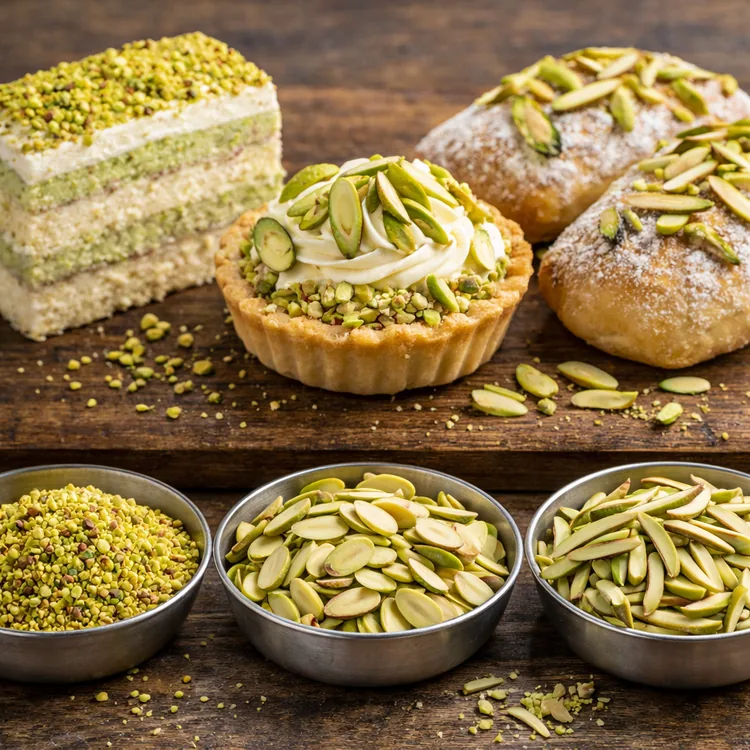
Although terminology can vary across markets and suppliers, these three bakery-oriented pistachio formats are generally understood in different ways. Granules are smaller cut pieces intended for more even distribution, controlled inclusion and broad surface coverage. Slices are flatter cut pieces that create a more visible decorative effect and can appear more refined in premium pastry or dessert applications. Slivers are often longer, narrower cuts that provide a more elegant and directional visual effect, especially where artisanal or gourmet presentation matters.
These differences are not only visual. They affect how the ingredient spreads, how it sits on the surface, how much coverage it provides, how it integrates into fillings and how it performs during handling. That is why the right cut should be chosen in relation to the finished bakery product rather than according to naming alone.
Why bakery applications require more format precision than many buyers expect
Bakery environments are diverse. A pistachio used on top of a croissant, inside a cookie dough, across a tart surface or within a premium cake coating may face very different process conditions. Some products require visible elegance. Others require volume efficiency. Some need controlled surface coverage, while others prioritize inclusion consistency or textural bite.
This means bakery buyers benefit from more precise ingredient language. Instead of asking for pistachio cuts in general, it is more useful to define whether the ingredient is intended for topping, filling, folding, decorating, coating, layering or retail presentation. Once the bakery role is clear, the correct cut format becomes easier to identify.
The first major format: pistachio granules
Pistachio granules are one of the most versatile bakery formats because they can be used across a wide range of products and process systems. They are especially useful when manufacturers want controlled distribution rather than dramatic individual nut identity. Granules can provide a recognizable pistachio presence without dominating the product visually or structurally.
In commercial bakery terms, granules are often chosen for applications where efficiency, coverage and repeatability matter. They can work well in fillings, cake toppings, dessert coatings, bakery bars, cookies, industrial pastries and layered sweet products. Because the pieces are smaller, they are often easier to portion and distribute consistently in scaled production systems.
Where granules are commonly used
Granules are especially relevant in applications where the product needs visible pistachio distribution but not necessarily a large premium decorative piece. Common uses may include:
- cookie and biscuit inclusions,
- bakery bar toppings,
- cake edge coatings,
- dessert layer decoration,
- sweet filling inclusions,
- surface finishes for industrial pastries, and
- consumer baking products where small, manageable particles are preferred.
Granules can also be commercially useful when the buyer wants a broad visual spread with lower risk of irregular coverage.
Why granules work well in industrial bakery systems
Many industrial bakery lines value granules because they are easier to dose, spread and standardize. Smaller pieces can support more predictable inclusion rates and more even surface presentation. This can reduce variability between units and help support more consistent finished product appearance, particularly when large-scale production is involved.
That does not mean granules are only for industrial use. They can also work well in premium products where a fine, refined pistachio texture is desired. The key point is that granules often offer a strong balance between visual presence and operational control.
The second major format: pistachio slices
Pistachio slices are more visually expressive than granules and are often selected when the ingredient must contribute to premium surface appeal. Their flatter shape can create a more deliberate and elegant look, especially in pastries, cakes, tarts, desserts and decorated bakery items. In these applications, the pistachio acts not only as an ingredient but also as part of the product’s visual identity.
Because slices are more visible individually, they are usually evaluated with greater attention to appearance, shape consistency and how attractively they sit on the finished product. In premium bakery segments, this can be an important buying consideration.
Where slices are commonly used
Slices are often used in products where the pistachio needs to be recognized clearly by the customer and where surface presentation contributes directly to perceived value. These uses may include:
- premium tart and cake decoration,
- artisan pastry topping,
- dessert garnish,
- baklava-style and layered sweet applications,
- premium cookies with visible pistachio finish, and
- retail bakery items positioned as gourmet or high-end.
In these cases, slices can help create a more sophisticated appearance than smaller cuts.
The third major format: pistachio slivers
Pistachio slivers are often valued where a longer, narrower decorative effect is preferred. They can create a more directional visual look and may support premium bakery presentation in a way that feels more artisanal or refined. Compared with broader slices, slivers may appear more delicate and stylized in the final application.
Commercially, slivers are especially relevant when the bakery product relies heavily on visual finish. They may be used selectively rather than in heavy coverage, particularly in premium pastries, specialty cakes, plated desserts, festive items and decorative sweet goods where detail matters.
Where slivers are commonly used
Slivers are often associated with more decorative uses, including:
- premium cake and entremet finishing,
- artisanal pastry topping,
- dessert plate garnish,
- specialty confectionery-bakery crossover products,
- seasonal and gift-oriented bakery lines, and
- high-visibility premium retail products.
In these categories, the sliver format helps create a more intentional visual signature.
Choosing the right format starts with the bakery role
The most useful way to choose between granules, slices and slivers is to begin with the actual bakery role. Is the pistachio primarily there for texture, coverage, decoration, filling identity, premium appearance or efficient inclusion? The answer determines which cut is likely to deliver better value.
Granules often suit high-coverage and process-oriented uses. Slices often suit broader decorative needs where visual premium cues are important. Slivers often suit more refined visible applications where the goal is elegance rather than coverage efficiency. None of these formats is universally better. Each one is better in a different commercial context.
Toppings versus inclusions: an important buying distinction
Bakery buyers should distinguish clearly between toppings and inclusions because the same pistachio cut may behave differently in each role. A topping is judged heavily by visible appearance, coverage and how well it sits on the surface. An inclusion is judged more by distribution, bite, consistency and how it integrates into dough, filling or layered structure.
This is a critical distinction. A slice that looks excellent as a decorative topping may not be the most efficient inclusion. A granule that performs well inside a cookie or bar may not create the right premium appearance on a pastry surface. Application definition therefore helps avoid format mismatch.
Surface coverage and visual economics
Different pistachio cuts create different visual economics. Granules often provide broader apparent coverage because many smaller pieces spread across the surface more easily. Slices and slivers may provide stronger individual visibility, but not necessarily the same density of coverage at the same usage pattern. This affects how buyers think about cost versus finished appearance.
In practical terms, a manufacturer may choose granules when wide visual distribution matters, and choose slices or slivers when elegance and product recognition matter more than dense surface coverage. This is why price comparisons between formats should always be linked to the visual and commercial goal of the finished product.
Texture contribution in bakery products
Cut format also affects eating texture. Granules can provide a finer, more distributed nut presence. Slices can provide a clearer visible bite without feeling too heavy. Slivers may add a more delicate but recognizable textural identity in premium applications. Because bakery products vary so much in softness, moisture level and structure, the right pistachio format often depends on the intended textural contrast.
A soft filled pastry may benefit from a lighter decorative cut. A cookie or bar may support a firmer inclusion texture. A cake edge coating may call for more controlled particle size. The ideal format is the one that strengthens the finished product rather than distracting from it.
Baking performance and process suitability
Bakery buyers should evaluate pistachio cuts not only on appearance but also on how they perform through handling and baking. Some products expose the pistachio directly on the surface for part or all of the bake cycle. Others add the ingredient later, after baking or during finishing. The timing of application affects what matters most.
If the pistachio is used in a baked topping or folded into dough, the buyer may need more emphasis on consistency, piece integrity and format stability. If the pistachio is added during post-bake finishing, visual appeal may matter even more. Good sourcing decisions connect the cut format to the actual process stage where it will be used.
Color and visual quality in bakery presentation
Kernel tone and visual quality remain important in bakery applications, especially when the pistachio is visible to the customer. Premium pastries, cakes and desserts often rely on pistachio appearance to communicate indulgence, craftsmanship and ingredient quality. This means cut format should be discussed together with visual profile, not separately.
In premium or consumer-facing bakery programs, the pistachio is often part of the product’s immediate shelf appeal. For that reason, buyers may assess how the chosen cut expresses color, how uniform the visible pieces appear and whether the final look supports the intended retail or foodservice position.
Premium bakery versus industrial bakery logic
Premium and industrial bakery operations may look at the same pistachio formats differently. A premium bakery or patisserie may choose slices or slivers for visual refinement, even if that format is less coverage-efficient than granules. An industrial bakery manufacturer may prioritize cost control, consistency and scalable dosing, which can make granules especially attractive.
Both models are valid. The correct decision depends on the product’s commercial role. Problems typically arise when a buyer expects premium visual results from a format selected only for efficiency, or pays for a decorative format in an application that does not reward that extra selectivity.
Packaging and handling considerations
Because granules, slices and slivers are more processed than whole kernels, packaging should support cleanliness, handling control and practical use in production. The right pack size depends on the buyer’s workflow. Some manufacturers need larger bulk units for continuous production. Others may prefer more manageable units that help control exposure and portioning.
Buyers should consider:
- whether the cut format will be used directly or repacked,
- how quickly opened packs will be consumed,
- whether the pack size suits line handling,
- how the product will be stored before use, and
- whether the packaging supports clean movement into the bakery process.
Good packaging choices help protect both product condition and operational efficiency.
Consistency and repeatability across orders
For bakery manufacturers with recurring product lines, consistency can be just as important as the visual appeal of the initial sample. A granule size that shifts noticeably, a slice profile that changes from lot to lot or a sliver format that becomes less uniform can affect finished product appearance and internal process stability. This matters especially in private-label, chain bakery and branded retail environments where customers expect repeatable presentation.
That is why buyers should ask not only whether the sample looks suitable today, but whether similar cut consistency can be maintained over repeated supply cycles.
Who typically buys these pistachio formats?
Granules, slices and slivers are relevant to several different customer types, including:
- Industrial bakery manufacturers using pistachios in cookies, bars, cakes and pastries.
- Patisseries and dessert producers needing visible decorative formats.
- Importers and distributors serving local bakery and pastry markets.
- Private-label bakery brands building premium or mainstream sweet goods.
- Retail ingredient packers selling bakery-ready pistachio cuts to consumers or foodservice users.
Each of these buyers may want different cut logic even when sourcing from the same Turkish pistachio supply base.
Why Turkish Antep pistachios can be attractive in bakery programs
Turkish Antep pistachios can be commercially attractive in bakery applications because they align naturally with premium pastry, dessert and confectionery positioning. In many bakery concepts, pistachio is used not only for flavor but also for visible culinary identity. A strong origin story can therefore support premium retail, artisanal bakery and specialty dessert formats.
However, origin should support the application, not replace application planning. The right cut, the right visual profile and the right operational fit still matter. The strongest bakery programs combine origin value with disciplined format selection.
How buyers should compare offers
Bakery buyers should compare pistachio cut offers through a structured application-led framework. Useful comparison points include:
- cut format suitability for the intended bakery role,
- visual appearance and tone where the product is visible,
- particle or slice consistency,
- coverage behavior or inclusion behavior,
- packaging fit for handling and storage,
- repeatability across future orders, and
- overall value relative to the finished product’s position.
Offers that look similar in general category terms may perform very differently once they are used in real bakery applications.
Common buying mistakes in bakery-format pistachio sourcing
Several avoidable mistakes appear frequently in this category:
- using one cut format across several very different bakery products,
- choosing based on price before defining topping versus inclusion use,
- ignoring surface coverage behavior,
- overpaying for decorative formats in process-heavy applications,
- under-specifying visual needs in premium bakery products,
- approving samples without testing them in the actual baked or finished application, and
- overlooking repeatability from one production cycle to the next.
Most of these errors come from buying “pistachio cuts” as a general category rather than defining the real bakery need clearly enough at the start.
Questions bakery buyers should answer before requesting quotations
Before approaching suppliers, buyers should ideally answer the following:
- Will the pistachio be used as a topping, inclusion, filling component or decorative finish?
- Which format best supports that role: granules, slices or slivers?
- Is the product premium, mainstream, industrial or artisanal?
- How important is visible appearance to the finished bakery item?
- What kind of texture should the pistachio contribute?
- Will the ingredient be baked, post-applied or both?
- What pack size and handling format suit the production line?
- How critical is repeatability across future orders?
- What level of coverage or visual density is required?
- How will the final product justify the selected cut commercially?
Suggested buyer brief for bakery applications
A useful supplier brief often includes:
- destination market and bakery category,
- required pistachio format,
- whether the ingredient is for topping, filling, inclusion or decoration,
- how visible the pistachio will be in the finished product,
- any priorities around texture or cut consistency,
- expected production rhythm or annual volume,
- packaging and handling preferences, and
- whether the product is industrial, premium, artisanal or private label.
Clearer briefs lead to clearer offers and more relevant sample comparisons.
Commercial summary table
| Format Area | Why It Matters | What Bakery Buyers Should Check |
|---|---|---|
| Granules | Support controlled distribution and broad coverage | Use when inclusion consistency, coverage efficiency or industrial dosing matters |
| Slices | Create stronger visible decorative appeal | Choose when the finished bakery item needs recognizable premium pistachio presentation |
| Slivers | Provide a more elegant and directional visual effect | Use when refined garnish or artisanal bakery presentation is important |
| Application Role | Determines the correct cut format | Define whether the pistachio is a topping, inclusion, filling addition or finishing element |
| Visual Profile | Supports shelf appeal and premium positioning | Check whether the cut and visible tone match the product’s market position |
| Handling Fit | Affects production practicality | Make sure pack size and cut behavior suit dosing, storage and line handling |
| Repeatability | Protects consistency across recurring bakery programs | Ask how reliably the approved cut profile can be maintained across future lots |
Atlas perspective
At Atlas, academy content is designed to help buyers turn broad ingredient categories into more precise sourcing decisions. Bakery-oriented pistachio cuts are a strong example of why this matters. Many buyers initially ask for chopped or sliced pistachios, but the more useful conversation is about what the cut needs to do in the finished bakery product.
When format is linked clearly to coverage, texture, decoration, processing stage and product position, supplier comparison becomes more meaningful and internal product development decisions become easier to manage.
Final takeaway
Pistachio granules, slices and slivers are not interchangeable bakery ingredients. They create different visual, textural and operational results. Granules often support efficient coverage and controlled inclusions. Slices often support stronger visible decoration. Slivers often support more refined and artisanal presentation. The right choice depends on how the bakery product creates value for the customer.
For buyers working with Turkish Antep pistachios, stronger sourcing decisions come from defining the bakery role first and the format second. Better format selection leads to better product presentation, more effective process fit, more realistic cost comparison and more reliable long-term supply performance.
Frequently asked questions
Who is this guide written for?
This guide is intended for bakery manufacturers, pastry producers, dessert brands, importers, distributors, private-label teams and other B2B buyers researching Turkish pistachio cut formats.
What is the main difference between granules, slices and slivers?
Granules are smaller pieces used for broader distribution and inclusion efficiency, slices are flatter decorative cuts and slivers are longer, narrower cuts used where a more elegant visual effect is preferred.
Which format is best for bakery toppings?
That depends on the finished look required. Granules often suit wider coverage, while slices and slivers often suit more visible premium decoration.
Which format is best for inclusions inside bakery products?
Granules are often especially practical for inclusions because they can distribute more evenly and support more controlled process use, though the right answer depends on the exact product.
Do slices and slivers always mean a more premium product?
Not always, but they are often used in more visible decorative roles where premium presentation matters more than broad coverage efficiency.
Why should buyers test the pistachio in the real bakery application?
Because the real commercial result depends on how the cut looks and behaves in the finished product, not only on how it looks in a loose sample tray.
What should a buyer include in an inquiry?
A strong inquiry should mention the bakery application, the required cut format, whether the product is a topping or inclusion, visual priorities, packaging needs and expected volume.
How can Atlas help?
Atlas helps buyers connect bakery application needs with the most suitable Turkish pistachio cut formats so sourcing discussions become more precise and commercially useful.