Introduction: why chocolate manufacturing requires a more specific pistachio brief
Chocolate products are highly sensitive to ingredient choice because they combine flavor, texture, appearance and process behavior in a tightly controlled system. Pistachios in chocolate are rarely neutral. They may provide crunch, color contrast, visible inclusions, premium visual cues, nut flavor, creamy filling character or gourmet positioning. As a result, the same pistachio ingredient can create very different outcomes depending on how it is used.
For that reason, chocolate manufacturers should not approach pistachio sourcing with generic language alone. Terms such as kernels, cuts or paste are not detailed enough on their own. Buyers need to understand whether the pistachio will remain visible, whether it will be ground or refined, whether it will sit inside a fat-based filling, whether it needs a decorative color profile and whether consistency across repeated production runs is commercially important.
Once the application is clear, the sourcing conversation becomes much more useful. Instead of comparing broad pistachio offers, the buyer can compare ingredients in relation to a specific chocolate use case.
Where pistachios are used in chocolate manufacturing
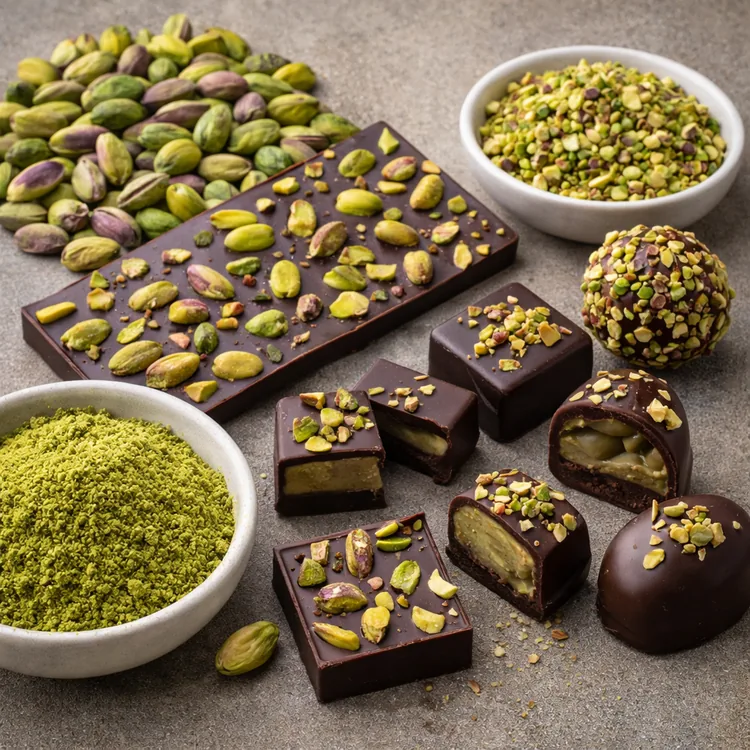
Pistachios appear in a wide range of chocolate products. In some cases they act as a premium inclusion, in others as a flavor base, and in others as a decorative or textural component. Common chocolate-sector uses include:
- Chocolate bars and tablets with whole kernels, split kernels or chopped pistachio inclusions.
- Filled chocolates and pralines using pistachio paste, cream centers or nut-based fillings.
- Dragées and coated nuts where pistachios are chocolate-coated for premium snack confectionery.
- Decorated pralines and molded pieces using sliced or chopped pistachio as an exterior finish.
- Pistachio spreads and pistachio-chocolate creams where texture and flavor integration are central.
- Seasonal and premium gifting lines where pistachios help support visual luxury and differentiation.
These applications do not rely on the same ingredient logic. A pistachio paste selected for a center filling is a different sourcing decision from a chopped pistachio selected for topping or a whole kernel selected for a premium bar inclusion.
Why application fit matters more than generic product description
Chocolate manufacturers often purchase pistachios under broad category names, but broad naming can hide important differences in commercial suitability. A diced pistachio that performs well in bakery topping may not create the right visual balance in a chocolate tablet. A pistachio paste that works in one fat system may not deliver the same behavior in another recipe design. A bright, visually selective kernel may be valuable in a premium exposed inclusion, but unnecessary in a deeper blended filling.
This is why chocolate-focused sourcing should begin with the intended role of the pistachio inside the chocolate product. The key question is not simply “Which pistachio can we buy?” but “What must this pistachio do in our finished chocolate?” Once that is clear, decisions about format, grade, visual profile and processing become easier and more commercially rational.
The main pistachio ingredient formats used by chocolate manufacturers
Chocolate manufacturers usually work with one or more of the following pistachio forms, depending on the intended product architecture:
- Whole kernels: used in premium bars, tablets and certain confectionery pieces where visible nut identity matters.
- Split kernels: often useful where a slightly more controlled visual inclusion is preferred.
- Diced or chopped pistachios: relevant for inclusions, toppings, coatings and decorative finishes.
- Sliced pistachios: often chosen where elegant visual presentation is important.
- Granules or smaller cuts: used in fillings, layered products and some exterior coating systems.
- Pistachio powder: useful in dry systems, blended applications or where finer distribution is needed.
- Pistachio paste: highly relevant for fillings, spreads, cream centers and pistachio-flavored chocolate concepts.
Each of these formats creates its own sourcing logic. Format selection should be aligned with visual design, process method and finished product positioning.
Whole kernels for chocolate bars and premium inclusions
Whole kernels are especially relevant in premium chocolate bars and molded products where the pistachio remains visible and contributes to the overall luxury impression. In these applications, the pistachio is not just a flavor note. It is part of the visual identity of the chocolate itself. Buyers therefore tend to care about kernel appearance, size harmony, color tone and overall consistency more strongly.
A whole-kernel inclusion should support the intended eating experience and pack presentation. If the brand is positioned as premium, uneven or visually weak kernels can reduce perceived value. This is why chocolate manufacturers using whole kernels often review samples not only as raw ingredients but in the finished chocolate application itself.
Diced and chopped pistachios for inclusions and decoration
Diced pistachios are one of the most versatile forms in chocolate manufacturing because they can be used in inclusions, surface decoration, layered products, bark-style chocolate, center coatings and premium confectionery finishes. However, cut size matters greatly. Too large a cut may create processing inconsistency or poor visual balance. Too small a cut may disappear visually and fail to deliver the intended premium signal.
That is why buyers should specify the intended role of the cut. Is it meant to remain highly visible on top of a chocolate piece? Is it meant to be distributed inside a chocolate mass or filling? Is it part of a dusting, coating or edge finish? Each of these uses can justify a different cut logic.
Sliced pistachios in premium confectionery presentation
Sliced pistachios are often chosen when manufacturers want a more refined, elegant and controlled visual effect. They can be especially effective in premium pralines, seasonal confectionery, decorative chocolate surfaces and gift-oriented chocolate lines. In these applications, the pistachio is functioning as a visual design element as much as a flavor element.
For sliced applications, appearance consistency becomes especially important. If the slice profile is too irregular or too mixed, the product may look less intentional on the finished piece. Buyers who value premium presentation usually evaluate slices with a stronger emphasis on visual harmony and application neatness.
Pistachio powder in chocolate and confectionery systems
Pistachio powder can be useful in chocolate-related applications where the goal is finer distribution, dry blending, decorative dusting or ingredient incorporation without visible whole-nut structure. It may also play a role in some filling systems or consumer-facing chocolate ingredient products. In these cases, buyers often focus less on the appearance of an individual kernel and more on the powder’s visual tone, handling practicality and suitability for the intended recipe system.
Powder should therefore be specified with application in mind. A decorative or consumer-facing use may value tone and appearance differently from a purely internal manufacturing use.
Pistachio paste for fillings, spreads and cream centers
Pistachio paste is one of the most important pistachio formats in chocolate manufacturing because it can function as the core flavor and textural base in pralines, truffles, cream fillings, pistachio bars, premium spreads and layered confections. This makes paste a separate sourcing decision rather than simply a more processed version of kernels.
When buying pistachio paste for chocolate use, manufacturers should think about how the paste behaves inside the recipe system. A paste selected for a molded praline center may not be evaluated the same way as a paste selected for a consumer spread or a pistachio-chocolate cream. Flavor, visual tone, consistency expectations and processing fit all matter. In other words, paste should be assessed as a functional chocolate ingredient, not merely as ground pistachio.
Why flavor fit matters in chocolate applications
Chocolate is a dominant flavor system, which means pistachio ingredients must be selected in relation to the type of chocolate they will accompany. A pistachio that performs attractively with white chocolate may create a different result in dark or milk chocolate. A premium pistachio inclusion in a high-cocoa bar may need a different flavor balance from a pistachio cream in a sweet filled shell.
That is why manufacturers should taste pistachio ingredients in the real chocolate context whenever possible. It is not enough to judge the pistachio on its own. The real question is whether it supports the intended sensory result in the finished confectionery concept.
Color and visual appeal in pistachio-chocolate products
Color can carry major commercial importance in chocolate manufacturing, especially when pistachios remain visible in the finished product. Consumers often read visible pistachio color as a cue for premium quality, richer nut content and more refined product selection. This is especially relevant in premium bars, pralines, toppings, filled chocolates and gifting products where appearance helps justify the price point.
However, the importance of color depends on the application. In a visible topping or premium center reveal, color may strongly influence perceived value. In a deep blended system, it may matter less. As with all other pistachio buying criteria, the right level of visual selectivity depends on where the ingredient creates value later in the chain.
Texture and eating experience
Texture is one of the most important reasons chocolate manufacturers use pistachios in the first place. Whole kernels can create a bold bite and recognizable nut identity. Smaller cuts can provide controlled crunch. Paste can create smooth richness and nut depth. Powder can help shape texture in a more subtle way. Because of this, format choice has a direct effect on the final sensory design of the chocolate product.
Manufacturers should therefore select pistachio ingredients with the target eating experience in mind. A premium tablet with visible inclusions needs a different textural logic from a smooth pistachio center or a coated nut confection. Good ingredient selection begins with that difference.
Visual consistency and premium positioning
In chocolate, visual consistency often influences commercial success more than buyers first expect. A pistachio inclusion that looks attractive in the first production batch but becomes mixed, dull or inconsistent later can weaken premium shelf presence. This is particularly important in private-label confectionery, premium gifting and recurring branded bars, where appearance becomes part of the customer’s expectation.
For this reason, buyers should think not only about whether a sample looks good today, but whether a supplier can support similar commercial appearance across repeat supply. A slightly less selective ingredient that is reliably repeatable can sometimes be a better long-term choice than an unusually strong sample that is difficult to match later.
Chocolate manufacturers should define the processing stage clearly
One common sourcing mistake is failing to define where in the production process the pistachio will be added. Will it be mixed into chocolate mass, placed into molds, applied on the surface, blended into a filling, ground into paste or used in a post-coating finish? The answer affects ingredient selection significantly.
For example, a pistachio used as a visible decoration may need more visual refinement than one used inside a center. A pistachio paste used in a smooth filling may need to align with specific texture expectations. A chopped pistachio intended for a coating finish may need a cleaner, more consistent cut than one used inside a rustic bark-style concept. Defining the processing stage early improves sourcing accuracy.
Why moisture management and packaging still matter
Even though chocolate manufacturers usually focus on recipe behavior, ingredient handling and finished product quality, packaging and storage logic remain important. Pistachio ingredients should arrive in a format that protects their commercial usability, supports warehouse handling and fits the manufacturer’s production rhythm. Kernels, cuts, powder and paste may all have different packaging priorities depending on the operational model.
Importers and manufacturers should therefore consider more than just ingredient specification. They should also ask whether the packaging format matches receiving systems, whether the unit size is practical for production and whether the shipment protection is appropriate for the route and storage plan.
How Turkish Antep pistachios can fit premium chocolate programs
Turkish Antep pistachios can be commercially attractive for chocolate manufacturers because they combine origin value with premium category relevance. In chocolate, origin story can support gourmet positioning, especially when the finished product is designed for specialty retail, gifting, artisanal confectionery or upscale dessert-driven channels.
That said, origin alone does not determine ingredient suitability. A chocolate manufacturer still needs the correct format, correct visual logic, correct processing fit and correct consistency profile. The strongest commercial outcome comes when origin value and application fit reinforce each other.
Private label and branded chocolate programs
Private-label chocolate products require especially careful pistachio sourcing because the ingredient directly influences not only product quality but also the retailer’s or brand owner’s reputation. In premium pistachio-filled bars, pralines or chocolate-coated products, inconsistency in nut appearance, cut profile or filling behavior can become a brand problem quickly.
For private-label programs, buyers should define the pistachio role very clearly. Is it a hero ingredient or a secondary note? Is the pistachio visible in the product reveal or only present in the flavor system? Is the finished product positioned as premium, gourmet, seasonal or mainstream? These questions influence which pistachio format makes commercial sense.
How to compare supplier offers for chocolate applications
Chocolate manufacturers should compare offers through a structured application-led framework rather than on generic price alone. A useful comparison includes:
- ingredient format and application fit,
- visual profile where visibility matters,
- cut size or paste suitability for the intended process,
- flavor compatibility with the target chocolate concept,
- consistency across likely repeat orders,
- packaging practicality for production handling, and
- overall commercial fit with the product’s target market position.
A lower-priced offer may not be the stronger choice if it creates visual inconsistency, recipe compromise or extra operational work. Better comparison logic usually leads to better product outcomes.
Common buying mistakes in chocolate-related pistachio sourcing
Several errors appear repeatedly when buyers source pistachios for chocolate manufacturing without a detailed application brief:
- using the same pistachio specification for multiple very different chocolate applications,
- focusing on price before defining the role of the pistachio in the finished product,
- choosing a visually premium ingredient for a non-visible application where it adds little value,
- approving a sample outside the real chocolate matrix,
- ignoring cut size consistency even though appearance and bite matter,
- treating pistachio paste as interchangeable with kernels or powder, and
- overlooking repeatability in private-label or recurring branded production.
Most of these issues come from one root problem: the ingredient requirement is not defined precisely enough at the start.
Questions chocolate manufacturers should answer before requesting quotations
Before seeking commercial offers, buyers should ideally answer the following questions:
- What type of chocolate product will use the pistachio ingredient?
- Will the pistachio be visible in the final product?
- Does the application require whole kernels, cuts, slices, powder or paste?
- How important are color and appearance to the final product position?
- What kind of eating experience is the pistachio expected to create?
- At which stage of production will the pistachio be added?
- Is the finished product premium, mainstream, gift-oriented or private label?
- How important is repeatability across future production runs?
- What packaging and handling format fits the receiving operation best?
- Does the ingredient need to support a chocolate flavor system, a filling system or both?
Suggested buyer brief for pistachio ingredients in chocolate manufacturing
A strong inquiry to suppliers will usually produce better results when it includes:
- destination market and end-use product category,
- required pistachio format,
- whether the ingredient remains visible in the finished product,
- the target chocolate type or product concept,
- any priorities around color, cut size or texture,
- whether the program is branded or private label,
- expected order rhythm or annual volume, and
- packaging or warehouse handling requirements.
Clearer briefs lead to clearer offers, more relevant samples and more commercially useful supplier conversations.
Commercial summary table
| Ingredient Area | Why It Matters | What Chocolate Buyers Should Check |
|---|---|---|
| Format Selection | Different chocolate products need different pistachio forms | Define whether the application requires kernels, cuts, slices, powder or paste |
| Visual Profile | Appearance can support premium positioning in visible chocolate products | Assess whether color and visual selectivity matter for the finished concept |
| Cut Size | Influences texture, appearance and process fit | Choose the cut logic that matches inclusion, decoration or filling use |
| Paste Suitability | Important in fillings, creams and pistachio-based centers | Evaluate paste according to recipe behavior and desired finished texture |
| Flavor Fit | Pistachio must work with the intended chocolate system | Review the ingredient inside the actual chocolate application when possible |
| Consistency | Crucial for recurring branded and private-label production | Ask how repeatable the approved ingredient profile is across future lots |
| Packaging | Affects handling and production practicality | Confirm that pack sizes and shipment format suit the receiving operation |
Atlas perspective
At Atlas, academy content is designed to help buyers move from broad ingredient interest to clearer commercial definition. Chocolate manufacturing is a strong example of why that matters. Pistachio ingredients are often grouped together under one category, but the real buying logic changes significantly depending on whether the product is a bar inclusion, a praline filling, a decorative element or a pistachio-based cream concept.
When buyers define the application clearly, pricing becomes easier to interpret, sample review becomes more meaningful and supplier comparison becomes more commercially useful. Better definition usually produces better finished chocolate products.
Final takeaway
Pistachio ingredients for chocolate manufacturers should always be sourced with the finished confectionery application in mind. The right ingredient is not simply the one with the most attractive sample appearance or the lowest headline price. It is the one whose format, cut size, visual profile, flavor contribution and consistency best support the intended chocolate product.
For buyers working with Turkish Antep pistachios, the strongest sourcing decisions come from linking ingredient form to product design. Whole kernels, cuts, slices, powder and paste all create different commercial possibilities. When those possibilities are matched correctly to chocolate bars, pralines, fillings, coatings and premium gift products, buyers gain stronger product outcomes, better internal alignment and more reliable long-term supply decisions.
Frequently asked questions
Who is this guide written for?
This guide is intended for chocolate manufacturers, confectionery brands, importers, distributors, private-label teams and other B2B buyers evaluating Turkish pistachio ingredients.
Which pistachio format is best for chocolate?
There is no single best format. The correct choice depends on whether the pistachio is being used as a visible inclusion, a decorative finish, a filling base, a paste ingredient or a powdered component.
Why should chocolate manufacturers not buy pistachios generically?
Because chocolate applications are highly specific. The ingredient must fit the product design, visual goals, textural intent and processing method of the finished confectionery concept.
Does kernel color matter in chocolate products?
Yes, especially in visible premium applications such as decorated pralines, inclusion bars, premium tablets and gifting products where appearance helps support perceived value.
Is pistachio paste mainly for fillings and spreads?
It is often highly relevant in fillings, creams, spreads and pistachio-centered chocolate products, but the buying decision should always be linked to the actual recipe and product architecture.
What is the biggest mistake buyers make?
One of the biggest mistakes is using the same pistachio specification for multiple different chocolate applications without defining the actual role of the ingredient in each product.
What should a chocolate manufacturer include in an inquiry?
A strong inquiry should mention the intended chocolate application, required pistachio format, the importance of visibility and color, any texture or cut requirements, packaging needs and whether the program is branded or private label.
How can Atlas help?
Atlas helps buyers connect pistachio format, chocolate application and sourcing requirements more clearly so supply discussions become more practical and commercially useful.