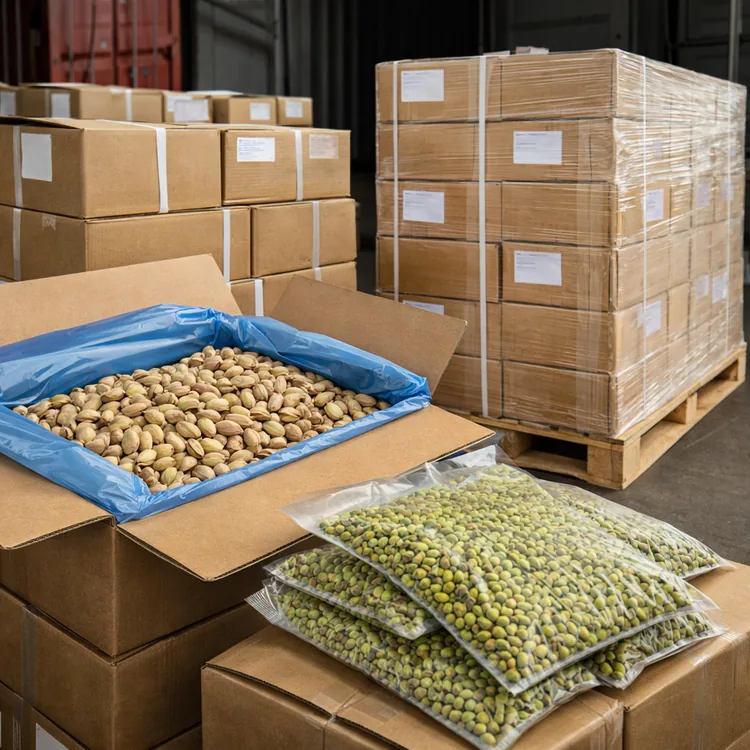
Introduction: why packaging deserves strategic attention in export trade
In pistachio export business, packaging is often discussed after price, grade and product format. In reality, it should be part of the core commercial discussion from the beginning. The same pistachio can behave very differently depending on how it is packed, how long it travels, how it is stored and how it will be handled when it reaches destination. A good product in unsuitable packaging can arrive in weaker condition, create warehouse inefficiency or increase repacking cost. A suitable packaging system can preserve value, simplify handling and reduce commercial risk.
This is especially important in international shipments where pistachios may travel across long sea routes, pass through multiple climate zones, face container humidity, remain in storage before use or be re-handled by importers, repackers and food manufacturers. Export packaging therefore needs to do more than contain the product. It needs to protect the product through the full logistics chain.
For Turkish pistachio supply, the right packaging decision should reflect product form, intended application, route length, storage expectations and the buyer’s downstream business model. Bulk ingredient buyers, retail repackers and private-label snack programs may all need different packaging logic even when purchasing from the same origin.
What export packaging means in practical B2B terms
Export packaging refers to the full system used to prepare pistachio products for international shipment and downstream handling. This includes the primary contact layer with the product, any inner liners or bags, the outer carton or other transport unit, pallet arrangement, wrapping method, labeling structure and container loading approach. Each level contributes to product protection and operational usability.
In practical B2B terms, good export packaging should achieve several objectives at once:
- protect product quality during storage and transit,
- reduce moisture and contamination risk,
- support efficient warehouse and pallet handling,
- match the needs of the destination market or production line,
- provide adequate traceability and shipment identification, and
- arrive in a format that is commercially useful rather than operationally inconvenient.
When buyers and suppliers discuss packaging only in terms of carton count or weight per box, they often miss the broader operational and quality implications.
Why packaging choice depends on product form
Not all pistachio products need the same packaging approach. In-shell pistachios, kernels, diced pistachios, powder and paste each have different sensitivities and handling needs. In-shell product may require strong carton structure and practical transport protection, especially if it is intended for repacking or roasting after arrival. Kernels and more selective ingredient forms may need stronger inner protection against moisture and external exposure. Powder and paste can have even more application-specific requirements depending on how they are processed and stored.
This is why buyers should begin with the actual product form before discussing the best packaging option. A packaging format that is perfectly workable for bulk in-shell export may be less suitable for a refined kernel program. Likewise, a format designed for industrial production handling may not work well for a distributor planning local repacking into smaller retail units.
The first major decision: bulk export packaging versus retail-ready packaging
One of the most important distinctions in export packing is whether the shipment is intended as a bulk industrial or wholesale input, or whether it is already being prepared in a more finished market-ready format. Bulk export packaging is common when the buyer will roast, repack, process or distribute the product after import. Retail-ready packaging is more relevant when the product is being prepared directly for shelf sale, private label or finished branded distribution.
Bulk formats usually prioritize protection, handling efficiency and freight practicality. Retail-ready formats must also support presentation, consumer convenience and shelf-life management. The right answer depends on where value is added in the supply chain. A buyer who plans to repack locally usually needs a different solution than a buyer who wants finished packaged goods shipped directly.
Common bulk carton formats for pistachio exports
Bulk cartons remain one of the most common export packaging choices for pistachios because they are practical, stackable and compatible with standard warehouse systems. They are especially relevant for importers, distributors, repackers and industrial users who need a robust transport format rather than direct retail presentation.
A typical bulk carton system may include:
- corrugated export cartons sized for stable pallet stacking,
- food-contact inner liners or bags,
- clear labeling with batch or shipment identification,
- palletized loading for easier unloading and storage, and
- protective outer wrapping to help stabilize the shipment.
The commercial strength of bulk cartons is that they balance transport practicality with reasonable product protection. However, carton quality, inner liner specification and palletization discipline still matter significantly. Not all cartons perform equally well under export conditions.
Inner liners and why they matter more than some buyers expect
In pistachio export shipments, the inner liner is often one of the most important protective layers because it is the closest barrier between the product and the surrounding environment. A strong outer carton alone does not provide enough protection if the internal liner is weak, poorly sealed or unsuitable for the storage and transport conditions.
Inner liners can help with:
- limiting exposure to moisture,
- reducing contamination risk,
- protecting cleanliness during handling,
- supporting better product integrity inside the carton, and
- helping preserve quality during longer transport or storage cycles.
For buyers, it is useful to ask not only whether a carton has an inner bag, but what type of inner protection is being used and why that format is appropriate for the product and route.
Barrier packaging and moisture protection
Moisture control is one of the central packaging concerns in pistachio exports, especially when goods move across long sea routes or into climates with fluctuating humidity. Even when the product itself is well prepared, poor barrier protection can weaken freshness and create avoidable risk during transit and storage.
Barrier-oriented packaging solutions are often considered when buyers want stronger protection against external exposure. This can be especially relevant for kernels and other more sensitive forms where maintaining condition through the shipment cycle is commercially important. The packaging decision should reflect both route risk and storage expectations at destination. A shipment that will be processed quickly after arrival may have different needs from one that will remain in stock for an extended period.
Vacuum-packed export options
Vacuum-oriented formats may be considered in certain pistachio programs where freshness management, compact packing or stronger protection is desired. These options are more common in some processed or ingredient-oriented formats than in standard large-volume in-shell trade, but the right use depends on the product and commercial model.
Vacuum packing can help by reducing air exposure inside the immediate product pack, but it should still be evaluated within the broader logistics system. Buyers should think about whether vacuum packing supports the intended storage cycle, whether it improves handling or simply adds cost, and whether the format is operationally useful for the receiving warehouse or production line.
Product-specific packaging logic for in-shell pistachios
In-shell pistachios are often packed in sturdy bulk export cartons when the buyer intends to roast, repack or distribute them after arrival. Since in-shell product typically occupies more volume and is handled differently from kernel or derivative formats, packaging choices need to balance protection with freight efficiency.
For in-shell programs, buyers usually care about:
- carton strength under stacking pressure,
- protection against shell dust leakage or liner failure,
- practical pack weights for warehouse teams,
- pallet stability during movement, and
- whether the shipment format suits the next step, such as roasting or local repacking.
The packaging does not need to act like a retail pack, but it still needs to protect the commercial value of the product until the buyer is ready to use it.
Product-specific packaging logic for kernels
Kernels usually demand more careful handling because they are more directly exposed product and are often used in premium food manufacturing, bakery, confectionery and retail ingredient channels. Packaging for kernels may therefore place greater emphasis on cleanliness, barrier performance, controlled internal protection and suitability for more selective downstream applications.
Buyers using kernels in visible or premium products may want packaging that helps preserve both condition and presentation quality. Buyers using kernels in industrial processing may focus more on handling convenience, unit size and compatibility with factory receiving systems. In both cases, kernel packaging should support the real business use, not merely the outbound shipment.
Packaging logic for diced, powder and paste formats
More processed pistachio products often need packaging that reflects their specific operational use. Diced material may need controlled packaging that helps maintain clean handling and consistent transfer into production. Powder may require packaging that supports clean storage and practical dosing or repacking. Paste may need application-specific packing formats that fit production flow, storage planning and handling discipline.
These formats should not be packed using assumptions copied from whole in-shell trade. The further a product moves from raw agricultural form toward ingredient functionality, the more packaging should be discussed as part of manufacturing fit.
Carton size and unit weight: why handling practicality matters
One of the most overlooked export packaging questions is whether the pack size is truly convenient for the receiving operation. Cartons that are efficient for shipment but awkward for warehouse teams, repacking staff or production lines can create downstream inefficiency. Packaging should therefore be considered from both logistics and labor perspectives.
Useful questions include:
- Is the carton weight practical for manual handling where required?
- Does the unit size suit the buyer’s warehouse and stock rotation system?
- Will the buyer open full cartons at once, or use product gradually?
- Does the pack size support the next operational step efficiently?
The right unit size often depends on the buyer’s real workflow, not only on what seems efficient at origin.
Palletization and shipment stability
Palletization is a major part of export packaging because it affects how securely the goods move through loading, unloading, warehousing and internal transport. Even strong cartons can be compromised if pallet arrangement is weak, unstable or inconsistent. Good palletization helps protect product condition and simplifies downstream handling.
Important pallet-related considerations may include:
- carton stacking pattern,
- pallet footprint compatibility,
- load height and balance,
- stretch wrap or securing method,
- corner stability and movement resistance, and
- practical unloading at the buyer’s facility.
Buyers who receive containerized shipments regularly know that pallet quality can influence not only product protection but also unloading speed and warehouse safety.
Container environment and transit risk
The right packaging choice should reflect the reality of container transport. Pistachio shipments may face long transit times, warm conditions, temperature changes and humidity fluctuations. Packaging should therefore be selected not only for static storage but for the actual transport environment.
A buyer shipping into a nearby market with fast turnover may accept a different packaging setup from a buyer moving product over a longer route and holding inventory for a longer period after arrival. The route matters. The climate matters. The storage model matters. Strong packaging decisions are made with those real-world conditions in mind.
Why export packaging should match the end use
Successful packaging decisions start with the final application. A food manufacturer that consumes pistachios directly in production has different needs from a distributor that breaks down shipments into smaller units. A private-label snack program has different needs from an ingredient importer. A retail-ready export model has different needs from a bulk industrial shipment.
This is why packaging should be chosen as part of product definition rather than treated as a generic shipping detail. The same product may need one packaging solution for direct factory use and another for downstream repacking. Packaging is strongest when it supports the real commercial flow after arrival.
Private-label and retail-ready export packaging
When pistachios are shipped in finished consumer packs or private-label formats, the packaging discussion becomes even broader. It is no longer only about protection and handling. It is also about retail presentation, category positioning, pack durability, labeling accuracy and consistency of the branded customer experience.
In these programs, buyers may need to think about:
- consumer-facing pack size,
- display readiness,
- outer carton configuration for retail distribution,
- shelf-life presentation,
- barcode and label placement, and
- how well the finished packs survive export transit without losing shelf appeal.
Retail-ready export packaging is therefore a more complete system, not just a smaller bag placed inside a carton.
Labeling and shipment identification
Clear labeling is an important operational part of export packaging. Good labeling helps receiving teams identify the product quickly, separate lots correctly, manage stock rotation and maintain traceability. For complex buyers handling multiple pistachio formats or multiple origins, poor carton labeling can create unnecessary confusion and internal handling errors.
Useful packaging labels may include product name, format, lot or batch reference, pack weight, origin indication, production or packing reference and any other shipment identifiers required by the commercial program. The goal is not visual design alone. It is operational clarity.
Traceability and commercial discipline
In modern B2B food trade, packaging also supports traceability. This is relevant not only for compliance and quality systems, but for day-to-day commercial control. When goods are packed and labeled clearly, the importer can track stock more effectively, isolate lots if needed and manage warehouse movement more confidently. Good export packaging therefore contributes to better internal discipline as well as better product protection.
How importers should evaluate packaging options
Importers should compare packaging options using a broader framework than simple cost or carton count. A more useful review looks at:
- product protection level,
- suitability for route and storage time,
- warehouse handling practicality,
- compatibility with repacking or production use,
- pallet and container efficiency,
- label clarity and traceability support, and
- overall fit with the commercial model after arrival.
A cheaper packaging option may still be weaker value if it increases damage risk, handling friction or quality loss downstream.
Questions buyers should ask before confirming packaging
Before placing an export order, buyers should try to clarify the following:
- What outer carton format is being offered?
- What kind of inner liner or internal protection is included?
- Is the packaging designed for the specific product form being purchased?
- How suitable is the packaging for the intended route and storage duration?
- What palletization method will be used?
- Does the carton size suit the buyer’s warehouse or line handling?
- Will the product be repacked locally, or used directly in production?
- What shipment labels and identification details will appear on the packs?
- Does the packaging support moisture and condition protection appropriately?
- Can the same packaging standard be maintained on repeat shipments?
Common mistakes in pistachio export packaging decisions
Several avoidable mistakes appear repeatedly in export programs:
- treating packaging only as a freight cost issue,
- choosing carton formats without considering receiving operations,
- underestimating moisture and storage risk,
- using the same packaging logic for very different product forms,
- ignoring pallet stability and container handling realities,
- approving packaging without checking how the goods will be used after arrival, and
- failing to connect labeling and packaging decisions to traceability needs.
Most of these problems result from discussing packaging too late or too narrowly. Better planning usually solves them before shipment begins.
Suggested buyer brief for export packaging discussions
To receive more relevant packaging proposals, buyers can provide a short brief that includes:
- product form and grade,
- destination country and route type,
- whether the product is for direct production, repacking or retail sale,
- expected storage period after arrival,
- preferred unit size or handling constraints,
- pallet or warehouse requirements,
- whether stronger barrier protection is desired, and
- any special labeling or private-label needs.
The clearer the buyer’s operational model, the easier it becomes to choose packaging that protects both the product and the business workflow.
Commercial summary table
| Packaging Area | Why It Matters | What Buyers Should Check |
|---|---|---|
| Outer Carton | Protects the shipment and supports stacking | Review carton strength, size, handling practicality and suitability for export transit |
| Inner Liner | Provides direct product protection | Check liner quality, closure approach and suitability for moisture-sensitive storage |
| Barrier Protection | Helps protect freshness and condition | Assess whether route length and storage time justify stronger barrier packaging |
| Pack Size | Affects warehouse and production handling | Choose unit weights that fit the receiving operation and downstream use |
| Palletization | Supports safe movement and unloading | Confirm load stability, wrapping method and pallet practicality |
| Labeling | Improves traceability and internal control | Make sure cartons show clear product and lot identification |
| End-Use Fit | Ensures the packaging supports the business model | Match the pack format to repacking, roasting, manufacturing or retail-ready distribution |
Atlas perspective
At Atlas, academy content is intended to make commercial conversations more precise and more useful. Packaging is a strong example of an area where broad descriptions are rarely enough. A buyer may ask for pistachios in cartons, but the more useful question is what kind of cartons, what internal protection, what handling logic and what downstream workflow the packaging must support.
When packaging is discussed early and in relation to the real route and end use, product decisions become easier, quotations become more relevant and shipment outcomes become more reliable. Better packaging definition often prevents avoidable commercial friction later.
Final takeaway
Pistachio packaging options for export shipments should be evaluated as part of the product strategy, not as a minor logistics detail. The right packaging protects freshness, supports handling, fits the destination workflow and helps the product arrive in commercially usable condition. The best option depends on product form, transit route, storage expectations and the buyer’s real use case after import.
For buyers working with Turkish Antep pistachios, stronger packaging decisions usually come from asking more practical questions early: how sensitive is the product, how long will it travel, how will it be handled, how long will it remain in storage and what level of protection is truly needed? Better answers lead to better shipments, better condition at arrival and better long-term supply performance.
Frequently asked questions
Who is this guide written for?
This guide is intended for importers, distributors, snack brands, private-label teams, ingredient buyers and food manufacturers evaluating export packaging options for Turkish pistachio products.
What is the most common export packaging format for pistachios?
Bulk export cartons with food-contact inner liners are among the most common formats, especially for importers, repackers and industrial users, although the right choice still depends on the product form and route.
Why does the inner liner matter so much?
The inner liner is one of the closest protective layers around the product, so it plays an important role in cleanliness, moisture protection and overall shipment integrity.
Should in-shell pistachios and kernels be packed the same way?
Not necessarily. They may require different packaging emphasis because their handling patterns, sensitivity levels and downstream applications can differ.
Is stronger packaging always better?
No. The goal is not maximum packaging in every case, but appropriate packaging for the route, product sensitivity and operational model. Over-specification can add cost without adding meaningful value.
What should a buyer include in a packaging inquiry?
A useful inquiry should mention the product form, destination market, route type, storage expectations, intended end use, preferred pack size and any handling or labeling requirements.
Why does palletization matter?
Because stable pallet loads help protect cartons during movement, improve unloading efficiency and reduce shipment handling problems in warehouses and container operations.
How can Atlas help?
Atlas helps buyers connect product selection and export packaging decisions more clearly so shipment formats better match the real commercial and operational needs of the business.