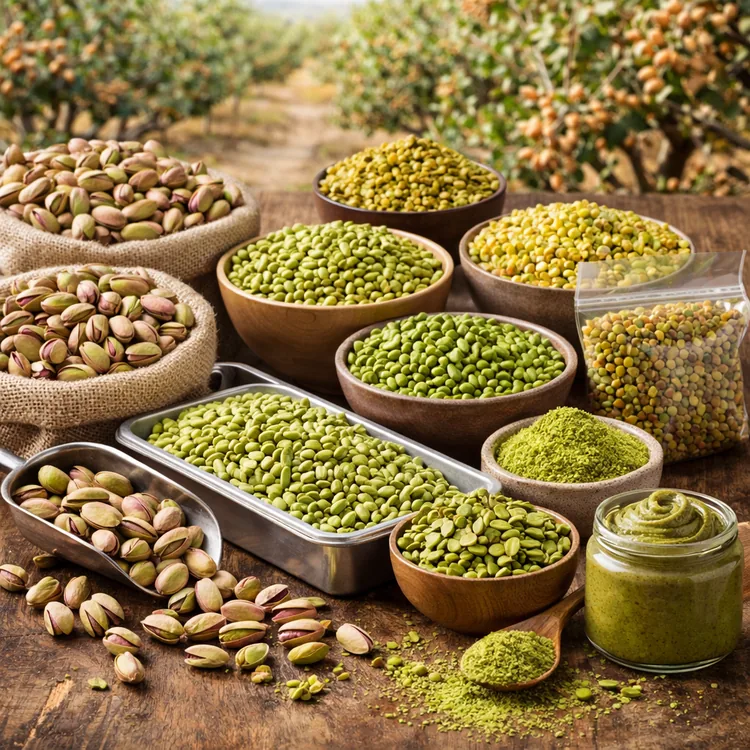
Introduction: why pistachio price is never just one number
In B2B pistachio trade, buyers often begin with price but quickly discover that price alone does not explain value. Two offers may appear similar on paper while representing very different quality levels, processing steps or application suitability. In other cases, a more expensive offer may actually create better commercial value because it improves usable output, supports premium positioning or reduces downstream operational risk.
This is especially true in Turkish pistachio sourcing, where buyers may be comparing in-shell product, kernels, cuts, powder, paste inputs or retail-oriented finished forms. Each of those products carries its own production logic. Even within the same broad category, factors such as color selection, visual uniformity, shell opening, cut precision or processing cleanliness can change commercial value significantly.
For that reason, buyers should think of pistachio pricing as a layered commercial result rather than a simple commodity tag. Crop, grade, color and processing are core drivers, but they are most useful when interpreted alongside the intended application and the real requirements of the market being served.
Why this topic matters to B2B buyers
For B2B buyers, price understanding is not only about negotiation. It is also about specification discipline. A company that understands what is driving a higher or lower offer can compare supply options more fairly, define requirements more precisely and reduce the risk of buying the wrong material for the job.
A snack buyer, for example, may care more about shell presentation, roast suitability and retail appeal. A pastry manufacturer may care more about color tone, granulation and application performance. A paste buyer may be less focused on outward appearance and more concerned with process suitability, flavor concentration and consistency. These priorities affect what kind of pistachio actually represents good value.
Without that context, pricing discussions can become misleading. Buyers may reject an offer that is appropriately priced for a premium application or accept a cheaper offer that later creates cost through lower yield, weaker presentation or application mismatch.
The first price driver: crop size and crop condition
Crop conditions are one of the most fundamental drivers of pistachio pricing because they influence overall raw material availability, product selectivity and market tension. In simple terms, the quality and volume of the crop shape the starting point from which all later grading and processing decisions are made.
When crop conditions are favorable, the market may have broader access to commercially useful material across multiple grades. When crop conditions are tighter, buyers may see stronger differentiation between ordinary and more selective lots. In those situations, the price relationship between grades can become more pronounced because selective material becomes harder to source and more commercially valuable.
Crop condition also affects more than total tonnage. It can influence the proportion of visually stronger kernels, the availability of premium snack-ready in-shell product, the level of sorting required and the amount of material that can be directed toward higher-value applications. For this reason, buyers should treat crop discussion as a quality and allocation topic, not just a volume topic.
Crop impact is not the same across all product forms
One important commercial nuance is that crop effects do not influence every pistachio form in exactly the same way. A market may have enough overall pistachio supply while still experiencing tighter availability in certain more selective formats. For example, the relationship between ordinary commercial kernel supply and premium green garnish material may not move in parallel.
This matters because buyers sometimes think in total product terms rather than format-specific terms. In reality, a crop can support one application comfortably while placing pressure on another. The more visually selective or application-specific the product requirement becomes, the more likely crop conditions are to influence price separation between grades.
That is why buyers should ask not only how the crop is described broadly, but how it affects the particular format they need.
The second price driver: grade selection
Grade is one of the clearest direct drivers of pistachio pricing because it reflects the level of selection and the commercial standard expected by the buyer. However, grade should not be understood only as a technical classification. It is also a market-positioning tool. A higher or more selective grade usually supports a different commercial outcome than a standard industrial or mainstream grade.
In practical terms, higher grades often involve stronger visual consistency, more attractive shell presentation, better kernel appearance, narrower tolerance ranges or a more application-specific selection logic. Lower or broader commercial grades may still be perfectly useful, but they are typically intended for applications where extreme selectivity adds less value.
This is why grade and price must be discussed together. A buyer who wants a premium retail snack, visually refined garnish or cleaner-looking ingredient cannot expect the same price structure as a buyer sourcing a broader commercial industrial format. The price difference reflects not only the raw material but also the selectivity behind it.
Why the right grade depends on the final application
Grade becomes meaningful only when connected to end use. A visually selective kernel may be essential in a pastry decoration application and unnecessary in a ground filling application. A stronger naturally open shell profile may be highly valuable in a branded snack pack and far less relevant in a process-focused industrial environment.
For buyers, the commercial lesson is simple: the best-priced pistachio is not the cheapest one, but the one whose grade is appropriate for the intended use. Overbuying grade creates unnecessary cost. Underbuying grade can create product weakness, customer complaints or a poor fit with the finished product concept.
That is why well-structured suppliers and buyers talk about application, grade and price together rather than in isolation.
The third price driver: kernel color
Color is one of the most commercially sensitive variables in pistachio trade, especially in kernels and derivative formats used in confectionery, pastry, dessert, bakery and premium culinary applications. In many of these categories, greener or more visually attractive material is perceived as more premium and may support stronger finished product appeal.
Color can influence price because it is not equally distributed across all raw material. More selective color outcomes may require more sorting discipline, more careful product allocation and stricter acceptance standards. As a result, product with stronger color appeal often carries different commercial value from more general-use material.
In practice, color matters most where the pistachio remains visible to the end customer or where color is part of the product’s premium identity. Dessert garnish, exposed fillings, premium confectionery, decorative toppings and selected retail ingredient formats often place more emphasis on this factor than applications where the pistachio is blended or visually hidden.
Color value changes by customer segment
Not every buyer should pay for the same color profile. A premium pastry brand may value stronger kernel color because it supports visual differentiation in the final product. A manufacturer producing less visible inclusions may place much less commercial value on that same trait. This is why color should be discussed in relation to product function, not just aesthetic preference.
For some buyers, color is a premium input. For others, it is a secondary quality variable. Understanding which category applies helps prevent two common mistakes: paying too much for a color profile that is not commercially necessary, or buying general-use material for an application that actually depends on visual refinement.
The fourth price driver: processing level
Processing level is one of the most practical price drivers because each additional step adds labor, handling, sorting, transformation and quality control requirements. A raw in-shell product, shelled kernel, diced pistachio, sliced pistachio, powder and paste are not just different forms of the same product. They represent different processing pathways and therefore different value structures.
In general, the more transformation and control required, the more the pricing conversation shifts away from simple raw material cost and toward processing value. Shelling removes one layer of raw format and introduces new yield and sorting considerations. Cutting, slicing or dicing introduces precision and application-based requirements. Powder and paste add further transformation and consistency expectations.
Buyers should therefore interpret price through the lens of process intensity. A higher price on a more processed product may not indicate weaker value. It may simply reflect the additional work required to convert the pistachio into a more ready-to-use commercial format.
Processing value is strongest when it saves downstream cost
The real commercial question is not whether processing raises price, but whether that additional price creates usable value for the buyer. In many cases, it does. A food manufacturer may prefer a ready-cut or ready-ground format because it saves line time, reduces handling, improves recipe control or simplifies labor planning. In those cases, paying for processing may reduce total operational cost even if the quoted product price is higher.
This is why buyers should think about total application value rather than raw invoice comparison. A less processed format can appear cheaper while creating more work, more loss or less consistency inside the customer’s own operation.
Shelling and kernel recovery influence value perception
Shelling changes the economic logic of pistachio supply because the buyer is no longer purchasing a whole in-shell format. The product becomes more concentrated, more application-oriented and more dependent on usable kernel recovery. That shift alone changes how price should be understood.
For snack buyers, in-shell value may depend heavily on shell opening, appearance and roast suitability. For kernel buyers, value is more likely to depend on color, integrity, purity and intended use. Although both products come from pistachios, they belong to different commercial frameworks. Direct price comparison between in-shell and kernel forms is therefore rarely meaningful without context.
Cut size, slice uniformity and derivative formats
Once pistachios move into cuts, slices, granules or powders, price becomes even more application-sensitive. In these categories, buyers are often paying not only for the product itself but for the suitability of the format. A bakery may need a certain cut profile for toppings. A confectionery producer may need a specific granulation for fillings. A retail baking line may need powder with reliable consumer presentation and handling convenience.
This is why derivative formats often require a more precise commercial conversation. The product is no longer being judged mainly on general quality; it is being judged on format-specific fitness. That added specificity can materially affect price.
The fifth price driver: application fit
Application fit is one of the most overlooked price drivers because it is less visible than color or grade, yet often more important in practice. A pistachio that fits the application well can support better performance, lower waste, stronger product consistency and better final presentation. A pistachio that does not fit the application can create hidden cost even if the initial quote looks attractive.
For example, a snack application may require natural shell opening and shelf appeal. A pastry filling may care more about grind suitability and flavor concentration. A garnish application may depend on strong color and visual refinement. An industrial mix may prioritize functional consistency over visual perfection. These are different value systems, and pricing must be interpreted accordingly.
When buyers discuss price without stating the final application clearly, they often receive offers that are hard to compare fairly.
Usable yield and waste risk also affect real cost
Commercially, the quoted price is only part of the equation. Buyers also need to think about usable yield. A product that looks cheaper per kilogram may become more expensive if it produces more waste, lower output quality, more manual sorting or weaker manufacturing efficiency. Conversely, a more refined format may improve usable output enough to justify its higher invoice price.
This is especially important in processing environments where labor, throughput and specification stability matter. If a more application-suitable pistachio format reduces operational friction, it may create stronger total value than a cheaper but less suitable alternative.
Packaging and export presentation can influence pricing too
Packaging is sometimes treated as a secondary issue, but it also influences final price. The type of packaging, the degree of protection required, the unit size, the commercial presentation and the handling logic can all contribute to cost structure. Retail-ready packs, private-label formats, premium presentations and more controlled packaging systems usually involve different economics than bulk industrial supply.
In export supply, packaging also affects how the product is protected during storage and transit. A more tailored packaging solution may cost more, but it may also support better product preservation, cleaner handling or stronger end-market suitability. Buyers should therefore understand whether the quoted price reflects a simple bulk supply model or a more finished market-ready packaging model.
Consistency and repeatability as hidden price factors
Consistency is one of the most commercially important but least visible price drivers. Buyers are not just purchasing a sample. They are usually purchasing the expectation that future lots will remain commercially usable in the same application. Suppliers who can support stronger repeatability often create more value even when their quoted price is not the lowest.
Repeatability matters because inconsistency creates cost in subtle ways. It can trigger re-approval work, disrupt production, weaken brand presentation, create formulation variation or force the buyer into last-minute substitutions. These risks may not appear in the initial price sheet, but they become highly relevant over time.
For that reason, a disciplined buyer should ask not only what the product costs now, but what level of consistency is realistically being offered across repeat supply.
Market positioning affects willingness to pay
Pistachio price is also shaped by the commercial segment the product is intended to serve. A premium gourmet or specialty retail line can justify a different product specification and a different cost base from a value-oriented industrial channel. That is not simply a matter of brand preference. It is a matter of how value is created and recovered in the final market.
In premium channels, color, appearance, origin story and presentation may carry greater weight. In industrial environments, processing fit, consistency and efficient output may matter more. The right pistachio therefore depends on where the buyer intends to capture value later in the chain.
Why origin alone does not explain price
Origin can be commercially important, especially when buyers are building a premium or differentiated offer, but origin alone does not fully explain pistachio price. Two products from the same origin can still have very different prices because of grade, color, format, processing and application logic. In other words, origin may set part of the story, but it does not remove the need to define the actual product requirement precisely.
For Turkish Antep pistachios, origin can support premium identity and culinary positioning. However, the real commercial comparison still depends on what the buyer is asking that origin product to do. A snack brand, bakery manufacturer and retail ingredient company may all value Turkish supply differently because their end uses are different.
Timing and supply planning can also influence commercial outcomes
Pricing discussions are often affected by timing, especially when the buyer has very specific format or color requirements. A reactive approach can reduce flexibility and make comparison harder because the buyer may end up evaluating only whatever is currently easiest to access rather than the most commercially suitable option.
Stronger planning usually leads to better price interpretation because the buyer has more time to define requirements, review samples and align the offer with the intended application. Even when the underlying product is the same category, better planning often produces a clearer value conversation.
How buyers should compare pistachio offers
The most useful way to compare pistachio offers is to build a structured framework rather than focusing only on headline price. Buyers should compare:
- crop and raw material context,
- grade and visual selectivity,
- kernel color or appearance profile where relevant,
- processing level and format suitability,
- packaging and handling practicality,
- expected repeatability, and
- fit with the intended commercial application.
When these factors are compared together, the pricing conversation becomes more realistic and much easier to act on.
Common pricing mistakes buyers make
Several avoidable mistakes appear regularly in pistachio sourcing:
- comparing unlike products as if they were direct equivalents,
- focusing on price per kilogram without considering usable value,
- ignoring application fit and buying on general description alone,
- paying for premium color or selectivity in a format that does not need it,
- underbuying grade for premium visible applications,
- overlooking repeatability and sample-to-production consistency, and
- treating processing value as a surcharge instead of as potential downstream savings.
Most of these mistakes come from one root issue: insufficient definition of what the product needs to achieve in the final business model.
Questions buyers should ask before discussing price in detail
Before moving too deeply into pricing comparison, buyers should answer several practical questions:
- What is the exact end use of the pistachio?
- Is this a snack, pastry, dessert, confectionery, bakery or industrial ingredient application?
- How important are color and visual appearance to the finished product?
- What level of grade selectivity is truly needed?
- Does the buyer need raw product, kernels, cuts, powder, paste or another processed form?
- What packaging format is required for handling and distribution?
- How important is repeatability across future shipments?
- Would a more processed format save downstream cost or time?
- Is the product part of a premium market position or a broader value-driven program?
- What quality points matter most to the customer or the production line?
These questions help transform price comparison from a narrow negotiation exercise into a more useful commercial evaluation.
Suggested buyer brief for better pricing discussions
Buyers often receive more accurate and useful quotations when they share a brief that includes:
- destination market and end-use category,
- required product form,
- relevant grade or quality expectations,
- whether color is commercially important,
- processing preference such as whole kernel, diced, sliced, powder or paste input,
- packaging expectations,
- estimated order rhythm or volume logic, and
- any special needs linked to retail, manufacturing or private-label use.
The clearer the product definition, the easier it becomes to understand what is really driving the final price.
Commercial summary table
| Price Driver | Why It Matters | What Buyers Should Check |
|---|---|---|
| Crop | Shapes raw material availability and selectivity | Assess how crop conditions affect the specific format or grade required |
| Grade | Reflects selection level and market positioning | Match the grade to the real application instead of buying too high or too low |
| Color | Can strongly affect value in visible premium applications | Clarify whether color is commercially important for the finished product |
| Processing | Additional transformation adds handling and application value | Review whether a more processed format saves time, labor or waste downstream |
| Application Fit | Determines real usable value | Compare products in relation to the exact end use, not only headline description |
| Packaging | Affects protection, handling and market readiness | Check whether the quoted packaging matches operational and commercial needs |
| Consistency | Protects future supply performance and brand reliability | Ask how repeatable the approved sample or grade is across future lots |
Atlas perspective
At Atlas, academy content is designed to help buyers move beyond generic sourcing language and toward more precise commercial thinking. Price is one of the areas where this matters most. Buyers often ask for the best price, but the more useful question is what product specification and application logic the price actually represents.
When crop, grade, color and processing are connected clearly to the final use, pricing discussions become more productive. Better definition leads to better offer comparison, better communication and better purchasing decisions.
Final takeaway
Pistachio pricing is shaped by multiple layers of value. Crop conditions influence availability and selectivity. Grade determines how much refinement the product offers. Color can create meaningful commercial separation in visible premium applications. Processing changes the value structure by adding transformation and application readiness. Beyond all of that, the final application decides whether the quoted product is truly appropriate.
For buyers working with Turkish Antep pistachios, the strongest pricing decisions come from understanding not only what the product costs, but why it costs what it does and whether that cost aligns with the intended commercial outcome. Better information leads to better comparisons, better negotiations and better long-term sourcing results.
Frequently asked questions
Who is this guide written for?
This guide is intended for importers, distributors, snack brands, bakery and pastry companies, confectionery producers and other B2B buyers evaluating Turkish pistachio supply.
What is the single biggest driver of pistachio price?
There is rarely one single driver in isolation. Price is usually shaped by a combination of crop conditions, grade, color, processing level and end-use suitability.
Does greener pistachio always mean better value?
Not always. Greener material can be highly valuable in premium visible applications, but it may be commercially unnecessary in formats where color is not important to the final product.
Why is a processed pistachio format often priced higher?
Because shelling, sorting, cutting, slicing, grinding or paste preparation add labor, handling and transformation value. The key question is whether that additional price creates downstream savings or stronger application performance.
Should buyers compare only price per kilogram?
No. They should also compare usable output, grade appropriateness, application fit, packaging, repeatability and the commercial role of the product.
Can a lower-grade pistachio still be the right choice?
Yes. A broader commercial grade can be the most efficient choice when the final application does not require premium visual or color selectivity.
What should buyers include in a pricing inquiry?
A strong inquiry should mention the product form, end use, relevant color or appearance priorities, packaging needs, expected volume and any special application requirements.
How can Atlas help?
Atlas helps buyers connect pricing discussions to product definition, application fit and sourcing requirements so offers can be compared on more meaningful commercial terms.