Introduction: why seasonal dessert demand changes the sourcing conversation
Many pistachio buyers do not operate on a flat annual demand pattern. Instead, they face strong consumption peaks linked to festive calendars, tourism-driven dessert sales, gift periods, promotions, product launches, hospitality demand and regional dessert traditions. In these situations, pistachio sourcing becomes a planning exercise rather than a simple spot purchase.
That planning challenge is especially important in dessert-focused applications because pistachios often play a visible and value-bearing role in the final product. They may be used as a garnish, a filling component, a core flavor, a premium inclusion or a visual differentiator. When demand rises seasonally, the cost of poor planning increases. Late purchasing can lead to format compromise, quality inconsistency, packaging stress, missed production windows or reduced margin at the exact moment the market opportunity is strongest.
For that reason, seasonal dessert demand should be approached through structured supply planning. Buyers need to think beyond price and ask what type of pistachio they need, when they truly need it, how it will be packed, how quickly it will be consumed and what level of stock flexibility is required to absorb demand volatility.
What seasonal demand means in practical B2B terms
Seasonal demand is not limited to one holiday or one sales event. In practical B2B terms, it means any period in which customer orders rise faster than normal, production schedules tighten and stock availability becomes more commercially sensitive. For dessert-related pistachio use, these peaks may occur around regional celebrations, festive gifting periods, tourism season, wedding season, hospitality surges, premium dessert launches or annual promotional cycles.
From a supply perspective, the important point is that seasonal demand often affects more than total volume. It can also change product mix. A buyer who normally purchases standard kernels may suddenly need more bright green garnish material, more diced pistachios for fillings, more powder for retail baking lines or more paste for dessert production. Seasonal growth can therefore place pressure on both quantity and format availability.
This is why effective seasonal planning starts with demand structure rather than procurement alone. Buyers need to understand not just how much they will need, but which formats, which grades and which packaging types will be most exposed during peak periods.
Why dessert applications require tighter planning than some other categories
Dessert applications often place more pressure on color, presentation and consistency than some broader ingredient categories. In pastry, confectionery, premium bakery, frozen desserts and plated sweets, pistachios are frequently visible to the consumer. They are not always hidden inside a formula. This means the choice of kernel tone, cut size, particle consistency and overall appearance can directly influence perceived product quality.
That matters because seasonal dessert periods are often premium periods. Consumers may be buying more gifts, visiting higher-end dessert shops, attending events or purchasing celebratory products where visual quality matters more than usual. A buyer who sources the wrong pistachio format or accepts unstable quality during those periods may affect not only operations but also brand perception.
As a result, seasonal dessert supply planning should include both volume readiness and quality-grade readiness. A buyer may have enough pistachio in total and still be underprepared if the available material does not match the actual seasonal application mix.
The first planning principle: start from the end use
The strongest seasonal supply plans begin with the final application, not with generic pistachio availability. Buyers should first identify where the pistachio will be used. Will it be a filling for premium pastries, a decoration for dessert counters, a core ingredient in pistachio cream, an inclusion in ice cream, a topping for bakery production or a retail packed baking ingredient?
Each end use creates different requirements. A garnish application may need more attention to color and cut precision. A filling application may prioritize consistency and grind suitability. A paste-based dessert line may need stable input material with reliable processing behavior. Retail baking packs may need consumer-friendly pack sizes and visually attractive product presentation. These are not interchangeable decisions.
When the end use is defined clearly, the buyer can make better decisions about grade, format, packaging, stock timing and replenishment logic. Without that clarity, seasonal purchasing often becomes reactive and less efficient.
The second planning principle: forecast by product format, not only by total volume
One of the most common planning mistakes is to forecast total pistachio demand without breaking it down into actual commercial formats. A business may estimate that it needs more pistachios for the season, but unless it also understands whether that increase is concentrated in kernels, diced product, powder, paste input, sliced material or premium garnish grades, the purchasing plan remains incomplete.
Forecasting by format helps buyers understand which lines are truly at risk during the seasonal peak. It also improves supplier communication, because the conversation becomes more precise. Instead of asking for more pistachios in general, the buyer can discuss likely requirements by application and prioritize the most exposed items.
This matters especially in mixed dessert businesses where one format may experience a moderate increase while another experiences a sharp spike. Better format planning leads to better inventory allocation and fewer last-minute compromises.
The third planning principle: align procurement timing with production timing
Buyers often think in terms of sales season, but supply planning must begin much earlier than the sales window itself. Pistachios must be sourced, packed, shipped, received, approved and integrated into production before the final demand peak occurs. That means procurement timing should be aligned with the operational calendar rather than the consumer calendar alone.
For dessert manufacturers and importers, this usually requires working backward from the actual production start date. From there, they can account for internal quality checks, packaging preparation, warehouse intake, transport time, processing schedule and buffer stock needs. In well-run programs, the supply plan is shaped around the moment the product must be ready to perform, not the moment the customer first sees it.
This timing discipline becomes more important when the buyer handles multiple markets or several product formats at once. A late decision in one part of the calendar can create pressure across the whole seasonal portfolio.
Which pistachio formats matter most in seasonal dessert programs?
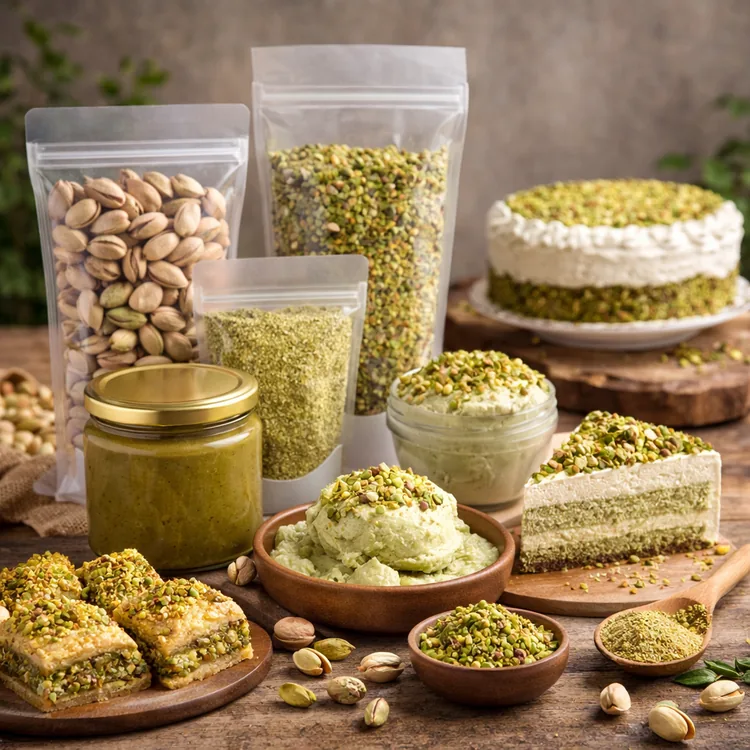
Different dessert businesses rely on different pistachio forms. Seasonal planning becomes more effective when the buyer treats each format as its own planning line rather than bundling them together. Common pistachio formats in dessert-driven supply programs may include:
- Whole kernels: useful for premium garnish, visible inclusions and high-end pastry decoration.
- Diced or chopped pistachios: suitable for fillings, coatings, dessert topping blends and bakery use.
- Sliced pistachios: often used where elegant presentation and even garnish coverage matter.
- Pistachio powder: relevant for bakery, pastry, home baking retail packs and dry mix applications.
- Pistachio paste: important in creams, spreads, fillings, ice cream and premium dessert flavor systems.
- Selected garnish-grade material: useful where visual value and color intensity play an especially strong role.
The correct seasonal plan will depend on which of these formats drive the business during the peak period. A confectionery manufacturer and a dessert retailer may both buy pistachios, but their seasonal format risk can be completely different.
Why color and appearance often matter more during seasonal peaks
Seasonal dessert demand frequently overlaps with premium presentation cycles. During those periods, the pistachio is often not just an ingredient but a visual signal of indulgence, celebration or craftsmanship. That means color tone, cut consistency and visible freshness may take on greater commercial importance than they do in standard production months.
For example, a garnish-focused dessert line may need more attention to bright, attractive presentation. A festive pastry range may rely on pistachio color to communicate quality quickly. A premium retail baking line may need consumer-facing packs that look refined and well selected. These needs place more pressure on material choice and stock allocation during seasonal peaks.
Buyers should therefore avoid assuming that any pistachio inventory can serve any seasonal requirement. Visual-grade demand can tighten faster than total inventory figures suggest.
Inventory strategy: balancing readiness with working capital discipline
Good seasonal planning is not simply a matter of buying as much as possible as early as possible. Buyers still need to manage working capital, warehouse space, shelf-life priorities, stock rotation and product sensitivity. The goal is to hold the right inventory, not just more inventory.
In practical terms, inventory strategy often involves separating stock into different roles:
- Base stock: the quantity needed to cover normal production or standard turnover.
- Seasonal uplift stock: additional inventory specifically linked to the expected demand peak.
- Safety stock: a controlled buffer kept to protect the business from demand surprises, replenishment delays or production drift.
- Strategic quality stock: selected material reserved for applications where visual or sensory requirements are harder to replace quickly.
This structure helps buyers make more disciplined choices about what must be secured early and what can remain more flexible.
Safety stock is not the same as overbuying
Some buyers hesitate to build safety stock because they associate it with unnecessary inventory cost. In reality, safety stock is most useful when it is designed carefully around real risk. It exists to protect customer service, production continuity and product quality during periods when replenishment is harder or mistakes are more expensive.
In seasonal dessert programs, safety stock can be particularly important for high-value or harder-to-substitute pistachio formats. A small shortage of the wrong format can disrupt a premium line even if the business still holds other pistachio inventory. This is why safety stock should be determined by risk exposure, not only by total volume percentage.
Why packaging planning belongs inside the supply plan
Packaging is often discussed late, but in seasonal programs it should be part of the initial supply conversation. The right pistachio format must arrive in a packaging configuration that works for the buyer's warehouse, line handling, stock turnover and production sequence. A well-priced product can still create inefficiency if it arrives in impractical units or without sufficient protection for the intended storage period.
Packaging priorities will vary by buyer type. Importers may focus on warehouse practicality and repacking logic. Manufacturers may care more about production-ready handling units. Retail-oriented users may need consumer-facing seasonal packs or specialized outer carton planning. In all cases, the packaging decision should support the operational calendar rather than remain an afterthought.
This is especially true when the seasonal plan includes multiple product formats or multiple customer programs running at once.
Consistency matters more when seasonal pressure is high
During peak demand periods, businesses often have less time to adjust to quality variation. A format inconsistency or application mismatch that might be manageable in a quiet month can become disruptive during a compressed seasonal production window. For that reason, quality consistency becomes even more important when demand is concentrated.
Importers and food manufacturers should think about consistency on several levels:
- consistency of format,
- consistency of appearance,
- consistency of application behavior,
- consistency from approved sample to delivered lot, and
- consistency across replenishment cycles during the broader season.
When seasonal output depends on repeat production runs, predictable input quality reduces both operational stress and downstream brand risk.
How forecasting should differ for importers, distributors and manufacturers
Not every buyer plans seasonal dessert demand in the same way. Importers, distributors and manufacturers each face different forms of uncertainty.
Importers often need to forecast inbound volume, inventory position and timing of local customer demand while balancing container economics and warehouse capacity. Distributors may need more flexible planning because their customer mix can shift quickly during the season. Manufacturers often need the tightest format-level forecasting because pistachios must fit a specific production recipe, quality system and factory calendar.
This means one generic planning method is rarely sufficient. The best seasonal plan reflects the actual business model and the real point where supply risk becomes expensive.
How to think about risk during seasonal dessert demand
Seasonal pistachio planning should include risk review, not just demand review. Buyers often concentrate on volume projection but underweight the operational risks that turn normal demand variation into supply problems. Relevant risks may include delayed approvals, weak forecast accuracy, packaging bottlenecks, insufficient buffer stock, wrong format mix, slow replenishment decisions or overdependence on a single planning assumption.
A useful way to manage seasonal risk is to identify which failures would hurt the business most. For some companies, the biggest problem is stockout. For others, it is having the wrong product mix. For premium dessert operators, the bigger risk may be not stock shortage in general but shortage of visually stronger or more selective pistachio material. Once the real exposure is known, stock and purchasing decisions can be more deliberate.
Sample approval should happen before the seasonal window tightens
Sample approval is often treated as a routine technical step, but in seasonal planning it has strategic importance. If a buyer waits too long to confirm the right pistachio format, valuable planning time disappears. Product testing, sensory review, line trials or application validation should ideally be completed before the demand window becomes operationally urgent.
This matters because seasonal dessert programs often involve high-visibility finished products. A buyer may need to test not only flavor but also visual effect, decoration quality, filling behavior, spreadability or production compatibility. Approving these details early gives the business more room to secure the right stock and align internal operations with fewer surprises.
Why spot buying can be risky for seasonal dessert programs
Spot buying can work in some categories, but it becomes riskier when the demand pattern is concentrated and the product plays a premium role in finished desserts. The closer the business moves toward the seasonal peak, the less flexibility it may have to accept the wrong format, the wrong presentation or the wrong packaging configuration.
That does not mean every buyer needs long contracts or highly rigid planning. It means the business should understand which part of seasonal demand can remain opportunistic and which part should be secured through clearer advance planning. The more critical the product is to the seasonal assortment, the more dangerous late-stage improvisation can become.
Commercial planning should connect sales, operations and procurement
Seasonal pistachio planning works best when it is cross-functional. Sales teams often understand the demand window. Marketing teams understand promotions and launches. Operations teams understand production constraints. Procurement teams understand supply risk and lead-time pressure. When those inputs stay separate, the pistachio plan may be incomplete.
A stronger model is to translate the seasonal commercial plan into a shared supply plan. This means aligning projected demand with actual product formats, internal production timing, packaging needs, approval deadlines and stock buffers. Even a simple internal planning structure can significantly improve purchasing decisions if it connects these functions early enough.
Questions buyers should ask before seasonal procurement begins
Before placing or expanding seasonal pistachio orders, buyers should try to answer the following questions:
- Which dessert lines or product groups are expected to peak?
- Which pistachio formats are required for those lines?
- Which formats carry the highest visual or quality sensitivity?
- When does production actually need the stock, not just when do sales begin?
- How much flexibility exists if demand exceeds the forecast?
- Which items need safety stock and which can remain more flexible?
- Does the packaging format support handling, storage and production flow?
- Have samples or applications been approved early enough?
- What level of repeatability is needed across seasonal replenishment?
- Which supply assumptions create the greatest risk if they prove wrong?
These questions help shift the business from reactive buying toward more structured commercial planning.
Suggested buyer brief for seasonal dessert demand
When requesting quotations or supply discussions, buyers can improve accuracy by sharing a short application-led brief. A useful seasonal inquiry may include:
- destination market and end-use category,
- expected seasonal demand window,
- required pistachio formats by application,
- whether the product is for garnish, filling, paste, baking, retail packs or mixed use,
- visual or color expectations where relevant,
- packaging requirements and preferred unit size,
- estimated base stock and seasonal uplift volume,
- any critical quality or consistency priorities, and
- replenishment expectations during the broader peak period.
The clearer the brief, the easier it becomes to compare proposals on real commercial fit rather than on generic price alone.
How to compare supplier offers for seasonal planning
Supplier comparison should reflect the realities of the seasonal demand pattern. Buyers should look at more than headline price and total availability. A stronger comparison framework includes:
- fit of the offered pistachio format to the intended dessert use,
- consistency of appearance and application performance,
- packaging suitability for storage and production,
- practicality of seasonal replenishment,
- confidence in repeatability across the peak window,
- clarity of communication around planning assumptions, and
- overall value in relation to the finished seasonal assortment.
A cheaper offer can become less competitive if it creates more operational stress, weaker product fit or higher risk during the most commercially important part of the calendar.
Common mistakes in seasonal pistachio planning
Several errors appear repeatedly in seasonal dessert procurement:
- forecasting only by total tonnage instead of by actual pistachio format,
- starting procurement too close to the production window,
- assuming all pistachio inventory is interchangeable across dessert lines,
- underestimating the importance of visual-grade material in premium seasonal products,
- treating packaging as a late decision rather than part of supply planning,
- failing to build safety stock for the most exposed applications, and
- approving samples too late to make meaningful planning decisions.
Most of these mistakes come from treating seasonal demand as a short-term buying spike rather than a structured planning cycle.
Who typically needs this kind of planning?
Seasonal pistachio planning is relevant to a wide range of buyers, including:
- Importers supplying pastry, confectionery and dessert customers in regional markets.
- Distributors serving mixed customer bases with changing seasonal format needs.
- Bakery and pastry manufacturers using pistachios for fillings, toppings and decorative applications.
- Confectionery brands launching seasonal premium lines or gift-oriented assortments.
- Ice cream and frozen dessert producers requiring consistent paste, powder or inclusion formats.
- Retail packers selling baking ingredients or premium seasonal consumer products.
Each of these businesses may define seasonality differently, but all benefit from a more deliberate approach to pistachio format, timing and stock risk.
Why Turkish Antep pistachios can be commercially relevant in seasonal dessert programs
Turkish Antep pistachios can be particularly relevant in dessert-driven programs because they align naturally with premium culinary positioning. In many dessert concepts, the pistachio is expected to deliver both flavor identity and visual value. A strong origin story can support that positioning, especially when the finished product is marketed as artisanal, premium, regional or festive.
However, origin alone is not the seasonal plan. Buyers still need to define the right format, the right application standard and the right supply timing. The most effective commercial use of Turkish pistachio supply occurs when origin value is supported by disciplined planning and format-level clarity.
Commercial summary table
| Planning Area | Why It Matters | What Buyers Should Check |
|---|---|---|
| End Use Definition | Determines the correct pistachio format and grade logic | Clarify whether the pistachio is for garnish, filling, paste, topping, bakery, confectionery or retail baking use |
| Format Forecasting | Prevents mismatch between demand and available stock | Forecast kernels, diced product, powder, paste and garnish material separately where relevant |
| Procurement Timing | Ensures stock arrives before production pressure intensifies | Work backward from the real production start date, not only from the sales season |
| Safety Stock | Protects the business from demand volatility and replenishment risk | Reserve buffer inventory for the most exposed or hardest-to-replace applications |
| Packaging | Affects storage, handling and production efficiency | Choose packing units that match warehouse flow, shelf-life priorities and line requirements |
| Quality Consistency | Reduces operational stress during compressed seasonal windows | Review appearance, application fit and repeatability across likely replenishment cycles |
| Sample Approval | Supports earlier and more accurate supply decisions | Test relevant formats before the seasonal window becomes urgent |
Atlas perspective
At Atlas, academy content is designed to help buyers connect category knowledge with more useful sourcing decisions. Seasonal dessert demand is a good example of a category challenge that looks simple from the outside but becomes more complex once format, presentation, packaging and operational timing are considered together.
The strongest supply conversations happen when buyers describe the seasonal application clearly, separate the key formats, define the commercial timing realistically and treat pistachio sourcing as part of the broader production plan rather than as a last-minute procurement activity. Better definition creates better quotations, better stock planning and better seasonal execution.
Final takeaway
Pistachio supply planning for seasonal dessert demand should be built around the real shape of the business: which dessert lines peak, which pistachio formats drive that peak, what quality profile those products require and how early the business needs stock in place to perform confidently. Good planning means more than buying early. It means buying the right product, in the right format, with the right packaging and the right level of protection for the most commercially sensitive part of the year.
For buyers working with Turkish Antep pistachios, the opportunity is strongest when origin value is supported by disciplined forecasting, thoughtful inventory design and application-specific supply planning. Better planning leads to better production continuity, better finished product consistency and better use of seasonal demand opportunities.
Frequently asked questions
Who should read this guide?
This guide is intended for importers, distributors, dessert brands, confectionery companies, pastry manufacturers, bakery producers and other B2B buyers planning Turkish pistachio supply around seasonal demand.
Why is seasonal planning more difficult for dessert applications?
Dessert applications often place stronger demands on format, appearance, color and presentation, especially during premium seasonal periods when customers expect a more refined finished product.
What is the biggest mistake in seasonal pistachio planning?
One of the biggest mistakes is forecasting only total volume without separating the actual pistachio formats and applications that drive the seasonal peak.
Should buyers always increase inventory heavily before a seasonal peak?
No. The better approach is to hold the right inventory structure, including base stock, seasonal uplift stock and carefully targeted safety stock for the most exposed applications.
Which pistachio formats are most common in dessert-driven programs?
Common formats include kernels, chopped or diced pistachios, sliced pistachios, pistachio powder, pistachio paste and selected garnish-grade material, depending on the dessert type.
Why does packaging matter in seasonal planning?
Because packaging affects how the product is stored, handled, protected and consumed in operations. A good product in the wrong pack can create unnecessary friction during the busiest part of the season.
When should samples be approved?
Ideally, samples should be reviewed and approved before the seasonal window becomes urgent so the business still has time to align procurement, packaging and production schedules properly.
How can Atlas help?
Atlas helps buyers define application-specific requirements, compare Turkish pistachio supply options more effectively and support clearer commercial planning discussions with suppliers.