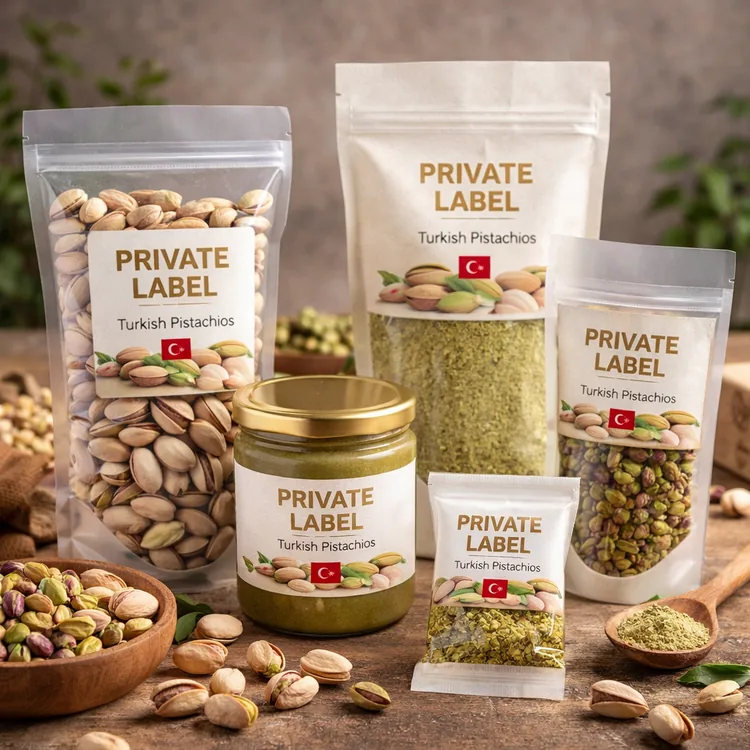
Introduction: why private label matters in pistachio trade
Private label has become one of the most commercially relevant models in packaged food because it allows retailers, distributors and regional food companies to build their own market identity while maintaining more control over price architecture, product positioning and customer loyalty. In the pistachio category, this model is especially attractive because pistachios can be marketed across multiple tiers at once: everyday snacking, premium snacking, gourmet gifting, baking ingredients and health-oriented convenience products.
For Turkish pistachio trade, private label creates an additional layer of value beyond simple bulk export. Instead of supplying only raw or generic processed product, the supply chain can also support branded packaged offerings that are designed for specific retail environments and specific customer profiles. This shift turns pistachios from a commodity-like item into a strategic branded category.
However, private-label success in pistachios is not automatic. It requires clear thinking about the end market, the product format, the visual standard, the brand promise and the operational ability to maintain consistency across repeated orders. A private-label program is only as strong as the underlying supply discipline behind it.
What private label means in practical B2B terms
In practical terms, private label means that the finished product is sold under the buyer’s own brand rather than the producer’s or exporter’s brand. The pistachios may still be sourced, processed or packed through specialized suppliers, but the commercial identity seen by the end customer belongs to the retailer, distributor or food company that owns the label.
This model can apply to a wide range of pistachio products. It may include roasted and salted in-shell pistachios, shelled kernels, pistachio snack packs, diced pistachios for consumer baking, premium gift packs, pistachio powder, pistachio paste in consumer formats or mixed nut assortments containing pistachios as a hero ingredient. In all of these cases, the buyer is not only purchasing product. The buyer is purchasing a branded consumer experience.
That distinction changes the sourcing logic. A normal commodity purchase can tolerate a broader commercial mindset. A private-label purchase must be assessed through the lens of brand protection, shelf performance, repeatability and retail credibility.
Why Turkish Antep pistachios can be attractive for private-label programs
Turkish Antep pistachios can be commercially attractive in private-label programs because they combine a strong origin identity with premium category associations. In many markets, consumers respond positively to products with a regional food story, especially when the product category already carries premium cues. Pistachios are naturally well suited to this because they are visually distinctive, widely recognized as premium nuts and highly adaptable across both snack and ingredient retail segments.
For a private-label buyer, Turkish origin can add storytelling value, but it can also support differentiated positioning on shelf. A product positioned as Turkish Antep pistachio may feel more specialized, more culinary and more premium than a generic pistachio offer. This can be valuable in gourmet retail, higher-end supermarket lines, ethnic premium food channels and specialty packaged ingredient ranges.
At the same time, origin alone is not enough. The product still needs to look, taste and perform in a way that supports the brand promise. Strong private-label execution happens when origin value is matched with consistent product specification and commercially appropriate packaging.
Why private label is more than a packaging exercise
One of the most common misunderstandings in food trade is the idea that private label is simply a packaging change. In reality, private label is a full commercial system. It includes product definition, sensory profile, visual presentation, packaging structure, labeling logic, retailer expectations, price positioning and repeat-order consistency. Packaging is highly visible, but it is only one part of the overall program.
For pistachios, this matters because the end customer notices many quality signals immediately. Shell appearance, roast consistency, fill presentation, kernel color, pack design and freshness perception all combine to shape the retail outcome. If the product inside the pack does not match the quality image on the outside, the brand is weakened quickly.
Private-label buyers should therefore think beyond artwork. The more important question is whether the full product architecture is coherent. Does the product inside the pack justify the claims, visuals and pricing on the outside? A successful private-label pistachio program answers yes to that question every time.
The commercial advantage of private label in pistachios
Private label can create several distinct commercial advantages when managed well. First, it allows the buyer to control brand positioning instead of depending entirely on a third-party supplier brand. Second, it can support better margin structure when the product is designed intelligently around the target market. Third, it gives the buyer more room to define packaging style, product range, promotional rhythm and consumer communication.
In pistachios specifically, private label can also help companies occupy white space in the market. A retailer may want a premium Mediterranean nut line. A distributor may want a strong mid-priced snack range. A specialty food company may want an ingredient-oriented consumer line with pistachio powder, kernels and paste under one umbrella. A private-label model makes these strategies easier to implement.
That said, margin opportunity should never be separated from execution risk. A poorly specified private-label program can create complaints, inconsistent presentation, stock issues and weak repeat purchase. Commercial upside comes from clarity and consistency, not from branding alone.
Which pistachio products are most suitable for private label?
Private-label opportunities in Turkish pistachio trade can cover several product groups, each with different requirements and commercial logic.
- Roasted and salted in-shell pistachios: ideal for mainstream and premium snack lines, where visibility, shell opening and sensory appeal matter strongly.
- Shelled pistachio kernels: suitable for premium snacking, healthy convenience, baking use and mixed nut applications.
- Diced, chopped or sliced pistachios in consumer packs: useful for home baking, dessert decoration and specialty retail ingredients.
- Pistachio powder: attractive for premium grocery, pastry-oriented retail and home confectionery applications.
- Pistachio paste or spread-style concepts: relevant to gourmet food retail, bakery-focused lines and added-value premium ranges.
- Gift formats and seasonal packs: suitable for festive retail, travel retail and premium presentation-oriented channels.
The best product choice depends on the intended sales channel, price point and consumer use case. A private-label buyer should not begin with generic pistachios and then search for a concept. The process works better in reverse: define the retail concept first, then select the most suitable pistachio format for that concept.
Retail strategy comes first
Before a private-label pistachio product is specified, the buyer should define its market role. Is the aim to create a value-oriented retail snack, a premium supermarket line, a specialty gourmet product, a gifting range or a functional ingredient line for home bakers? Each of these models leads to different product decisions.
For example, a value snack line may focus on efficient pricing, solid commercial quality and practical pack sizes. A premium line may demand more attention to shell presentation, roast profile, design refinement and storytelling. A consumer baking line may prioritize clarity of format, pack convenience and consistency rather than luxury cues.
This is why the right starting point for private label is not the product specification sheet. It is the category role. Once the role is clear, product, packaging and pricing logic become easier to define.
Private-label success depends on consistency
Consistency is one of the most important principles in private-label pistachio trade. When the product carries the buyer’s own brand, every lot becomes a direct representation of that brand. Customers do not see the exporter, processor or packer. They see only the label on the front of the pack. This means any inconsistency in appearance, taste, fill presentation or pack quality becomes a brand issue rather than a supplier issue.
For that reason, private-label buyers should pay close attention to sample-to-production match, lot repeatability and communication around acceptable ranges. A product that looks excellent in the first approved sample but drifts in later shipments can create commercial damage that is difficult to reverse. Even if the product remains technically edible, inconsistent retail experience weakens trust.
In practical terms, good private-label programs are built on clearly defined standards, disciplined approvals and aligned supplier expectations from the beginning.
Packaging as a strategic tool
Packaging is one of the strongest decision points in a private-label pistachio program because it affects both product protection and category perception. The right pack format can strengthen premium cues, improve convenience, support freshness and communicate value clearly. The wrong format can make a good product feel generic, awkward or commercially misaligned.
Common private-label packaging options may include:
- stand-up pouches for modern retail snack presentation,
- zipper packs for resealable premium convenience,
- window pouches that highlight shell or kernel appearance,
- jars and tubs for pantry storage and family use,
- single-serve or small multipack formats for convenience and travel,
- gift boxes or tins for seasonal or premium channels, and
- ingredient pouches for home baking and dessert applications.
The pack should match the intended category role. A premium pistachio product in weak packaging can underperform visually. A value product in an over-engineered premium pack may create unnecessary cost and pricing pressure.
Why product format and packaging must work together
In private label, the product and the pack cannot be evaluated separately. Roasted in-shell pistachios, for example, rely heavily on visible shell appeal, so clear windows or transparent elements may help drive sales. Shelled kernels may benefit from a cleaner, more refined pack architecture that highlights color and freshness cues. Powder or chopped pistachio products may need more emphasis on convenience, usage ideas and kitchen practicality.
When the format and packaging support each other, the product becomes easier to position and sell. When they are disconnected, the range feels less coherent. That is why smart buyers review mock-up packs and real product samples together instead of approving them in isolation.
Quality criteria that matter most in private-label pistachios
The exact quality criteria vary by product form, but the core principle is simple: the product must support both the brand promise and the real consumer use case. In in-shell snack products, shell opening, shell cleanliness, roast consistency and visual uniformity matter strongly. In kernel products, color tone, size consistency, integrity and freshness perception may matter more. In chopped or powdered consumer products, clarity of format and usage suitability become especially important.
Across all private-label forms, buyers should pay attention to:
- appearance consistency,
- product-to-pack fit,
- fill presentation,
- sensory balance,
- repeatability across orders,
- packaging protection, and
- alignment between quality level and target retail price point.
Private label is strongest when the product feels intentionally chosen for the brand, not merely sourced and repacked.
How importers and distributors can use private label
Private label is not limited to large retailers. Importers and distributors can also use it strategically to strengthen their own market presence. A distributor serving independent retail stores may use a private-label pistachio line to improve customer loyalty and reduce direct brand comparison. An importer may launch a focused pistachio range to serve regional premium grocery or specialty food channels. A food company may use a private-label ingredient line to build recognition in the home baking market.
In these cases, private label is not only about selling pistachios. It is about creating a branded business asset. The buyer becomes less dependent on purely transactional trade and more capable of shaping long-term customer perception.
Private label versus generic trade supply
Generic trade supply and private label operate with different commercial logic. In generic trade, the product is usually evaluated more directly on price, availability and practical commercial quality. In private label, the product must also carry the weight of retail identity, consumer trust and repeat purchase. This makes the sourcing process more demanding but also more strategic.
The same pistachio lot may be acceptable in a generic wholesale transaction and insufficient for a branded retail program. That does not mean one is objectively better in every sense. It means the value criteria are different. Private-label programs require a more refined alignment between product, positioning and packaging.
Operational requirements behind a strong private-label program
Behind every successful private-label pistachio line is an operational system that supports it. This includes supplier communication, packaging planning, labeling control, production coordination, order forecasting and replenishment discipline. Buyers sometimes focus heavily on the front-end concept while underestimating the operational structure required to sustain it.
Important operational points may include:
- clear product specifications,
- approved pack dimensions and materials,
- labeling and market-language requirements,
- carton configuration and logistics planning,
- repeat-order timing and minimum quantity assumptions,
- quality review procedures, and
- alignment between forecasted volume and production practicality.
Even the best private-label idea can struggle if these practical details are not planned early.
Why sample approval is especially important
Samples play a more critical role in private-label work than in many generic trade transactions because the buyer is approving not only a product, but a representation of their own future brand. Ideally, buyers should assess the product in real or near-real packaging rather than reviewing loose product alone. This allows them to evaluate how the consumer will actually encounter the item.
Where possible, the review process should involve procurement, quality, sales and brand stakeholders. Each team sees different risks. Quality may focus on consistency. Sales may focus on competitive positioning. Marketing may focus on how the product supports the story. Procurement may focus on whether the specification is realistic for repeated supply. That combined evaluation often leads to better decisions.
Common private-label mistakes in pistachio trade
Several mistakes appear repeatedly in private-label pistachio programs:
- treating the project as only a packaging change,
- under-specifying the product while expecting premium retail performance,
- approving artwork without confirming product-to-pack fit,
- ignoring sample-to-production consistency,
- choosing pack formats that do not support the intended category role,
- buying mainly on price despite a strong brand-quality expectation, and
- launching a product range without clarifying its true retail position.
Most of these errors come from incomplete definition. The more clearly the buyer defines the commercial goal, the more effectively the private-label program can be built.
Questions a private-label buyer should answer before requesting quotations
Before approaching suppliers, buyers should ideally clarify the following:
- What role will this product play in the assortment?
- Is the target market value-oriented, mainstream, premium or gourmet?
- Which pistachio format best supports that role?
- What packaging style matches the intended shelf position?
- What quality cues will customers notice first?
- What level of consistency is required across repeat lots?
- What annual or seasonal volume is realistically expected?
- What labeling, language or compliance needs apply in the destination market?
- Will the range be expanded later into other pistachio products?
- How will the brand distinguish itself from existing offers?
These questions help transform a vague private-label idea into a workable sourcing brief.
Suggested buyer brief for a private-label pistachio program
When requesting proposals, buyers can often receive better responses by sharing a clear short brief that includes:
- destination market and target channel,
- product format or product range,
- desired positioning such as value, premium or gourmet,
- preferred pack type and pack size,
- quality priorities relevant to the intended product form,
- expected order volume and replenishment rhythm,
- labeling and artwork requirements, and
- any important brand or category expectations.
The clearer the brief, the easier it becomes to compare proposals on meaningful commercial grounds rather than on generic price alone.
How to compare supplier offers for private-label projects
Private-label offers should be compared through a broader value framework. Buyers should look at:
- product suitability for the intended retail role,
- consistency and quality confidence,
- packaging compatibility,
- ability to support brand positioning,
- practicality of repeat supply,
- clarity of specification, and
- overall commercial fit, not just unit price.
A cheaper offer may look attractive initially but become less competitive if it weakens the final shelf result or increases the risk of inconsistent customer experience. Private label should be evaluated as a total retail system, not as an isolated procurement line.
Private label as a long-term portfolio strategy
One of the strongest advantages of private label in pistachios is that it can evolve into a portfolio rather than a single item. A buyer may begin with one in-shell snack pack, then expand into kernels, gift formats, baking ingredients or pistachio-based premium grocery products. This creates more brand coherence and gives the company a stronger foothold in the category.
For Turkish pistachio trade, this portfolio logic can be particularly attractive because the same origin story can support several related products while still allowing clear segmentation by format, usage and price point.
Commercial summary table
| Area | Why It Matters | What Private-Label Buyers Should Check |
|---|---|---|
| Category Role | Defines product, pricing and packaging logic | Clarify whether the item is value, mainstream, premium, gourmet or ingredient-oriented |
| Product Format | Shapes consumer use and retail fit | Select the pistachio form that best supports the intended channel and customer need |
| Packaging | Influences freshness, visibility and shelf appeal | Match the packaging style to product form, retail positioning and practicality |
| Consistency | Protects the buyer's brand reputation | Assess sample-to-production reliability and repeat-order alignment |
| Quality Cues | Drive consumer trust and repeat purchase | Review the visual and sensory points most relevant to the selected product type |
| Operational Fit | Supports scalable execution | Confirm volume logic, lead time expectations, packaging readiness and replenishment practicality |
| Brand Positioning | Determines whether the final offer feels coherent | Check that the product quality matches the message, design and target price point |
Atlas perspective
At Atlas, academy content is designed to help buyers move from broad interest to practical product definition. Private label is one of the areas where this matters most, because the success of the program depends on connecting brand ambitions to real sourcing decisions. The stronger the product brief, the more useful the supplier conversation becomes.
For buyers interested in Turkish pistachio trade, private label is often most effective when treated as a structured commercial program rather than a simple pack customization exercise. Better definition leads to better samples, better offer comparisons and stronger long-term retail execution.
Final takeaway
Private-label opportunities in Turkish pistachio trade can be commercially powerful, but only when the product, packaging and market position are aligned. Turkish Antep pistachios can support differentiated branded programs across snack, premium grocery and ingredient retail segments, but the value comes from disciplined execution rather than origin story alone.
The most successful buyers define the retail role first, then choose the right pistachio format, packaging structure and quality standard to support that role. From there, supplier comparison becomes more intelligent, sample approval becomes more meaningful and the private-label program becomes easier to scale with confidence.
Frequently asked questions
Who should read this guide?
This guide is intended for importers, distributors, retailers, private-label teams, food companies and B2B buyers researching Turkish pistachio supply for branded retail programs.
What is the biggest private-label opportunity in pistachios?
The biggest opportunity is the ability to build a differentiated brand offer in a naturally premium category while controlling packaging, product mix and retail positioning more directly.
Is private label only relevant to large retailers?
No. Distributors, regional importers, specialty food companies and smaller retail groups can also use private label effectively when the program is clearly defined and commercially realistic.
Which pistachio products are easiest to launch under private label?
Roasted and salted in-shell pistachios and consumer kernel packs are often strong starting points, but the best choice depends on the sales channel, customer profile and target price point.
Why is consistency more important in private label?
Because every shipment reflects the buyer's own brand. Inconsistent product quality or pack presentation becomes a direct brand problem rather than a background supplier issue.
Does premium packaging automatically create a premium private-label product?
No. The packaging and the product inside it must support each other. Premium-looking packaging cannot compensate for weak product fit or inconsistent quality.
What should a buyer include in a private-label inquiry?
A strong inquiry should include the destination market, target sales channel, product format, pack size, desired positioning, expected volume and any packaging or quality priorities.
How can Atlas help?
Atlas helps buyers clarify product requirements, compare private-label supply options more effectively and communicate more precisely with Turkish pistachio suppliers.