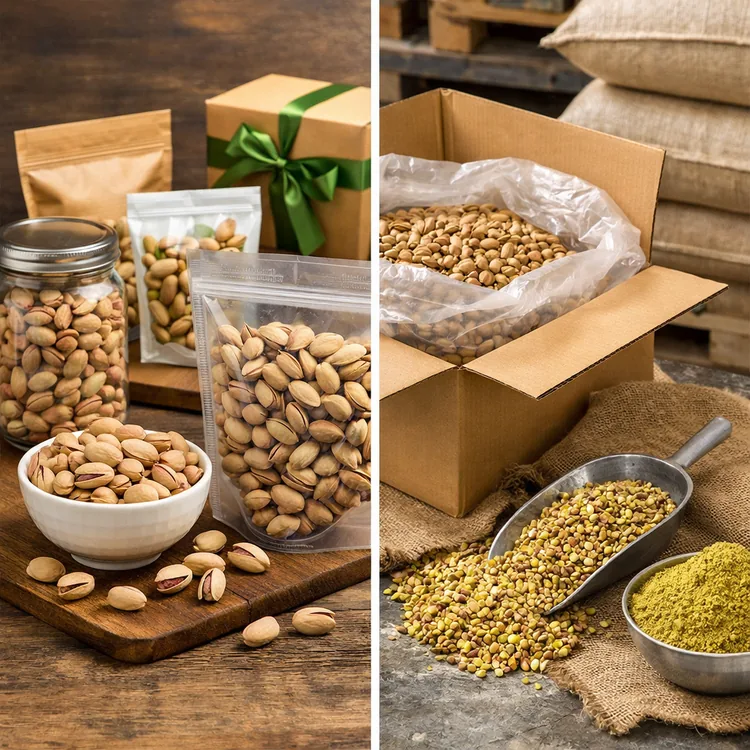
Introduction: one product family, two very different buying logics
At first glance, pistachio sourcing can appear straightforward. A buyer requests pistachios, compares a few offers and then evaluates price, origin and delivery terms. In practice, however, pistachio buying becomes much more precise once the end use is clearly defined. A retail snack pack and an industrial bulk ingredient program may both involve Turkish Antep pistachios, but the two categories are built around different commercial realities.
Retail packs are bought for visibility. They sit on shelves, compete for attention, carry brand identity and are judged immediately by the end consumer. Industrial bulk supply is bought for functionality. It moves into production lines, is transformed into other products and must perform consistently across batches, formulations and manufacturing conditions. Because of this difference, the same raw material may be considered excellent for one application and inefficient for another.
This distinction matters for more than product description. It affects specification design, price comparison, packaging choice, logistics planning, quality control priorities and supplier communication. Buyers who approach the two channels with the same evaluation framework often face preventable problems such as the wrong grade, unnecessary cost, unsuitable packaging, unstable quality perception or poor process fit.
Why this distinction matters for B2B buyers
For B2B buyers, pistachio sourcing is not simply about purchasing nuts. It is about purchasing the right commercial outcome. Retail customers want shelf-ready products that look attractive, feel premium and support repeat purchasing. Industrial buyers want reliable ingredients that integrate smoothly into recipes, machines and quality systems. The supply model should therefore reflect the intended business model.
When the difference between retail and industrial logic is not clearly defined at the start, buyers can end up over-specifying the product and paying for unnecessary visual selectivity, or under-specifying it and receiving material that does not suit the target application. In both cases, the result is a weaker commercial decision.
Understanding the difference early helps buyers ask better questions. Instead of asking only what grade is available, they begin asking whether the product will be packed for direct shelf sale or sent into a processing environment, whether appearance or yield matters more, whether the format should be ready for branding or ready for production efficiency, and whether the economics should be judged per pack sold or per kilogram used in manufacturing.
What counts as a retail pistachio pack?
Retail pistachio packs are consumer-facing products prepared for direct sale. These may include branded snack pouches, stand-up zipper packs, jars, tubs, gift packs, supermarket private-label packs, convenience-store formats or specialty gourmet presentations. The product may be in-shell, shelled, roasted, salted, flavored or plain, depending on the target channel and positioning.
The defining feature of a retail product is not just the pack size. It is the fact that the product must perform visually and commercially in front of the consumer. This means appearance, consistency and pack presentation matter strongly. The pistachio is no longer only an agricultural or ingredient item; it becomes part of a finished branded offer.
Because retail products are sold through customer perception, they are often specified with tighter attention to visual grade, color harmony, shell opening, pack fill appearance, roast uniformity and premium cues. Even small details can affect the way shoppers interpret value. A cleaner-looking lot, a more uniform kernel tone or a more attractive pack window can change perceived quality significantly at the shelf.
What counts as industrial bulk supply?
Industrial bulk supply refers to pistachios purchased primarily as an input for manufacturing, food processing or repacking operations rather than for immediate retail display. This may include kernels for confectionery, pistachio pieces for bakery, pistachio paste inputs, powder, meal, diced material or bulk in-shell product intended for downstream handling. The product is typically shipped in formats designed for efficiency, protection and production practicality rather than for direct shopper appeal.
In an industrial setting, the product is valued mainly for what it does inside a process. Buyers care about how it blends, grinds, bakes, mixes, fills, disperses, colors, tastes and behaves under manufacturing conditions. Visual perfection may still matter, especially in premium applications, but it is rarely evaluated the same way as a finished retail pack.
Industrial supply programs are therefore usually more specification-driven in terms of usable yield, consistency, format suitability and application performance. The product may be evaluated by recipe functionality, tolerance control, color range, particle size, moisture behavior, purity and repeatability across production runs. This is a different buying language from retail, even when the underlying origin is the same.
The core difference: perception value versus process value
The easiest way to understand the distinction is to separate perception value from process value. Retail products depend heavily on perception value. The consumer sees the product, the pack, the shape, the color and the presentation before deciding whether to buy. Industrial products depend more heavily on process value. The manufacturer cares about how efficiently the material can be used to create a final product with predictable quality and controlled cost.
That does not mean retail buyers ignore functionality or industrial buyers ignore quality appearance. Both care about quality. The difference lies in where value is created. Retail value is created at the shelf and in the consumer experience. Industrial value is created inside the factory, formulation and throughput system.
This change in value logic affects almost every sourcing decision. A retail buyer may willingly pay more for a product with better visual presentation because the product supports premium positioning and higher shelf pricing. An industrial buyer may reject that same premium if the application hides the visual difference and the extra cost does not improve manufacturing output or finished product performance.
How retail buyers typically evaluate pistachios
Retail buyers usually begin with market positioning. Is the product meant for everyday snacking, premium gifting, private label, gourmet food retail or health-focused premium shelves? Once that is defined, they assess the pistachio in terms of what the consumer will notice first and what will support repeat purchasing later.
In practical terms, retail buyers often focus on:
- Visual appeal: how clean, attractive and premium the product looks in the pack.
- Uniformity: whether the lot feels controlled and commercially polished.
- Pack fit: how well the pistachio format suits the chosen packaging style.
- Consumer convenience: especially relevant for in-shell products, opening ease and usability.
- Flavor profile: how suitable the roast, salt or natural taste is for the target market.
- Brand alignment: whether the product quality supports the intended brand price point.
Retail buyers are effectively buying a combination of product quality, consumer appeal and merchandising value. For that reason, a technically usable lot can still be commercially weak if it lacks the visual confidence needed for shelf sale.
How industrial buyers typically evaluate pistachios
Industrial buyers normally start from the application. Will the pistachio be used in pastry fillings, chocolate bars, ice cream, bakery toppings, dessert sauces, cereal inclusions or ingredient blends? The answer shapes the specification. A buyer purchasing for bakery inclusions, for example, does not evaluate the material the same way as a buyer sourcing pistachios for jarred retail snacks.
Industrial evaluation usually focuses on:
- Application fit: whether the product matches the intended use in terms of size, texture and format.
- Specification stability: how consistently the lot performs from one shipment to another.
- Usable yield: how much of the delivered product becomes productive output.
- Processing behavior: how the product handles cutting, grinding, mixing or inclusion.
- Purity and control: cleanliness, defect control and suitability for industrial quality systems.
- Cost efficiency: the product’s true value relative to manufacturing use, not just invoice price.
Industrial buyers are purchasing a manufacturing input, not a finished shelf statement. That changes the way price, grading and packaging should be interpreted.
Retail pack logic: what makes a pistachio commercially shelf-ready?
Retail shelf-readiness depends on a product’s ability to look desirable and trustworthy at the point of sale. In the pistachio category, that often means a balance between premium appearance, strong taste expectations and pack protection. The product must photograph well, display well, fill the pack attractively and maintain freshness throughout its retail life cycle.
For in-shell retail pistachios, naturally open shells, clean surface appearance and uniform roast presentation can be especially important. For shelled kernels or premium snack mixes, color balance, kernel integrity and overall visual harmony matter more. In both cases, the buyer is thinking about the product through the eyes of the shopper.
The pack itself is also part of the product. Stand-up pouches, window packs, jars, seasonal tins and private-label sachets all create different expectations. A premium transparent pouch places more pressure on visual consistency because the product is always visible. A jar format may emphasize abundance and color. A matte high-end pouch may rely more on branding and claims, but the content still needs to justify the message once opened.
Industrial bulk logic: what makes a pistachio efficient for manufacturing?
In industrial bulk programs, the pistachio must support a stable process and predictable result. The buyer is not asking how attractive the lot looks on a shelf, but how well it behaves as an ingredient. Does it maintain the desired flavor intensity? Does the particle size stay within target? Does the product work consistently in recipes? Does it create unnecessary wastage or process interruptions?
Industrial logic tends to be built around utility. A lot that is perfectly suitable for grinding or filling does not need the same visual polish as a premium retail product. What matters is whether the product delivers value inside the production environment. If a processor is paying for appearance that never reaches the end consumer, the sourcing model may be economically inefficient.
That said, industrial supply is not a lower standard. It is simply a different standard. A manufacturer may have very strict requirements for particle size, moisture control, purity, formulation behavior or lot-to-lot repeatability. Those requirements can be highly technical and commercially critical, even if they are less visible to the consumer.
Packaging differences: presentation versus protection and throughput
Packaging is one of the clearest operational differences between the two supply models. Retail packaging is designed to sell, protect and communicate. Industrial packaging is designed to move, store and integrate efficiently into operations.
Retail pack formats may include:
- small consumer pouches for individual sale,
- family-size snack packs,
- zipper pouches for resealability,
- jars or tubs for pantry storage,
- premium gift formats, and
- private-label retail packs prepared for store placement.
Industrial bulk formats may include:
- lined cartons,
- vacuum or barrier-packed bulk units,
- foodservice sacks or large pouches,
- ingredient-ready cases for production environments, and
- bulk configurations designed for repacking or downstream transformation.
In retail, the packaging decision is closely tied to merchandising. In industrial programs, it is more closely tied to logistics, production handling and cost efficiency. Choosing the wrong packaging logic can create avoidable cost, weak shelf performance or operational inconvenience.
Specification differences: why one product brief should not be used for both
A common sourcing mistake is to use a single generic pistachio brief for very different applications. This usually results in vague offers, misaligned samples and poor comparability. Retail and industrial programs should be briefed separately because the product success criteria are not the same.
A retail brief should usually define:
- target market and sales channel,
- brand positioning,
- intended pack format and fill size,
- preferred visual style,
- consumer taste direction,
- whether the product is private label or branded,
- labeling needs, and
- expected pack-life requirements.
An industrial brief should usually define:
- application type,
- required format such as whole kernel, pieces, granules, powder or paste input,
- processing expectations,
- range or consistency requirements,
- packing unit suitable for the line,
- expected usage rate,
- production volume and call-off rhythm, and
- critical quality tolerances relevant to manufacturing.
The clearer the brief, the more useful the supplier response becomes. Instead of receiving a generic pistachio offer, the buyer receives a more precise commercial proposal matched to the end use.
Quality control priorities in retail packs
Retail products are judged strongly by appearance and first impression, so quality control in retail programs often gives extra attention to visual and sensory factors. The product should feel intentionally selected, not merely packed. Even small inconsistencies can have an outsized effect on perceived value once the product reaches shelves.
Retail quality control often pays special attention to:
- visual cleanliness,
- uniformity of size or presentation,
- shell opening for in-shell formats,
- kernel integrity for shelled formats,
- roast or finish consistency where applicable,
- salt or seasoning distribution for snack products,
- dust level inside the pack, and
- the overall consumer impression when the pack is opened.
Retail buyers should ideally review both loose samples and packed samples, because some quality issues become more visible only in the final merchandising format.
Quality control priorities in industrial bulk supply
Industrial buyers usually evaluate quality through the lens of process suitability and economic efficiency. A good industrial lot is one that supports stable production, not one that simply looks premium in isolation. This shifts inspection priorities toward factors that affect real output.
Industrial quality control often emphasizes:
- format consistency,
- handling suitability,
- purity and foreign material control,
- repeatability across lots,
- behavior during processing,
- compatibility with machinery or recipes,
- storage performance in bulk conditions, and
- yield after intended transformation.
For manufacturers, a visually attractive product that creates line inefficiency or specification drift is not a good buy. Industrial quality should therefore always be defined in application terms.
Pricing logic: why the cheapest quote is often the wrong comparison
Retail and industrial pistachio programs should not be compared using the same price logic. In retail, the price has to be understood in relation to perceived shelf value, pack architecture, branding power and consumer willingness to pay. In industrial programs, the price has to be understood in relation to usable output, process efficiency and cost per effective application.
For example, a more selective retail grade may carry a higher unit price but still be commercially efficient if it enables premium shelf positioning, stronger sell-through or better consumer trust. On the other hand, paying for premium visual selection in a bulk ingredient application may create unnecessary cost if the product is chopped, ground or blended in a way that removes that visual advantage.
The better question is not “Which quote is cheaper?” but “Which quote creates the best value in the actual business model?” That question leads to better sourcing decisions and more realistic offer comparisons.
Retail margin logic versus industrial yield logic
Retail programs are often built around brand margin, shelf placement and consumer willingness to pay. A buyer may accept a higher product cost if it supports a stronger premium story, better pack appearance or a higher perceived value at the point of sale. In this context, visual and sensory differentiation can directly justify commercial pricing.
Industrial programs are more often built around yield logic. The question becomes how efficiently the material turns into productive output. Does the product minimize loss? Does it support formulation consistency? Does it reduce operational headaches? A product with a lower invoice price but weaker yield or unstable processing behavior can become more expensive in real use.
This is why sophisticated buyers often speak in terms of landed value, usable value or manufacturing value rather than only ex-works or invoice price.
Logistics and inventory planning differences
Retail and industrial channels also create different planning rhythms. Retail programs may be influenced by promotions, seasonal launches, gift periods, branding calendars or supermarket listing cycles. Industrial programs are more often tied to production schedules, manufacturing forecasts, monthly consumption rates and supply continuity requirements.
Retail inventory planning typically needs attention to:
- finished pack turnover,
- shelf-life visibility for stores,
- launch timing,
- promotional spikes, and
- presentation-ready stock availability.
Industrial planning typically needs attention to:
- batch scheduling,
- safety stock for production continuity,
- warehouse handling of bulk units,
- call-off efficiency, and
- risk reduction from supply inconsistency.
These differences affect not only shipping strategy but also packaging choice, order size and how supplier relationships are structured over time.
Private label retail programs: where sourcing becomes branding
Private label sits firmly within retail logic, but it has its own sourcing discipline. A private-label pistachio program is not simply about obtaining a snack product. It is about obtaining a snack product that reliably represents a retailer’s or distributor’s brand promise. That makes consistency especially important.
Private-label buyers usually need to define product style, pack format, artwork needs, labeling requirements, target sensory profile and visual expectations very clearly. Because the customer sees only the retailer’s brand, even minor inconsistencies in lot appearance, seasoning or pack fill can create disproportionate reputational risk.
For this reason, private-label retail programs often benefit from tighter product briefing, clearer sample approval steps and closer attention to sample-to-production match than generic spot purchases.
Industrial repacking and hybrid models
Not all supply models fit neatly into one category. Some buyers import bulk product and then repack it for local retail distribution. Others purchase industrial formats but require a higher visual standard because the product remains partially visible in the final application. Some distributors serve both retail and manufacturing customers from the same sourcing network.
These hybrid models require even more care because the buyer may need separate grades, separate packing configurations or separate pricing logic under one broader purchasing relationship. The most important principle is not to treat all pistachio programs as interchangeable. Even within one company, different customer groups may need distinctly different product definitions.
Common buying mistakes when comparing retail and bulk offers
Several sourcing mistakes appear repeatedly when buyers move between retail and industrial pistachio programs without adapting their framework. The most common include:
- comparing retail-ready products against industrial ingredients using only price per kilogram,
- paying for premium appearance in an application where appearance is commercially irrelevant,
- under-specifying a retail program and receiving product that looks too ordinary for shelf sale,
- using consumer-pack packaging assumptions for bulk production environments,
- approving a sample without clarifying the intended application,
- assuming the same grade should serve both premium retail and process-focused manufacturing, and
- failing to evaluate the true cost in terms of yield, repacking, complaints, presentation or operational efficiency.
Most of these problems come from one root issue: not defining the business model clearly enough before evaluating offers.
How importers should decide which route is right
The best starting point is to work backward from the point of value creation. Ask where the pistachio needs to perform. If it must attract a consumer and justify a retail price on the shelf, retail logic should dominate. If it must feed a manufacturing process and deliver reliable output, industrial logic should dominate.
Helpful decision questions include:
- Will the pistachio be sold directly to the end consumer or used as an ingredient?
- Is visual appeal a sales driver or merely a secondary quality factor?
- Does packaging need to sell the product or simply protect it efficiently?
- Is the key economic measure margin per retail pack or performance per kilogram used?
- Will the product be judged by shoppers, by production teams or by both?
These questions help clarify what kind of supply program the buyer should build and which suppliers or processors are most relevant to the requirement.
What importers should ask suppliers for retail programs
Retail buyers benefit from asking application-specific questions rather than generic product questions. Useful points to clarify include:
- What product style is best suited for the intended sales channel?
- How will the product look in the final pack format?
- What pack sizes and retail-ready options are available?
- How consistent is the visual profile from lot to lot?
- What quality points most directly affect consumer impression?
- Can the product support private-label or branded retail positioning?
- How should shelf-life expectations be aligned with the chosen packaging format?
What industrial buyers should ask suppliers
Industrial buyers should focus more directly on process fit and operating value. Useful questions include:
- Which pistachio format best fits the intended manufacturing application?
- How stable is the specification across repeat lots?
- What packing configuration is best for warehouse and production handling?
- How should the product be stored and managed before use?
- What type of consistency can be expected across supply cycles?
- Is the offered grade aligned with process value or does it include unnecessary premium cost?
- What practical factors may affect usable yield in the factory environment?
Retail versus industrial comparison table
| Area | Retail Pistachio Packs | Industrial Bulk Supply |
|---|---|---|
| Primary Purpose | Direct consumer sale and shelf performance | Manufacturing input and process efficiency |
| Main Value Driver | Perception, presentation and repeat purchase | Usable yield, consistency and application fit |
| Packaging Logic | Merchandising, branding and freshness in retail packs | Protection, handling efficiency and bulk practicality |
| Typical Buying Focus | Appearance, pack readiness, taste and consumer appeal | Specification control, process behavior and efficiency |
| Economic Lens | Margin per pack and shelf value | Cost per effective use in production |
| Quality Emphasis | Visual consistency and sensory impression | Functional consistency and operational reliability |
| Best For | Retailers, importers, distributors, private-label brands | Food manufacturers, ingredient users, processors, repackers |
How Turkish Antep pistachios fit both models
Turkish Antep pistachios can serve both retail and industrial programs, but the value proposition should be framed differently in each case. In retail, the origin may contribute to premium storytelling, authenticity and specialty appeal. In industrial use, the same origin may be valued more for flavor character, application suitability and differentiation inside finished products.
The key point is that origin alone does not determine the right commercial format. The pistachio still needs to be matched to the relevant supply model. A strong origin story can add value, but it does not remove the need for clear grading, packaging and specification logic.
Atlas perspective: why better category definitions improve sourcing outcomes
At Atlas, educational content is used to make product discussions more practical and more precise. Buyers often know they need pistachios, but the more useful question is what kind of pistachio program they are actually building. Once that becomes clear, conversations about quality, pricing, packaging and supplier fit become much easier and more productive.
A clearer distinction between retail and industrial models helps buyers avoid mismatched quotations, compare offers more fairly and move faster toward commercially useful specifications. It also supports better communication between procurement, sales, brand and technical teams, all of whom may evaluate the same product from different perspectives.
Final takeaway
Retail pistachio packs and industrial bulk supply should never be treated as the same buying category simply because they involve the same raw product family. Retail programs are shaped by shelf performance, consumer experience and brand positioning. Industrial programs are shaped by application fit, operational consistency and manufacturing economics.
The smartest buyers define the end use first, then build the product specification around that reality. That is how they avoid overbuying, underbuying or comparing offers that are not truly comparable. Better category definition leads to better samples, better supplier conversations, better pricing logic and better long-term sourcing outcomes.
In practical terms, the question is not just “Which pistachio should we buy?” It is “Which pistachio supply model best supports our business?” Once that question is answered, the buying process becomes more disciplined and far more effective.
Frequently asked questions
Who should read this guide?
This guide is written for importers, distributors, private-label buyers, snack brands, repackers and food manufacturers researching Turkish pistachio supply.
What is the biggest difference between retail and industrial pistachio buying?
The biggest difference is the source of value. Retail buying is heavily influenced by shelf appeal, pack presentation and consumer experience, while industrial buying is driven more by process fit, consistency and cost efficiency in production.
Can the same pistachio grade work for both retail and industrial use?
Sometimes, but not always. A product that works well in one model may be unnecessarily expensive or commercially weak in the other. The right answer depends on the intended application and business model.
Why should buyers avoid comparing only price?
Because price alone does not show real value. Retail products should be judged in relation to consumer perception and pack performance, while industrial products should be judged in relation to yield, process behavior and production efficiency.
Is private label considered retail or industrial?
Private label is generally a retail-oriented model because the product is sold directly to the consumer under a store or distributor brand, even if it may be sourced and packed through a B2B supply chain.
What should an importer include in a retail inquiry?
A strong retail inquiry should mention the target market, sales channel, pack size, positioning, desired product style, branding needs and any special packaging or labeling requirements.
What should an industrial buyer include in an inquiry?
An industrial inquiry should clearly state the intended application, desired format, relevant processing expectations, packing preference, estimated volume and any consistency points that matter to the manufacturing process.
How can Atlas help?
Atlas helps buyers define the right pistachio format, compare supply options more intelligently and communicate more clearly with Turkish pistachio processors and exporters.