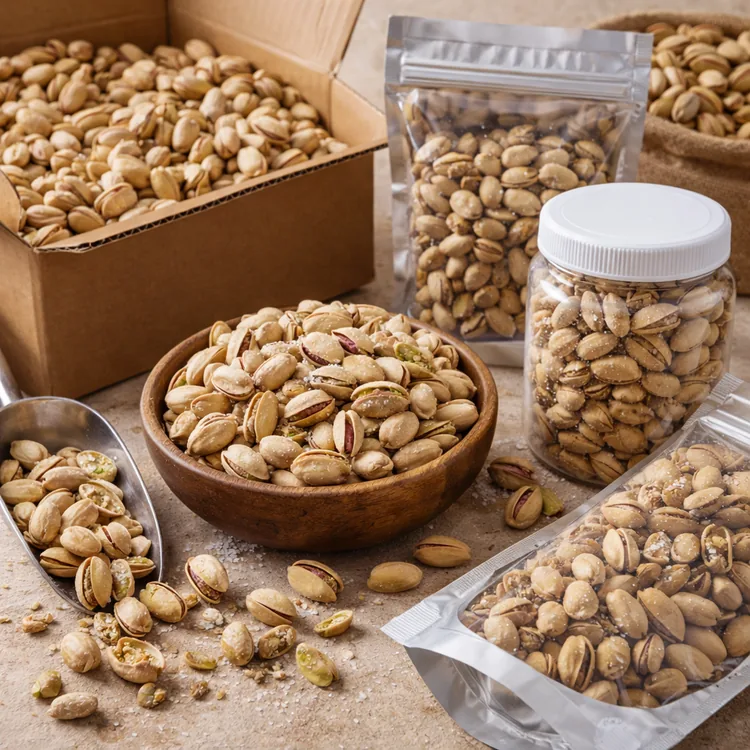
Introduction: why importers need a more detailed buying framework
In-shell roasted and salted pistachios are usually purchased for consumer-facing channels, which means the product is judged twice: first by the buyer during sourcing, and later by the end customer at the shelf and at the moment of consumption. This dual evaluation makes the category commercially sensitive. A shipment that is technically acceptable on paper may still underperform if the roast is uneven, the shells look dull, the nuts are hard to open, or the salt level does not match local taste preferences.
For that reason, professional importers should evaluate roasted and salted pistachios as a finished retail or distribution product rather than as a simple agricultural commodity. The relevant questions extend beyond raw material origin and total price. Buyers should examine shell opening ratio, appearance, color consistency, roasting style, defect tolerance, packaging suitability, label-readiness and expected shelf performance in the destination market.
Turkish Antep pistachios are especially relevant in premium and origin-driven programs because they are associated with strong pistachio character, regional identity and distinctive market positioning. However, even an attractive origin story must be supported by consistent processing and a clear commercial specification if the product is intended for recurring import programs.
What exactly is the product in commercial terms?
Roasted and salted pistachios in this context generally refer to in-shell pistachios that have been cleaned, sorted, roasted and seasoned for direct consumption. They are commonly sold in supermarkets, gourmet retail, convenience channels, travel retail, hotel and hospitality settings, specialty food stores and private-label snack ranges. Depending on the market, the same product may be positioned as a daily snack, a premium sharing nut, a festive gift item or a high-end Mediterranean or Middle Eastern specialty.
Although the basic product description sounds simple, there can be significant variation in commercial style. Some buyers prefer a lighter roast that preserves a fresher nut character and lighter shell tone. Others want a darker roast with stronger aroma and more visible roasted character. Salt can also be subtle or assertive depending on the consumer segment. Pack sizes may range from small impulse packs to family packs and bulk distributor formats. These differences should be defined early because they directly affect the quotation, processing method and final product fit.
Why origin and raw material selection still matter after roasting
Roasting enhances aroma and texture, but it does not hide all weaknesses in the underlying raw material. In fact, it can exaggerate some of them. Mixed maturity, poor shell appearance, excessive defects or inconsistent sizing may become even more obvious after roasting. This is why strong finished product performance begins with disciplined raw pistachio selection.
For importers evaluating Turkish product, origin is relevant not only as a marketing asset but also as a practical sourcing factor. Buyers typically associate Turkish Antep pistachios with a more concentrated flavor identity and a strong premium story. However, the actual finished result still depends on sorting quality, size selection, shell cleanliness, natural opening characteristics and the processor’s roasting discipline.
When comparing offers, importers should therefore distinguish between three layers of value:
- Agricultural value: origin, varietal characteristics, harvest condition and base raw material quality.
- Processing value: cleaning, grading, roasting, salting, sorting and packing execution.
- Commercial value: retail suitability, consistency, branding readiness, compliance support and supply reliability.
The first key criterion: naturally open shells and ease of consumption
One of the most important buying points for roasted and salted in-shell pistachios is the shell opening ratio. End consumers expect the product to be easy to open and pleasant to eat. A retail program can lose value quickly if too many nuts are tightly closed, difficult to crack or visually unattractive. This issue affects both user experience and perceived quality.
From a buying perspective, shell opening matters for several reasons. It influences consumption convenience, premium perception, photo appeal for branded packaging, complaint risk and repeat purchase. Open shells also improve shelf presentation because the customer can immediately see the kernel tone and the product looks more generous and snackable.
Importers should ask how the processor handles shell sorting and whether the finished product is designed around naturally open pistachios for retail presentation. In more premium programs, buyers may want to define acceptable levels for closed shell content, shell staining or visually weak lots. Even when exact thresholds vary by supplier and market, the principle remains the same: the better the shell presentation, the stronger the retail positioning.
The second key criterion: roast profile and flavor development
Roasting is not only a preservation or finishing step. It is a flavor-shaping step that determines whether the product feels premium, ordinary or overprocessed. A successful roast should intensify pistachio aroma, improve crunch, reduce raw notes and create a warm, appetizing sensory profile without introducing burnt bitterness, uneven color or excessive dryness.
Importers should assess roast profile with both sensory and commercial thinking. A lighter roast may preserve more of the origin character and natural nut sweetness, while a medium roast may create broader consumer acceptance in mainstream snack channels. A darker roast can work in some markets, but only if it remains controlled and does not overpower the pistachio identity.
During supplier discussions, it is useful to ask whether the roast is designed around:
- a more natural and premium flavor expression,
- a more pronounced snack-style aroma,
- stronger shelf appeal through darker shell tone, or
- specific market expectations in the buyer’s destination country.
Sampling should not be reduced to “tastes good” or “tastes normal.” Buyers should check whether the roast is uniform across the lot, whether aroma is clean and characteristic, whether the product feels too dry or too oily in finish, and whether the roast level supports the intended brand image.
The third key criterion: salt application and taste balance
Salting is often underestimated in sourcing conversations, yet it has major impact on consumer acceptance. Salt level affects first impression, repeatability, flavor persistence and how easily the product can fit into different snack positioning strategies. Too little salt can make the product feel flat in markets that expect a classic savory snack profile. Too much salt can overpower the nut and make the product feel aggressive, less premium or less suitable for health-conscious positioning.
Importers should not assume that “salted” means the same thing in every market. Taste expectations differ by region, retail channel and brand concept. A mainstream convenience format may tolerate a stronger savory profile, while a premium private-label or gourmet brand may prefer more restrained seasoning that keeps attention on the pistachio itself.
Important commercial questions include:
- Is the salt level aligned with the target consumer profile?
- Is the seasoning evenly distributed or patchy across the lot?
- Does the product leave excessive surface residue in the pack?
- Does the salt enhance flavor, or does it dominate it?
- Will the taste profile support long-term repeat purchase rather than a one-time trial?
Appearance and visual merchandising value
Retail snack products are purchased with the eyes before they are judged by taste. This is especially true for pistachios because the shell, the partially visible kernel and the natural color contrasts all contribute to shelf appeal. In practical terms, the product needs to look clean, inviting and premium when viewed through transparent windows, jars, pouches or open display bins.
Importers should review the full visual picture: shell color, shell cleanliness, degree of staining, proportion of open shells, lot uniformity and how the roast affects the final appearance. A visually mixed lot can create the impression of inconsistent processing even if the flavor is acceptable. For premium and private-label channels, consistent visual presentation becomes part of the brand promise.
Buyers working on branded programs should ideally evaluate products in the final pack format as well as in loose sample form. A product that appears attractive in a tray may look much less refined once packed into a retail pouch if shell dust, breakage or uneven color become more obvious through the pack window.
Size grading and why it influences perceived value
Size is not simply a technical classification. It is also a pricing and positioning variable. Larger, more uniform pistachios generally support stronger premium perception, particularly in gift, gourmet and export retail channels. Smaller or mixed size lots may still be commercially viable, but they should match the intended price point and market segment.
For importers, size consistency matters because it influences pack appearance, fill presentation and customer expectations. A pack that contains highly mixed sizes can appear less controlled and less premium, even when the product is safe and edible. In shelf-ready formats, visual uniformity often contributes directly to the perceived value of the brand.
When requesting offers, buyers should clarify whether they want a standard commercial program, a premium retail program or a visually selective private-label grade. This helps reduce quotation ambiguity and makes sample evaluation more meaningful.
Defects, tolerances and practical quality control points
No agricultural product is entirely free of natural variation, but professional import programs require clear expectations about defects and tolerances. For roasted and salted pistachios, common control points include closed shells, shell damage, broken shells, shriveled kernels, empty shells, scorched nuts, excessive staining, foreign material, shell dust and non-uniform seasoning.
Importers should be careful not to judge only one dramatic issue while missing the broader pattern. A lot may not show severe burning, for example, but still be commercially weak because it contains too many visually dull shells, inconsistent opening, or noticeable size scatter. Good supplier communication therefore requires both technical language and market language.
It is useful to assess defects under four headings:
- Consumer convenience defects: closed shells, hard-to-open shells, excessive shell breakage.
- Visual defects: staining, uneven roast appearance, dull shells, high breakage.
- Sensory defects: scorched notes, stale aroma, excessive salt patches, weak crunch.
- Handling defects: too much dust, packaging weakness, poor carton condition, inconsistent fill.
Moisture, texture and shelf-life performance
Texture is one of the main reasons consumers buy roasted pistachios in the first place. The product should feel crisp and freshly roasted, not leathery, stale or overly dry. Achieving the right texture depends on roasting control, post-roast handling and packaging performance. Even a well-roasted nut can deteriorate if moisture management or barrier packaging is inadequate.
From an importer’s perspective, shelf life is not just a number printed on a specification sheet. It is the result of several linked decisions: raw material condition, roast profile, cooling practice, packaging material, oxygen exposure, storage conditions and transit environment. Long sea freight routes and hot climates can place additional stress on the product. That is why shelf-life discussions should be connected to the actual logistics route and pack format, not treated as a generic claim.
Questions worth addressing include:
- How is the product packed after roasting?
- What barrier level is used for the intended format?
- How does the supplier manage freshness during export preparation?
- What shelf-life expectation is realistic for the destination market and channel turnover speed?
- Are there any special storage recommendations once the goods arrive?
Packaging decisions: more than just a transport choice
Packaging plays both a protective role and a commercial role. In bulk export programs, the packaging must protect the product during handling, container loading and transit. In retail programs, packaging must also communicate quality, support the brand image and preserve freshness through the shelf cycle. The right packaging choice depends on the buyer’s route to market.
Typical packaging scenarios include:
- Bulk cartons or liners for repackers and distributors.
- Foodservice packs for hospitality and institutional channels.
- Retail stand-up pouches for supermarket and private-label shelves.
- Gift or premium packs for higher-value seasonal or specialty channels.
- Private-label formats where the importer defines both the branding and specification.
Importers should align packaging with the real sales model. A supplier might offer an attractive price on a bulk format, but if the buyer ultimately needs premium retail presentation, the real landed value of that offer may be lower once repacking complexity, pack loss and presentation compromises are taken into account.
Private label considerations for importers and distributors
Roasted and salted pistachios are a strong private-label category because they combine visible quality cues with premium snack positioning. However, private-label success depends on consistency. The customer will associate every lot with the brand on the pack, not with the processing variability behind it. That makes specification discipline essential.
For private-label programs, buyers should define:
- target roast style,
- target salt profile,
- acceptable appearance range,
- pack format and fill weight,
- artwork and labeling requirements,
- language and regulatory needs,
- carton configuration, and
- expected annual or seasonal volume.
Private-label buyers should also think about pack architecture from a shopper perspective. Is the product sold as a value snack, premium snack, gourmet origin product or giftable nut selection? The answer affects packaging material choice, imagery, claims, pack size and the tolerance for visible irregularity.
Retail positioning: mainstream snack vs premium specialty
Not every roasted and salted pistachio program should be built the same way. Some are designed for price-sensitive, high-rotation snack channels. Others are positioned for premium specialty retail where origin story, appearance and refined flavor matter more than aggressive pricing. Importers who define their market position clearly at the start tend to buy more effectively.
A mainstream retail program may prioritize broad acceptability, efficient pack costs and steady quality within practical commercial tolerance. A premium program may prioritize attractive shell opening, cleaner appearance, more selective lot choice and a more refined roast-and-salt balance. Both models are valid, but the specification logic is different. Problems arise when a buyer wants premium presentation while negotiating only on commodity logic.
How importers should compare supplier offers
Many buyers make the mistake of comparing only unit price, country of origin and pack weight. This can lead to misleading conclusions, especially when one offer is built around a more selective grade or better processing control. A better approach is to compare offers on a structured basis.
A practical comparison framework includes:
- raw material and origin positioning,
- shell opening and visual presentation,
- roast consistency,
- salt style and consumer fit,
- defect tolerance,
- packaging suitability,
- documentation and export readiness,
- sample-to-production consistency, and
- ability to support repeat orders.
In other words, importers should compare value architecture, not just price architecture.
Sampling best practices before committing to a shipment
Samples are the bridge between the offer sheet and the real product. They should be evaluated carefully and, where possible, by more than one internal stakeholder. Procurement, quality, sales and brand teams may each notice different strengths or risks. A sample review that includes both sensory and commercial feedback is far more useful than a narrow pass/fail opinion.
When reviewing samples, buyers should consider:
- first visual impression when opening the pack,
- shell cleanliness and degree of openness,
- uniformity of roast color,
- salt distribution and residue level,
- aroma intensity and naturalness,
- crunch and freshness perception,
- aftertaste and overall balance,
- fit with the target market and pack concept.
If the product is meant for branded retail, it is also useful to review the sample within a mock pack or packaging prototype. This helps assess how the product will look to the end consumer rather than only to the sourcing team.
Questions importers should ask before placing an order
Clear questions lead to better offers and fewer misunderstandings. Before placing an order for roasted and salted pistachios, importers should try to confirm the following points with the supplier:
- What is the intended product grade and positioning?
- Is the product built around naturally open in-shell pistachios for retail presentation?
- How would the roast profile be described: light, medium or fuller roast?
- What salt style is intended, and can it be adjusted for the target market?
- What are the main visual quality expectations for the finished lot?
- What packaging formats are available for export and retail?
- How is freshness protected through packing and shipment?
- What documentation and labeling support can be provided for the destination market?
- How consistent can repeat lots be across the buying season?
- What minimum order logic or production planning assumptions affect pricing?
Common buying mistakes in this category
Experienced importers often avoid problems not because the category is simple, but because they know what not to overlook. Several recurring buying mistakes appear in roasted and salted pistachio sourcing:
- Buying on price alone without defining the intended market position.
- Ignoring shell opening ratio even though the product is meant for retail snacking.
- Approving a sample without discussing repeatability for production lots.
- Assuming the supplier’s salt style automatically fits the destination market.
- Using bulk-oriented packaging logic for a premium retail project.
- Failing to evaluate the product in the final pack format.
- Overlooking visual defects because the taste seems acceptable in a quick tasting.
These errors often lead to avoidable friction later in the project: complaints, repacking cost, weak shelf performance, retailer dissatisfaction or slower repeat purchasing.
Suggested importer briefing template
To get more accurate and useful supplier feedback, buyers can prepare a short product brief before requesting final quotations. A good brief usually includes:
- destination market and intended sales channel,
- target consumer position: mainstream, premium, gourmet or private label,
- preferred roast intensity,
- preferred salt level or taste direction,
- desired pack size and format,
- any appearance priorities such as stronger open-shell presentation,
- labeling or language requirements,
- estimated order volume and frequency,
- storage and transport expectations,
- timeline for first shipment and repeat planning.
The clearer the brief, the more commercial the supplier response becomes. Instead of generic pistachio pricing, the buyer receives a more application-specific proposal.
Who typically buys this product?
Roasted and salted pistachios are relevant to several buyer types, each with different priorities:
- Importers and distributors: often focus on repeatability, packing flexibility and broad market suitability.
- Private-label snack brands: focus heavily on appearance, retail fit, packaging detail and sample-to-production consistency.
- Gourmet and specialty food companies: often prioritize origin story, sensory character and premium presentation.
- Foodservice suppliers: may emphasize pack practicality, handling ease and reliable quality in larger formats.
- Regional wholesalers: may seek a balance between commercial pricing and strong consumer acceptance.
Why Turkish Antep pistachios can be commercially distinctive
For many buyers, Turkish Antep pistachios represent more than a country of origin. They carry a strong culinary association, a premium cultural identity and a flavor story that can support differentiation in the market. In branded or specialty channels, this can be valuable. Consumers often respond positively to products that feel regional, authentic and rooted in a specific food tradition.
That said, the origin story works best when supported by disciplined processing and clear communication. Premium positioning is strongest when the product looks the part, tastes the part and performs consistently in the pack. Importers should therefore treat origin as a commercial advantage, but not a substitute for proper specification management.
Commercial summary table for quick review
| Buying Area | Why It Matters | What Importers Should Check |
|---|---|---|
| Shell Opening | Directly affects convenience and premium perception | Look for strong naturally open presentation and lower risk of difficult-to-open nuts |
| Roast Profile | Shapes aroma, crunch and brand fit | Assess roast consistency, absence of scorching and whether the roast matches the target channel |
| Salt Level | Determines consumer acceptance and flavor balance | Confirm that salt style suits the intended market and does not overpower the nut |
| Appearance | Supports shelf appeal and private-label credibility | Review shell cleanliness, visual uniformity, dust level and overall presentation |
| Defects | Influence complaints and commercial downgrade risk | Check for closed shells, breakage, staining, uneven lots and sensory defects |
| Packaging | Protects freshness and supports market positioning | Match packaging to export route, retail format and shelf-life goals |
| Consistency | Critical for repeat orders and brand trust | Discuss whether approved samples can be matched in production lots |
Final takeaway
Roasted and salted pistachios should be sourced as a finished consumer product, not just as a roasted commodity. The strongest import decisions come from connecting processing detail with market reality. Shell opening, roast style, salt balance, appearance, packaging and consistency all shape the final commercial result.
For importers working with Turkish Antep pistachios, the opportunity is clear: combine origin value with disciplined product definition. A well-specified program can support premium positioning, stronger retail acceptance and smoother repeat purchasing. A vague program, by contrast, tends to create pricing confusion, sample mismatch and avoidable operational friction.
In practical terms, buyers who define the end use, target market, sensory profile and packaging logic before requesting final offers usually make better sourcing decisions. Better information leads to better comparison, better communication and better long-term supply partnerships.
Frequently asked questions
Who should read this guide?
This guide is mainly intended for importers, distributors, private-label snack brands, foodservice suppliers and specialty food buyers evaluating roasted and salted Turkish pistachio supply.
Is price the main factor when buying roasted and salted pistachios?
No. Price matters, but it should be evaluated together with product grade, roast quality, appearance, packaging fit, consistency and suitability for the target market. The lowest quoted price is not always the strongest landed value.
Why are open shells so important?
Because they improve ease of use, shelf appeal and the consumer’s perception of quality. In retail snacking, hard-to-open or mostly closed shells can create dissatisfaction very quickly.
Can roast and salt level be aligned with different markets?
Yes, in many commercial programs buyers discuss the desired roast character and salt balance based on local taste preferences, retail positioning and brand concept.
Are roasted and salted pistachios suitable for private label?
Yes. They are a strong private-label category, especially when the specification is clear and the supplier can maintain consistent product presentation across repeat lots.
What should an importer send when asking for a quotation?
A useful inquiry usually includes the destination market, product format, pack size, roast preference, salt preference, target channel, expected volume and any special packaging or labeling needs.
How can Atlas support buyers in this category?
Atlas helps buyers clarify product requirements, compare sourcing options more effectively and communicate more precisely with Turkish pistachio processors and exporters.