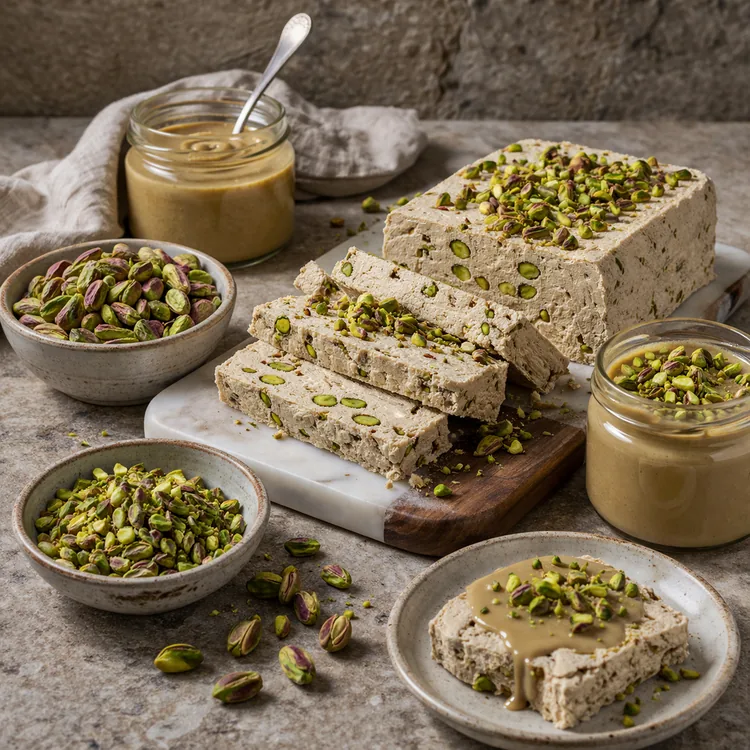
Introduction: why pistachio choice matters more in this category than many buyers expect
Halva and tahini-based products are rich, distinctive and strongly associated with ingredient quality. They are not neutral backgrounds. Tahini brings a deep sesame character, a creamy-to-dense mouthfeel and a naturally rich oil structure. Halva adds a fibrous, delicate, sweet sesame body that can feel light or crumbly depending on the style. In both cases, any pistachio added to the system becomes highly visible in sensory terms. The nut changes how the product looks, how it breaks, how it tastes and how premium it feels.
That is why pistachio selection in this category should not be reduced to a generic nut-buying decision. Buyers need to ask what the pistachio is supposed to do. Is it there to create a bold visual signature? Is it meant to add crunch or bite contrast? Is it supporting a premium gifting or retail story? Is it being used as an inclusion inside halva, as a visible topping on a tahini spread, as part of a layered sesame confection or as a blended element inside a premium paste or cream? The answer to that question should guide the sourcing decision from the beginning.
For B2B buyers, this matters because halva and tahini products are often sold on perception as much as on taste. The product has to look right, feel right and align with what the customer expects from a premium pistachio-sesame combination. A pistachio that is merely acceptable may still underperform commercially if it fails to support those expectations.
Why halva and tahini applications create unique sourcing requirements
Not every food system interacts with pistachios in the same way. In chocolate, the nut may work against sweetness and cocoa fat. In pastry, it may sit inside creams or on decorative surfaces. In frozen desserts, it influences flavor release at cold serving temperatures. Halva and tahini systems are different. Sesame is already rich, aromatic and texturally assertive. That means the pistachio must be chosen in a way that either complements or intentionally contrasts with that strong sesame foundation.
In halva, pistachio may be used as visible kernels, chopped pieces or distributed inclusions that create green contrast inside a pale sesame structure. In tahini-based spreads or confectionery, pistachio may be used on top, mixed through, layered in or blended with sesame into a more complex premium product. These differences matter because the ideal pistachio format for one use is not automatically ideal for another.
A buyer sourcing pistachios for halva should therefore think not only about the nut itself, but also about how the sesame matrix will affect perception. Texture, color visibility, oil-rich mouthfeel and the finished product’s intended retail or foodservice presentation all play a role.
Commercial value: pistachio helps turn sesame products into premium products
From a market perspective, pistachio often acts as a premium signal in halva and tahini-based goods. Sesame alone already carries culinary value, but pistachio can elevate the product further by adding color contrast, recognizable ingredient richness and stronger gift or premium retail appeal. A tahini-based product with visible pistachio may feel more refined than a plain sesame version. A halva with attractive pistachio distribution often looks more luxurious and more intentional than a standard variety.
This is commercially important for importers, distributors and brand owners because it helps justify stronger positioning. Pistachio does not merely change the recipe. It changes the product language. It can support a more premium shelf story, strengthen visual merchandising, improve cut-open presentation and give sales teams something more distinctive to communicate. In many markets, that translates into better differentiation rather than just a different flavor variant.
For private-label and branded manufacturers, the combination of tahini or halva with pistachio often works particularly well because it blends familiarity with visible added value. The sesame base feels rooted and traditional. The pistachio adds a premium upgrade that is easy for customers to understand.
What buyers usually mean when they ask for pistachios for halva
When buyers request pistachios for halva, they are usually asking for more than a product that can simply be mixed in. In practice, they often want one or more of the following:
- strong visual contrast inside the halva body,
- an upgraded premium impression for gifting or retail,
- controlled bite and texture within a fragile sesame structure,
- a recognizable ingredient story that can be communicated on pack or in sales materials,
- repeatability so each batch looks commercially consistent.
That means the pistachio must be evaluated not only for flavor but also for how it appears once embedded in the product. A pistachio that looks attractive on its own may still be a weaker choice if it disappears visually inside halva, feels too coarse in the bite or distributes unevenly in the finished slab or bar.
What buyers usually mean when they ask for pistachios for tahini-based products
Tahini-based products can cover a broader range than halva. They may include sweet sesame spreads, layered dessert fillings, tahini creams, sesame-pistachio blends, premium breakfast spreads, confectionery bars or hybrid snack products. In these cases, pistachio can serve several different purposes depending on the formulation:
- as a visible topping to reinforce ingredient richness,
- as a chopped inclusion to create texture inside a smooth sesame base,
- as a premium layer or swirl alongside tahini,
- as a blended nut-sesame flavor component,
- or as part of a more luxurious alternative to plain tahini presentations.
Because the range is broader, the sourcing brief needs to be more precise. A pistachio suitable for topping a jarred tahini spread is not necessarily the same pistachio best suited to a cuttable sesame bar or a layered confectionery product. The key is to define how visible, how structural and how premium the pistachio role needs to be.
Whole kernels, split kernels or chopped pieces: choosing the right visual language
One of the first sourcing decisions is the physical pistachio format. That choice shapes both product experience and commercial appearance.
Whole kernels
Whole kernels are most relevant when a strong premium visual effect is needed. They can work well in halva slices, decorative surfaces, premium presentation boxes and products where visible nut identity is central to the appeal. However, whole kernels are not always the most practical choice for uniform distribution inside more delicate or densely cut products.
Split kernels
Split kernels can offer much of the visual benefit of whole kernels while sitting slightly more naturally in some applications. They can be useful where a buyer wants visible pistachio identity but also a more adaptable format for incorporation.
Chopped kernels
Chopped pistachios are often the most versatile option. They can create even distribution, support cleaner portioning and make the product easier to standardize. In tahini-based spreads, chopped pistachios can also contribute texture without overwhelming the sesame base.
Granules or smaller cuts
Granules are useful where the pistachio should be more evenly dispersed or where the finished product requires a finer bite. They may be more appropriate in smoother tahini-based systems or in products where large visible pieces would feel too dominant.
There is no single correct answer. The best format depends on whether the finished product needs a bold premium look, a subtle textural lift, a highly repeatable structure or a combination of these goals.
Why size consistency matters so much in halva and tahini products
In many sesame-based products, size consistency influences both visual quality and cutting behavior. Halva, for example, often relies on a fragile internal structure. If pistachio pieces are too irregular, the finished product may look inconsistent or feel less balanced from bite to bite. In tahini-based products, uneven particle distribution can make one unit look generously filled while another looks sparse.
For B2B buyers, controlled size variation matters because it supports:
- better visual uniformity across production batches,
- more predictable bite and crunch,
- cleaner portioning and slicing in structured products,
- stronger match between approval sample and later lots,
- and easier downstream customer acceptance.
A highly mixed lot may still be usable, but it can create more inconsistency than premium brands or careful distributors want. That is why pistachio selection in this category often benefits from tighter control rather than broad commercial approximation.
Color and visual contrast: one of the strongest reasons to use pistachio here
Sesame-based products often sit in a pale beige-to-cream visual range. Pistachio can create a highly attractive contrast against that background, especially when used visibly. This is one of the main reasons it adds such strong commercial value in halva and tahini categories. The product can immediately look more premium, more giftable and more ingredient-rich when the pistachio provides a clean and appealing contrast.
That said, the right color profile depends on the product concept. Some brands want a vivid premium look. Others want a more natural, traditional appearance. The key point is not that one tone is universally better than another. It is that the pistachio should support the visual promise of the finished product. A premium halva sold as a gift product may need a stronger visual effect than a more rustic sesame confection sold through traditional channels.
For importers and brand owners, this means pistachio color should be reviewed in context, not in isolation. The question is not only whether the nut looks attractive on its own, but whether it looks right once paired with tahini or halva.
Flavor balance: pistachio should complement sesame, not disappear into it
Tahini and halva already have a deep, roasted sesame character that can be assertive and lingering. If pistachio is intended to be a meaningful ingredient in the finished product, its flavor contribution must be considered carefully. In some cases, the pistachio mainly supports visual and textural value. In others, it is expected to contribute a clearly recognizable nut note that works alongside sesame without vanishing behind it.
This is why flavor style matters. A pistachio with a profile better suited to pastry decoration might not create enough character in a tahini-rich spread if the product concept depends on a noticeable pistachio presence. By contrast, a stronger pistachio direction may help a premium sesame-pistachio product feel more complete and intentional. The correct target depends on whether the product is marketed as a sesame base with pistachio accent or as a more balanced sesame-pistachio composition.
Roast style and flavor direction
Not every halva or tahini product needs the same pistachio flavor direction. In some cases, a fresher and more natural pistachio note may suit the product best, especially where the sesame base already carries enough depth and the buyer wants the pistachio to brighten the profile. In other cases, a more developed nut character may integrate more naturally with a robust sesame system.
The important thing is to think about balance. Sesame products can become heavy or monotonous if the supporting nut choice is not made thoughtfully. Pistachio should either lighten, sharpen or enrich the product in a deliberate way. Buyers should therefore review pistachios according to the exact product style they are trying to build rather than assuming all pistachio profiles behave the same once combined with tahini.
Texture interaction: why sesame products need careful inclusion planning
Texture is one of the most important reasons to use pistachio in halva and tahini products. Halva often has a soft-fragile, fibrous break. Tahini-based spreads tend to be smooth, rich and dense. Pistachio can improve both, but only when the piece size and quantity match the product structure.
In halva, pistachio pieces can create welcome interruption in the sesame body and make each bite feel more layered. But if the pieces are too large, too hard or too irregular, they can disturb the elegance of the product. In tahini-based spreads or fillings, finely chopped or medium pistachio pieces can provide textural interest and help the product feel more premium and less flat. However, if the particles are too coarse, the spread may feel unbalanced or harder to use smoothly.
This is why texture design should be intentional. The pistachio should not simply be present. It should contribute the right level of contrast for the final product format.
Halva applications: where pistachio often delivers the most value
Halva is one of the clearest examples of a category where pistachio adds both real sensory value and immediate premium perception. Common uses include:
- visible inclusions throughout the halva body to create contrast and richness,
- decorative surface applications for gifting or premium presentation,
- cut-open visual enhancement in sliced or portioned formats,
- premium variant differentiation compared with plain sesame halva,
- combined flavor-texture positioning where pistachio is expected to upgrade both taste and appearance.
Because halva is often sold by look as well as by taste, the pistachio selection needs to support the finished visual rhythm of the product. Distribution, piece size and color presence all influence how convincing the final product feels.
Tahini-based product applications: broader, more flexible, more format-dependent
Tahini-based product development often gives buyers more room to choose different pistachio strategies. Depending on the concept, pistachio may act as a topping, an internal inclusion, a paste-layer partner or a visual finishing element. Examples include:
- premium tahini spreads topped with chopped pistachios for strong shelf appeal,
- sesame-pistachio creams or layered jars where pistachio contributes premium differentiation,
- tahini bars or confections where pistachio adds bite and visible nut value,
- dessert components where sesame and pistachio are positioned as a premium flavor pairing,
- hybrid snack or breakfast products that use pistachio to make tahini formats feel more upscale and ingredient-led.
Because these products vary so widely, it is especially important for buyers to define the pistachio’s role before sourcing. The right format for a topping is not necessarily the right format for an internal blend or layered filling.
Why premium positioning matters so much in this category
Halva and tahini products often sit in categories where heritage, gifting, dessert culture and ingredient reputation matter. Pistachio can strengthen all of those. A plain sesame product can become a more premium sesame-pistachio product very quickly when the nut choice is visually convincing and commercially well positioned. This makes pistachio particularly valuable for premium retailers, modern dessert brands, boutique confectionery makers and private-label lines looking to move beyond standard sesame presentations.
From a distributor perspective, this can be highly useful. A strong pistachio-led sesame line is easier to present as an upgraded option. From a manufacturer perspective, it creates room for better differentiation. From a private-label perspective, it can support higher-value packaging and more premium communication. In short, pistachio often adds more than flavor. It adds market language.
How importers and distributors should think about portfolio fit
Importers and distributors serving halva and tahini customers should think in terms of customer segments rather than one universal pistachio line. A premium gifting customer may need visually stronger kernels or chops. A confectionery producer may need more controlled particle size for repeatable inclusion work. A tahini spread brand may want a topping-grade chop or a smooth combination of paste and visible pieces. A wholesale customer may need a more commercially efficient but still attractive option.
This is why a structured portfolio often works better than a one-size-fits-all offer. Segmenting products by visible premium use, process use and broader commercial use helps the sales team place the right pistachio more effectively and helps purchasing choose the right supply profile for each channel.
Packaging and handling considerations
Packaging is important because halva and tahini buyers may use pistachios in different ways. Some may incorporate them directly into batch production. Others may use them for topping or finishing. Some may repack for retail or smaller-scale distribution. A packaging format that works well for one customer type may be less suitable for another. This is especially relevant for distributors and manufacturers who need efficient handling and repeatable production flow.
A good sourcing decision therefore considers not only the pistachio itself, but how the product will arrive, be stored and be used. The more the packaging matches the operational model, the easier the product is to integrate into normal production or resale activity.
Why sample approval matters more than broad product descriptions
Pistachios for halva and tahini products should ideally be reviewed not only as raw nuts, but as ingredients in a real or pilot product context. A sample might look attractive on its own yet underperform once placed in a sesame matrix. It may disappear visually, feel too coarse, distribute poorly or create less premium contrast than expected.
That is why sample approval is so important. It allows the buyer to answer practical questions such as:
- Does the pistachio look right in the finished halva or tahini system?
- Does the piece size feel balanced in the bite?
- Is the product commercially attractive when sliced, portioned or opened?
- Does the pistachio support the intended premium positioning?
- Will this same profile be repeatable in later lots?
The last question is crucial. A great first sample is helpful, but a repeatable commercial standard is what actually builds a successful program.
Repeatability matters because these products are highly visual
Halva and tahini-based products often reveal inconsistency quickly. If one batch has beautiful pistachio distribution and another looks sparse or visually weaker, the difference is obvious. That affects customer confidence, gifting appeal, shelf presentation and brand reliability. This is why buyers should treat repeatability as a core sourcing criterion rather than an afterthought.
For manufacturers, that means aligning on what made the sample acceptable. For distributors, it means ensuring that what is sold as a premium pistachio-sesame line remains visually and commercially coherent over time. For private-label programs, it means protecting the brand promise across repeated orders.
Commercial perspective
Successful pistachio purchasing for halva and tahini-based products starts with the final application. Buyers should compare whole kernels, split kernels, chops, granules, powder or paste according to whether the finished product needs visible premium identity, controlled bite, blended sesame-nut harmony or a topping-grade visual effect. The strongest sourcing decisions usually come from defining the role of the pistachio clearly before supplier comparison begins.
- Define the exact end use before comparing offers.
- Review format, color, texture impact, packaging and repeatability together.
- Decide whether the pistachio is meant to be visible, structural, decorative or blended.
- Match premium origin value to the actual commercial position of the product.
- Use sample approval as a benchmark for future supply, not just a one-time visual check.
Technical perspective
Technical expectations vary according to the customer and product style. Premium halva buyers may care most about visible inclusion quality and attractive cross-sections. Tahini spread brands may focus on topping behavior, particle feel and premium appearance in jars or tubs. Food manufacturers may care more about cut consistency, batch repeatability and the ability to achieve a stable product look across production runs.
What matters in every case is linking the pistachio to the application. The best product is not the one with the most flattering broad description. It is the one that performs correctly inside the intended sesame system while supporting the commercial goals of the finished product.
Common mistakes buyers should avoid
Choosing only on appearance outside the real product system
A pistachio may look good in a sample jar yet not create the right effect once combined with halva or tahini.
Using the same cut profile for every sesame-based product
A chop that works well in halva may not be right for a tahini spread or a layered confectionery product.
Ignoring the relationship between sesame richness and pistachio intensity
Tahini has a strong sensory presence. The pistachio should either contrast or complement it deliberately.
Approving a sample without defining the standard
If color, distribution or bite mattered during approval, those points should remain part of the ongoing commercial understanding.
Treating pistachio only as garnish
In these categories, pistachio often influences the finished product far more than a decorative topping normally would. It deserves a more deliberate sourcing approach.
Guidance for different buyer types
Importers
Importers should think in terms of downstream category fit. A strong line for sesame confectionery customers may not be the same line best suited to industrial tahini applications. Segmenting by use makes comparisons and resale easier.
Distributors
Distributors benefit from being able to explain why one pistachio format works better for premium halva and another for tahini-based spreads or bars. Clear segmentation improves customer trust and portfolio clarity.
Food manufacturers
Manufacturers should begin with the finished product’s texture, cross-section and premium position. The pistachio should support how the product eats and how it is sold, not just how it is described in procurement language.
Private-label teams
Private-label buyers should think carefully about visual repeatability and product promise. If pistachio is used to signal premium value, the ingredient standard must support that signal consistently.
How Atlas approaches this topic
At Atlas, pistachios for halva and tahini-based products are best treated as application-specific ingredients rather than as generic nut inputs. The right product form depends on whether the customer needs strong visible identity, refined bite, topping-grade appeal, or a more integrated sesame-nut composition. That is why the sourcing discussion should begin with the finished product style, customer segment and commercial objective.
Once those are clear, it becomes easier to identify whether the project calls for whole kernels, split kernels, chopped pistachios, granules or another format. Better clarity at that stage leads to better sample selection, stronger supplier comparison and a more commercially useful supply program.
Key takeaway
Selecting Pistachios for Halva and Tahini-Based Products is about much more than choosing a nut ingredient that can be mixed into sesame products. The pistachio often defines how premium the finished product feels, how attractive it looks, how it breaks in the bite and how convincingly it can be sold as a higher-value offering.
For importers, distributors and manufacturers working with Turkish Antep pistachios, the strongest sourcing decisions come from connecting the pistachio format directly to the application. Visual profile, cut size, flavor balance, texture compatibility, packaging and repeatability all matter. When these are aligned well, pistachio can turn a good halva or tahini-based product into a stronger and more commercially distinctive one.
Frequently asked questions
What is the main benefit of adding pistachio to halva?
The main benefit is the combination of visual contrast, premium perception and improved texture interest inside the sesame-based product.
Are whole kernels always the best option for halva?
Not always. Whole kernels can create strong premium visual impact, but chopped or split formats may be more practical depending on distribution, slicing behavior and the intended product style.
Why is pistachio selection important in tahini spreads?
Because the pistachio affects not only flavor and appearance, but also how premium and ingredient-rich the finished tahini product feels to the customer.
Should buyers review pistachios only on their own?
No. They should ideally evaluate the pistachio in a real or pilot halva or tahini application to confirm visual, textural and commercial fit.
Does every sesame-based product need the same pistachio profile?
No. A premium halva, a topped tahini spread and a blended sesame-pistachio confection will often need different pistachio formats and different sourcing priorities.
What is the biggest sourcing mistake in this category?
A common mistake is choosing pistachios based only on broad premium language or isolated appearance instead of defining the exact role they need to play inside the finished sesame product.
Talk to Atlas about pistachios for halva, tahini spreads, sesame confectionery and premium ingredient applications
If your team is developing halva, tahini-based products, sesame-pistachio confections or premium dessert applications, Atlas can help clarify the most suitable pistachio format, quality profile and sourcing approach for your product goals.