Why this topic matters
Middle East distributor programs tend to operate in markets where pistachios are not niche or unfamiliar products. They are already relevant across sweets, premium gifting, pastry, frozen desserts, chocolate, bakery products, fillings, gourmet retail and bulk ingredient trade. That familiarity creates opportunity, but it also raises expectations. Buyers in the region often know what good pistachio products should look like, how they should taste and where they should fit in the market. Distributors therefore need more than a generic supply offer. They need a pistachio range that can stand up to comparison in quality-sensitive and presentation-sensitive categories.
Turkish pistachios are especially relevant in that environment because they can support both product performance and market language. For many buyers, Turkish Antep pistachios carry strong regional identity, culinary relevance and premium potential. That can be commercially useful for distributors selling to artisan producers, premium retailers, hotel and restaurant channels, dessert brands, private-label buyers or industrial customers that still care about ingredient image.
This is why distributor strategy matters. A distributor is not only choosing pistachios for themselves. They are choosing which pistachios will make sense for their downstream customers, which formats will be easiest to position and which supply relationships can support consistent business over time.
Why Middle East distributors look at Turkish pistachios
Distributors in Middle East markets often look at Turkish pistachios because the category sits naturally within regional food culture and premium dessert traditions. Pistachio is already a meaningful ingredient in many established sweet and savory contexts, so a distributor is not trying to introduce an unknown concept. Instead, the challenge is to select the right pistachio profile for the right customer segment and application.
Turkish pistachios can be attractive because they support multiple commercial goals at once. They can help a distributor offer a more premium line, strengthen origin-based selling, support visible ingredient positioning and address a broad range of buyers from confectionery makers to bakery users to premium gifting channels. In other words, the product can be relevant at both the ingredient level and the portfolio level.
For distributors, that combination is valuable. It means the pistachio is not only something they can stock. It is something they can segment, explain and sell in multiple ways.
The Middle East is not one single distributor market
It is important to avoid treating the region as a single uniform business environment. Different markets may lean more strongly toward premium gifting, traditional sweets, hotel and foodservice channels, industrial bakery, modern retail, private label or specialist ingredient distribution. Even within one market, a distributor may serve very different customer groups at the same time. One customer may want selected kernels for pastry decoration. Another may want chopped pistachios for a chocolate filling. Another may need paste for frozen desserts. Another may want in-shell pistachios for premium retail snacking.
This matters because a strong distributor strategy begins with segmentation. The correct question is rarely “What is the best pistachio?” The better question is “Which pistachio format and quality profile best serve each customer type in our portfolio?”
Once a distributor starts thinking that way, sourcing becomes much more precise and much more commercially useful.
Distributor strategy begins with the end market, not the product list
Many weak sourcing programs begin with a supplier catalog instead of with the customer base. A distributor sees available pistachio items and tries to decide what to buy. A stronger approach works in reverse. The distributor starts by defining the customer segments they want to serve, the categories those customers sell into and the kind of pistachio language that matters in those categories. Only then do they decide which product forms and quality profiles belong in the range.
For example, a distributor serving premium confectionery customers may need more precise chops, inclusions or paste profiles than a distributor focused on general wholesale trade. A distributor serving hotel pastry and dessert accounts may need stronger visual standards. A distributor serving value-driven manufacturing accounts may still need consistency, but perhaps with different priorities. The key is to align pistachio sourcing with the real structure of the business.
That is why serious sourcing is really a portfolio decision, not only a procurement decision.
Product form is the first major decision
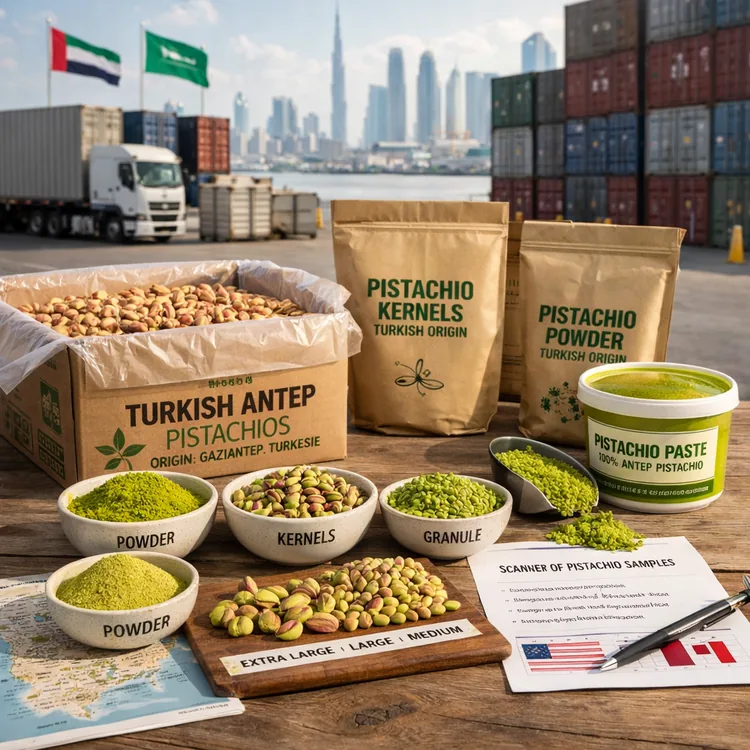
One of the biggest mistakes in pistachio sourcing is using overly broad terminology. A distributor should not ask only for pistachios. They should define the exact product form that matches the downstream need. Common product forms include in-shell pistachios, whole kernels, split kernels, chopped kernels, granules, powder and pistachio paste. Each one serves different customers and different applications.
In-shell pistachios may be more relevant for premium snack retail or gift-style channels. Whole kernels may suit bakery, pastry, dessert decoration and premium ingredient retail. Chopped kernels and granules are more relevant for confectionery, fillings, bars, inclusions and manufacturing. Powder and paste may be central for industrial users, frozen dessert producers or premium formulation work.
The better the product form is defined, the easier it becomes to compare offers, approve samples and communicate internally with sales and purchasing teams.
Application fit should guide every sourcing choice
Every strong distributor program is built around application logic. Pistachios can go into a wide variety of products, but the correct pistachio for one use is not automatically the correct pistachio for another. This is why application fit is more useful than broad premium language.
Middle East distributors often supply customers in categories such as:
- premium retail snacking where shell opening, presentation and visible quality matter,
- bakery and pastry where color, kernel integrity and decorative value may be central,
- traditional and modern confectionery where chopped sizes, inclusions and paste functionality matter,
- ice cream and frozen desserts where paste profile, color and flavor behavior matter,
- food manufacturing where repeatability, cut control and process suitability matter,
- private-label programs where commercial appearance and lot consistency matter greatly.
A distributor who sources according to these real uses will usually build a stronger assortment than one who buys according to generic labels.
Why origin matters in distributor sales language
Origin can be commercially meaningful because distributors are often selling both a product and an explanation of that product. Turkish Antep pistachios can be especially useful in this respect because the origin itself can support premium language, culinary relevance and stronger customer recognition. In categories where ingredients are visible, named or associated with craftsmanship, that origin value can be easier to communicate than a generic pistachio offer.
This does not mean origin should be used as a substitute for product performance. Serious distributors still need the right format, quality and repeatability. But when origin aligns with product fit, it strengthens the commercial case. It helps the sales team differentiate the line, support premium positioning and create more meaningful product descriptions for customers who care about source identity.
Visual profile is often commercially decisive
In many Middle East distributor channels, pistachios are purchased for applications where they will be seen clearly in the final product. That makes visual profile highly important. A beautiful pastry topping, a refined chocolate center, a premium gift product or a dessert garnish all rely on the pistachio looking appropriate for the concept. If the visual quality is weak, inconsistent or too far from the expected premium impression, the finished product may lose value even if the flavor is acceptable.
Distributors should therefore review not only whether a pistachio is clean and usable, but whether it looks right for the category they want to serve. Some customers may want a more vivid premium profile. Others may prefer a more natural tone. Some applications require stronger kernel integrity. Others can work with more processed formats. The right answer depends on the customer and the application, not on abstract notions of quality.
Size consistency matters for resale credibility
Distributors do not just need products that look good in one sample. They need products that can be sold repeatedly without creating unnecessary complaint risk. This is why size consistency matters so much, especially in chops, granules, kernels and other visible formats. If one lot is noticeably different from the next, the distributor may face pressure from downstream customers, even when the initial approval looked strong.
In manufacturing-sensitive categories, size consistency also affects how the customer uses the product. Uneven chops may change filling texture, topping look or inclusion performance. Mixed kernel sizes may affect premium presentation in pastries or snack packs. For a distributor, this means controlled sizing is not only a technical issue. It is a commercial reliability issue.
Different distributor tiers may need different pistachio programs
Not every customer needs the same type of pistachio. A strong distributor often creates a tiered portfolio rather than a one-size-fits-all range. This can help reduce confusion and improve sales conversations. For example:
- Premium origin tier: products for gourmet retail, premium pastry, luxury confectionery and brand-sensitive applications.
- Application-performance tier: products chosen for functionality and suitability in specific manufacturing uses.
- Commercial efficiency tier: products positioned for broader wholesale or cost-sensitive but still quality-conscious channels.
This kind of portfolio thinking helps the sales team match the product to the customer rather than forcing all customers into one offer. It also helps the buying team source more deliberately because each line item has a clear commercial purpose.
Why Middle East distributors should think beyond initial price
Price always matters, but distributors usually need to think in terms of resale viability and customer satisfaction, not only purchase cost. A cheaper pistachio line may still become less profitable if it is harder to explain, less visually suitable, less repeatable or more likely to disappoint a downstream customer. On the other hand, a more selective product may justify itself if it supports stronger pricing, easier selling and fewer complaints.
That is why the best distributor decisions are usually based on total usefulness. Buyers should ask whether the product is aligned with the intended portfolio segment, whether it supports a clear commercial story and whether the supplier can keep the product standard steady enough for repeat trade.
In many cases, the strongest value does not come from the cheapest offer. It comes from the offer that is easiest to sell well and most reliable to reorder.
Packaging should match the distributor model
Packaging is not a secondary issue for distributors. It affects receiving, warehouse handling, stock management, repacking logic and downstream resale practicality. A packaging format that works for one business model may not work for another. A distributor serving industrial users may prefer one approach, while a distributor supplying mixed customer segments may need more flexibility.
For this reason, packaging should be part of the sourcing discussion early. A good product in an awkward handling format can create unnecessary friction. A good product in a commercially suitable format is much easier to integrate into normal operations. The right solution depends on the volume flow, customer profile and how the distributor intends to move the stock through the business.
Documentation and commercial readiness matter
Distributors often sit between the source and multiple downstream customers. That means they frequently need product clarity strong enough to support resale conversations, internal purchasing decisions and customer approvals. Even when a buyer is not asking for highly technical documentation at the first step, they still need evidence that the supplier has a disciplined commercial setup and can describe the product in a clear, repeatable way.
That includes practical clarity around product form, visual profile, packing logic, sample alignment and repeat-order expectations. Strong communication here reduces confusion later. It also makes the distributor more credible when they explain the product to their own customers.
Why samples are essential for distributors
Samples are especially important in distributor sourcing because a distributor is not only asking, “Do we like this product?” They are asking, “Can we sell this product confidently to the customers we serve?” A sample gives the team a chance to review appearance, cut or size profile, color tone, general product feel and application suitability before the product is introduced into the portfolio.
Ideally, distributors should evaluate samples with real resale logic in mind. If the pistachio is meant for premium pastry customers, does it meet that visual standard? If it is meant for confectionery manufacturers, is the cut profile suitable? If it is intended for retail nuts, does it present well enough? The better the sample is tied to an actual portfolio use, the better the sourcing decision becomes.
Sample approval should become a commercial benchmark
A frequent sourcing weakness is approving a sample without clearly defining what made it acceptable. For distributors, this can create problems later when sales teams promise one visual or quality impression but incoming lots drift from that standard. The better approach is to treat sample approval as a benchmark, not as a one-time impression.
If the sample was approved because it had the right size balance, the right color tone or the right level of visual appeal for a customer segment, those factors should be carried into the ongoing commercial understanding with the supplier. That helps the distributor protect portfolio consistency and reduces the risk of downstream dissatisfaction.
Commercial perspective
Successful distributor sourcing starts with the end customer and the application. Buyers should compare Turkish pistachio offers according to how well they fit the portfolio, how clearly they can be sold and how reliably they can be repeated. The strongest programs usually follow a few practical principles:
- Define the target customer segment before comparing products.
- Match product form to the actual application category.
- Review appearance, size consistency, aroma and packaging together.
- Separate premium origin-led programs from more efficiency-led programs.
- Evaluate whether the supplier can support a stable resale standard over time.
These steps help the distributor move from generic sourcing toward purposeful portfolio building.
Technical perspective
Technical expectations differ according to the distributor’s customer base. Snack customers may care more about in-shell presentation, roast style and immediate appearance. Confectionery and pastry customers may care more about inclusion quality, cut size and visual elegance. Frozen dessert users may focus on paste performance, flavor and color. Industrial users may emphasize repeatability, handling practicality and formulation fit.
This is why technical review should always be connected to a specific use case. A distributor does not need one abstract quality definition. They need a working definition of quality for each customer segment they serve. Articles like this help translate those expectations into practical buying language.
Common sourcing mistakes Middle East distributors should avoid
Building the range around supplier availability instead of customer need
A distributor range should be shaped by what the business intends to sell, not only by what happens to be quoted first.
Trying to sell one pistachio line into every segment
Different customers need different formats and different visual or functional standards. Portfolio segmentation usually produces better results.
Using broad premium language without defining the actual product profile
Terms such as premium or selected are not enough on their own. The product still needs a clear commercial purpose and a usable specification logic.
Ignoring repeatability
A beautiful first lot is not enough if the product cannot be kept commercially stable for later sales.
Choosing only on price
A cheaper product can become harder to sell, harder to defend and less profitable once customer expectations are taken into account.
How different distributor types should think about sourcing
General food distributors
These businesses should focus on building a practical core assortment that can serve multiple customer types without creating too much complexity. Clear segmentation between retail, pastry and industrial uses can help.
Premium ingredient distributors
These distributors should emphasize origin, visual quality, customer education and application fit. Turkish Antep pistachios can be especially effective in a premium ingredient narrative when the product profile supports it.
Confectionery and bakery-focused distributors
These businesses should pay close attention to cut size, visual profile, customer application needs and repeatability. Their customers are often highly sensitive to ingredient presentation.
Frozen dessert and specialty ingredient distributors
For these distributors, paste profile, flavor character and formulation suitability may be more important than generic appearance alone.
Wholesale import distributors
These businesses often need to balance practical volume movement with enough quality clarity to support resale across multiple channels. Packaging and program consistency become especially important here.
Where Turkish pistachios may create the strongest distributor value in the region
Turkish pistachios often create their strongest distributor value where the product is visible, named or commercially positioned as premium or ingredient-led. This may include premium sweets, pastry and dessert applications, modern chocolate and praline work, premium retail nuts, frozen desserts, fillings, private-label gourmet ranges and quality-sensitive foodservice channels.
In those segments, Turkish pistachios can help the distributor offer something more than a basic commodity item. They can support a refined product story, stronger visual identity and better customer differentiation. In more price-sensitive bulk uses, the value logic may be different, but even there the distributor still benefits from clarity around format and suitability.
A practical buyer checklist for Middle East distributors
Before requesting quotations or approving stock programs, distributors should be able to answer the following questions:
- Which customer segments are we buying for?
- What exact pistachio format does each segment require?
- Do we need premium origin-led positioning, functional performance, or both?
- How important is visual profile in the final customer application?
- What level of size consistency or cut control is needed?
- Will this product be resold as-is, repacked or used in manufacturing supply?
- What packaging format best suits our warehouse and sales model?
- Can the supplier match the approved sample over repeated orders?
- How will our sales team explain this product to customers?
- Are we comparing offers on real portfolio fit or only on purchase price?
How Atlas uses this knowledge
Atlas uses academy content to make product discussions clearer and more useful for serious buyers. For distributor markets, that means helping companies move from broad product interest to a more structured sourcing brief. A good distributor program depends on understanding product form, application fit, commercial segmentation and repeatability. The more clearly those elements are defined, the easier it becomes to identify the right supplier conversations.
That clarity benefits both purchasing and sales. Buyers can compare offers more intelligently. Sales teams can position the products more confidently. Internal teams can align more quickly on what each line is supposed to achieve inside the portfolio. In practice, this leads to better sourcing and better resale results.
- Connect commercial guidance to relevant distributor segments.
- Connect technical information to real downstream applications.
- Support clearer product positioning and better internal alignment.
- Clarify when origin value should be central and when it should be secondary.
- Help distributors turn samples into workable long-term supply decisions.
Key takeaway
Sourcing Turkish Pistachios for Middle East Distributors is not only about finding supply. It is about building a portfolio that matches the needs of real customers across premium, wholesale and manufacturing channels. The strongest distributor programs begin with customer segmentation, application fit and a realistic understanding of how product form, visual profile, packaging and repeatability affect resale success.
For importers, wholesalers and ingredient distributors, better information leads to better assortment decisions, stronger supplier conversations and more effective sales positioning. When Turkish pistachios are sourced with that discipline, they become more than a stock item. They become a commercially useful asset inside the distributor’s wider market strategy.
Frequently asked questions
Why are Turkish pistachios relevant for Middle East distributors?
They are relevant because they combine regional familiarity, premium positioning potential and broad usefulness across sweets, pastry, confectionery, frozen desserts, retail nuts and ingredient applications.
What is the first thing a distributor should define?
The first priority is the target customer segment and the exact product form needed for that segment. Without that, quotations are usually too broad to compare properly.
Should one distributor carry only one pistachio profile?
Usually not. Many distributors benefit from a tiered portfolio that separates premium origin-led products, application-performance products and more general commercial lines.
Why does repeatability matter so much?
Because distributors resell products into downstream markets. If incoming lots vary too much, it becomes harder to maintain customer trust and harder to position the product consistently.
Are samples only for checking basic quality?
No. Samples are also for checking whether the pistachio actually fits the distributor’s intended customer segment and whether it can support the sales story that will be built around it.
What makes a supplier more useful for a distributor?
Clear communication, an application-aware product offer, representative samples, practical packaging and the ability to support a repeatable commercial standard all make a supplier more useful to a distributor.
Talk to Atlas about Turkish pistachios for Middle East wholesale, retail, pastry, confectionery and ingredient channels
If your team is evaluating Turkish pistachio kernels, cuts, powder, paste or in-shell programs for Middle East markets, Atlas can help clarify the right format, commercial fit and sourcing approach for your distributor portfolio.