Why this topic matters
North American pistachio buyers often work in highly structured commercial environments. Importers need reliable product definitions and clean supply communication. Distributors need product stories that sales teams can explain clearly. Food manufacturers need ingredients that behave predictably in processing. Private-label buyers need repeatability, visual consistency and commercially useful differentiation. In all of these cases, the purchasing decision goes beyond the basic question of whether pistachios are available.
Turkish pistachios, especially Turkish Antep pistachios, are often evaluated because they offer more than a generic nut ingredient position. They are associated with regional identity, premium culinary use and strong relevance in confectionery, pastry, frozen desserts, fillings and premium snack applications. For North American buyers, that can be valuable because many market segments now care about ingredient storytelling, visible quality and more refined sourcing narratives, not just raw material price.
At the same time, North American sourcing decisions are practical. Buyers need to know whether the product form is right, whether the quality standard is commercially manageable and whether the supplier can support repeat orders with the same profile that was approved in the sample stage. That is why a stronger framework is useful. Better sourcing comes from better questions.
Why North American buyers look at Turkish pistachios in the first place
In premium food categories, buyers are often searching for ingredients that offer both functionality and distinction. Turkish pistachios can attract attention because they help support a more selective ingredient story. For a distributor, that may mean a premium origin line that stands apart from more standard nut assortments. For a manufacturer, it may mean a pistachio ingredient that supports a more refined finished product concept. For a private-label team, it may mean a stronger commercial narrative around product quality, culinary inspiration or ingredient identity.
North American markets also include many categories where pistachios are not hidden. They are visible in bars, pastries, fillings, inclusions, gourmet snack packs, gelato, desserts and premium confectionery. In those contexts, the ingredient is judged not only by technical function but by how it looks, tastes and contributes to market positioning. This is one reason Turkish pistachios are often considered by buyers who need a more premium outcome rather than only a lowest-cost input.
What North American buyers usually mean by sourcing
When a buyer says they are sourcing pistachios for North America, they are usually doing more than locating a product. They are trying to establish a workable supply arrangement. That often includes the product itself, but also the level of quality consistency, the packaging setup, the documentation support, the sample approval logic and the supplier relationship that will make the program viable over more than one shipment.
In other words, sourcing is not simply about one order. It is about building enough commercial confidence that repeat business is possible. A first shipment may be treated as a test, but the evaluation typically starts much earlier. Buyers want to know whether the offer is aligned with their product category, whether the seller understands the intended use and whether the proposed supply can fit the operational expectations of North American businesses.
North America is not one uniform buying environment
It is also useful to recognize that North America is not a single monolithic market. Some buyers are premium ingredient importers. Some are national or regional distributors. Some are food manufacturers with specific production requirements. Some are brands creating premium retail goods. Some are private-label teams building customer-specific products. Each of these buyer groups may look at Turkish pistachios differently.
An importer may focus on repeatability, landed practicality and downstream resale potential. A food manufacturer may care most about size consistency, grind suitability or paste behavior in a real formulation. A brand owner may care about how pistachio supports product storytelling and visual differentiation. A distributor may need a pistachio line that can be segmented by application rather than sold as a single broad category.
This is why suppliers and buyers alike benefit when the sourcing discussion begins with the buyer type and end use, not only with the product name.
Start with the exact product form
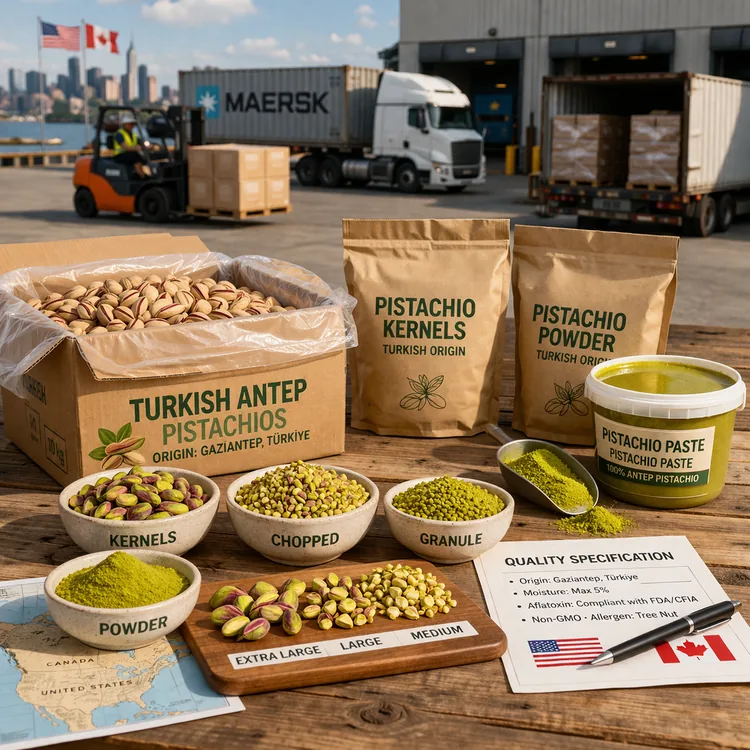
One of the most important steps in sourcing Turkish pistachios is clarifying the exact format needed. A quotation for “pistachios” is not enough to make a meaningful comparison. North American buyers usually need to determine whether they are looking for in-shell pistachios, whole kernels, split kernels, chopped kernels, granules, powder, paste or another prepared ingredient form.
This matters because the right product form depends on the application. Snack products may require a different visual and structural profile than pastry fillings. A premium confectionery inclusion may need different cut control than a powder used in a processed food system. Gelato makers may need pistachio paste rather than any particulate format at all. Buyers who start with a precise format definition usually get better quotations and avoid wasted sampling cycles.
Application fit should lead the buying decision
Strong buyers do not usually ask only for “premium pistachios.” They ask for pistachios that work in a specific application. The intended use should shape how every other variable is evaluated. For North American buyers, common applications include premium snack packs, cereal or granola systems, better-for-you bars, pastry and bakery fillings, chocolate and praline work, premium ice cream, gelato, ingredient blends and industrial food manufacturing.
The application determines what matters most. If the pistachio is visible in the final product, color and visual presentation may be crucial. If it is going into a filling, texture and grind or paste behavior may matter more. If it is going into a premium retail mix, overall appearance and ingredient integrity may be central. If it is being used in a manufacturing environment, consistency across lots may matter more than immediate sample beauty.
This is why the most useful sourcing conversations are application-first conversations. They reduce ambiguity and make supplier comparison much more accurate.
Why origin matters in North American markets
Origin can matter because many North American premium categories increasingly value ingredient identity. Products are often marketed through provenance, culinary influence, regional inspiration or premium ingredient narratives. Turkish Antep pistachios are commercially useful in this environment because origin is not simply a technical detail. It can contribute to the product’s story, perceived value and premium presentation.
That does not mean every North American buyer needs origin language. Some industrial buyers may care far more about format, behavior and price balance than about branding. But in premium retail, private-label premium ranges, gourmet distribution, pastry, confectionery and frozen dessert categories, origin may contribute real commercial value. Buyers should therefore evaluate whether origin is central, supportive or secondary in their own case.
Quality expectations are usually higher than generic product descriptions suggest
North American B2B buyers often work with internal quality, purchasing or product development teams that need clearer definitions than broad marketing language provides. Terms like premium, selected or high quality may sound positive, but they rarely define the product well enough on their own. Buyers usually want to know what the product actually looks like, how it is graded for the relevant use and whether the supplier can repeat the same profile later.
That may involve reviewing color, piece integrity, size consistency, roast style, cleanliness, packaging, general visual presentation and suitability for the declared application. For ingredient-focused businesses, it may also involve looking more closely at cut distribution, blend behavior or paste characteristics in a formulation setting. What matters most depends on the product form, but the broader point remains: sourcing improves when quality is described in useful operational language rather than in broad compliments.
Color and visual profile can shape commercial success
Pistachio is a highly visual ingredient. In many North American categories, that visual quality affects perceived value immediately. A pistachio used in pastries, bars, confectionery, snack assortments or frozen products is often part of what makes the product feel premium. Buyers therefore frequently review color and overall appearance closely, especially if the pistachio will be visible to the end customer.
The right visual profile depends on the market and the product concept. Some finished goods benefit from a brighter premium look. Others benefit from a more natural and balanced appearance. Either way, the important point is that visual profile should be aligned with the intended use rather than treated as a generic preference. A product that is ideal for one category may not be the strongest option for another if the finished presentation goals differ.
Size consistency matters more than many first-time buyers expect
For North American manufacturers and distributors, consistency is often one of the most important buying priorities. This is true not only for paste or powder, but also for kernels, chops and granules. A lot with wide variation in size can create problems in finished product appearance, line behavior, texture distribution and customer expectations. Even if the flavor is acceptable, inconsistent size can reduce confidence in the supply program.
This is especially relevant in bars, inclusions, toppings, visible pastry applications and manufactured foods where a product must look reasonably similar from batch to batch. Buyers should therefore think carefully about whether they need large selected pieces, more uniform chopped material, finer granules or a different format altogether. In many cases, controlled variation matters more than average size alone.
Documentation and commercial preparedness matter in North American sourcing
Many North American buyers need more than a product and a price. They also need commercial clarity. Even when a supplier offers an attractive product, the buying process can stall if the documentation or product communication is weak. Procurement teams, quality teams and logistics teams may all need enough information to evaluate the program confidently.
That is why strong sourcing conversations usually include discussion around specification clarity, product form, packing details, sample alignment and the supplier’s ability to communicate consistently. Buyers do not always need excessive paperwork at the first conversation, but they do need evidence that the supply side is organized enough to support a real program, not just a one-off sale.
Packaging is not a secondary detail
Packaging affects product protection, warehouse handling, manufacturing convenience and commercial practicality. North American buyers often think about how the product will move through multiple stages after arrival, including storage, redistribution, repacking or direct production use. A pistachio offer that looks strong on paper may still be less attractive if the packaging setup is awkward for the buyer’s operations.
This is especially true for importers and distributors who may have to hold stock or split volume across customer types, and for manufacturers who need practical intake and line-side handling. Packaging should therefore be treated as part of the product fit conversation, not something discussed only after price is agreed.
Logistics thinking begins before the order is placed
North American buyers usually think about logistics early because long-distance sourcing affects planning, stock strategy and customer commitments. Even without getting into country-specific compliance rules, the practical reality is clear: the further the supply chain, the more important it becomes to define the commercial arrangement properly before shipping begins.
That means buyers often want clear timing expectations, workable order structure, realistic replenishment logic and a sense that the supplier understands the needs of export-oriented business rather than purely local trade. A strong sourcing partner does not only offer product. They help create an arrangement that fits the buyer’s operational rhythm.
Why samples are so important
Sample approval is central to pistachio sourcing because so much of the product’s value is sensory and visual. North American buyers often want to review samples not only to confirm basic product attractiveness, but also to see whether the proposed material fits the intended application. A product can look good in a sample pouch and still be wrong for a bar, pastry, confectionery filling or premium snack mix if the size, color or format is mismatched.
Samples should therefore be evaluated with the real product use in mind. A buyer developing a filled confectionery center may test chopped kernels in a real filling system. A gelato producer should assess paste in a real recipe or pilot system. A distributor may review whether the visual profile fits the market segment they intend to sell into. The better the sample review is linked to real use, the more useful the sourcing process becomes.
Sample approval should also define the repeat-order standard
One common sourcing mistake is approving a beautiful first sample without translating that approval into a clear commercial expectation. Serious buyers know that the goal is not only to approve one attractive lot. It is to establish a reference point for future supply. If size consistency, color tone or paste behavior mattered in the approval stage, those factors should be carried into the ongoing commercial discussion.
This is especially important for North American buyers because repeatability affects much more than internal convenience. It affects how finished goods look on shelf, how production schedules are managed and how downstream customers experience the product over time. A supplier that can support repeatability is usually far more valuable than one that only performs well once.
Commercial perspective
Successful pistachio purchasing starts with the final application, but it also requires commercial discipline. North American buyers should compare offers according to total usefulness, not just stated price. That means looking at product definition, application fit, consistency, communication quality, packaging practicality and the supplier’s ability to support repeated orders at the intended standard.
Buyers often get better results when they:
- define the intended end use before comparing offers,
- review format, color, aroma, packaging and repeatability together,
- share clear product requirements so pricing and supply discussions are more accurate,
- separate premium-origin needs from purely cost-led ingredient needs,
- and evaluate whether the supplier can support a program rather than just a shipment.
These steps help reduce vague quoting and make product comparisons much more meaningful.
Technical perspective
Technical expectations vary by customer segment. Snack buyers often focus on shell opening, roast profile and appearance. Ingredient buyers typically look more closely at kernel tone, cut size, grind consistency, purity, moisture management and performance during processing. Frozen dessert developers may focus on paste behavior, color and flavor release. Confectionery buyers may care about inclusions, premium texture and visible product identity.
Articles like this help connect those quality cues to practical buying language so teams can review products with greater confidence and consistency. Instead of discussing “good pistachios” in general terms, buyers can frame the conversation around the real demands of the finished product. That usually leads to stronger supplier conversations and fewer mismatched assumptions.
Common sourcing mistakes North American buyers should avoid
Comparing offers without aligning the product form
A quotation for whole kernels and a quotation for chopped kernels may both look like pistachio offers, but they are not interchangeable. Buyers should make sure they are comparing like with like.
Focusing on price before defining the application
A lower price may not represent better value if the product form, consistency or visual profile is not suited to the finished use.
Approving a sample without defining why it was approved
If the sample mattered because of color, cut size, roast style or appearance, those reasons should be clearly understood before repeat business begins.
Ignoring packaging and handling practicality
A good ingredient still has to move through receiving, storage and use efficiently. Packaging can affect real operational cost and convenience.
Assuming every North American customer wants the same product
They do not. The right pistachio for a premium pastry customer is not always the right pistachio for an industrial food manufacturer or a snack distributor.
How different buyer types should think about sourcing
Importers
Importers should focus on repeatability, resale logic and downstream segment fit. The best import program is not simply the cheapest one. It is the one that can be positioned clearly and supplied reliably to the intended customer base.
Distributors
Distributors should think in portfolio terms. Turkish pistachios can be especially valuable when presented as application-specific solutions rather than as a single undifferentiated item.
Food manufacturers
Manufacturers should begin with the line and the finished product. The ingredient should behave correctly in the application, not just look attractive in a sample.
Private-label teams
Private-label buyers should consider how the pistachio supports the finished product’s market position. If the product is consumer-facing and premium, visual appeal and repeatable quality become especially important.
Brand owners
Brand owners should think about pistachios as part of both formulation and storytelling. In premium North American markets, ingredient visibility and regional identity can contribute real commercial value.
Where Turkish pistachios can create the most value in North America
Turkish pistachios often create their strongest value where the ingredient is visible, named or central to the finished product’s premium perception. This may include premium snack assortments, pastry and bakery fillings, gelato, premium ice cream, luxury confectionery, filled bars, gourmet retail formats and ingredient lines where provenance matters. In these categories, the product can help support differentiation and a stronger ingredient narrative.
In more hidden or purely industrial uses, origin and premium identity may still matter, but the economic value of those features may be less central. Good sourcing recognizes the difference between these two situations and buys accordingly.
A practical buyer checklist
Before requesting quotations or approving supply, North American buyers should be able to answer the following questions:
- What exact product form do we need?
- What is the intended application?
- Does origin value matter for our market position or only for internal preference?
- How important are color and visual presentation in the finished product?
- Do we need tighter size consistency or a broader commercial range?
- What packaging format best supports our receiving and storage process?
- What level of repeatability do we require from shipment to shipment?
- Will we evaluate the product only as a sample, or in a real application test?
- Can the supplier support a practical long-term relationship, not just an initial order?
- Are we comparing offers on total fit, or only on stated price?
How Atlas uses this knowledge
Atlas uses academy content to make product discussions clearer and more useful. Each article supports a better understanding of product forms, applications, quality expectations and the questions buyers should ask before placing an order. For North American sourcing, that means helping buyers move from a vague request for pistachios to a more precise and commercially useful sourcing brief.
That clarity benefits everyone. Buyers can compare more intelligently. Suppliers can respond more accurately. Internal teams can align more quickly. And the final sourcing decision is more likely to support the actual product and market need rather than a generic assumption.
- Connect commercial guidance to relevant product categories.
- Connect technical information to real manufacturing applications.
- Support faster, better-prepared conversations with buyers.
- Clarify when premium origin value is central and when it is secondary.
- Help buyers turn samples into workable long-term supply decisions.
Key takeaway
Sourcing Turkish Pistachios for North American Buyers gives buyers a stronger framework for evaluating Turkish pistachios with confidence. Better information leads to better product choices, smoother communication and more effective purchasing decisions. The most successful programs usually begin with clear application thinking, disciplined supplier comparison and a realistic understanding that value in this category comes from fit, repeatability and market usefulness rather than from price alone.
For importers, distributors, manufacturers and private-label teams, the best sourcing strategy is to define the real need first, evaluate product offers in that context and work toward a supply arrangement that can support the same standard over time. When those steps are handled well, Turkish pistachios can become a more effective commercial asset in North American food and ingredient markets.
Frequently asked questions
Why do North American buyers consider Turkish pistachios?
They often consider them when they want a pistachio ingredient with stronger regional identity, premium positioning potential and useful application value across visible or quality-sensitive product categories.
What is the first thing a buyer should clarify?
The first priority is the exact product form and end use. Without that, quotations are often too broad to compare properly.
Do all North American buyers need the same pistachio profile?
No. Importers, distributors, manufacturers, private-label teams and premium brands may all need different formats and different quality priorities depending on the finished use.
Why is sample approval so important?
Because pistachio value is often visual and sensory. Samples help confirm whether the proposed product actually fits the intended application and commercial position.
Is price the main deciding factor?
Price matters, but in many premium and application-sensitive categories, total fit, repeatability, packaging practicality and supplier reliability matter just as much or more.
What makes a supplier feel stronger in this market?
Clear communication, a well-defined product offer, representative samples, practical packaging, repeat-order consistency and a good understanding of the buyer’s intended application all contribute to supplier credibility.
Talk to Atlas about Turkish pistachios for North American snack, pastry, confectionery, frozen dessert and ingredient applications
If your team is evaluating Turkish pistachio kernels, cuts, powder, paste or in-shell programs for North American markets, Atlas can help clarify the right format, commercial fit and sourcing approach for your application and customer segment.