Why this topic matters
Frozen desserts are highly formulation-sensitive products. Even small shifts in sweetness, nut intensity, solids or fat perception can change the final result. A pistachio paste may look like a single ingredient on paper, but in practice it influences the overall structure and identity of the finished product. That is why buyers in the gelato and ice cream sector rarely evaluate pistachio paste only by price. They look at flavor depth, texture, color, concentration, processing style and repeatability because the paste becomes part of the foundation of the recipe.
Unsweetened pistachio paste matters especially because it gives the recipe developer more freedom. Instead of inheriting a predetermined sugar level from the supplier, the manufacturer can build sweetness and body independently. This is useful for artisan gelato makers, industrial frozen dessert producers and private-label brands alike. It supports both more traditional pistachio formats and more customized product development.
For Turkish pistachio buyers, this topic is also commercially important because premium pistachio frozen desserts often use ingredient language as part of their market value. A well-made pistachio gelato or ice cream is not simply a green nut flavor. It is a product built around pistachio identity, and the paste is central to whether that identity feels authentic, refined and worth a premium position.
What unsweetened pistachio paste actually is
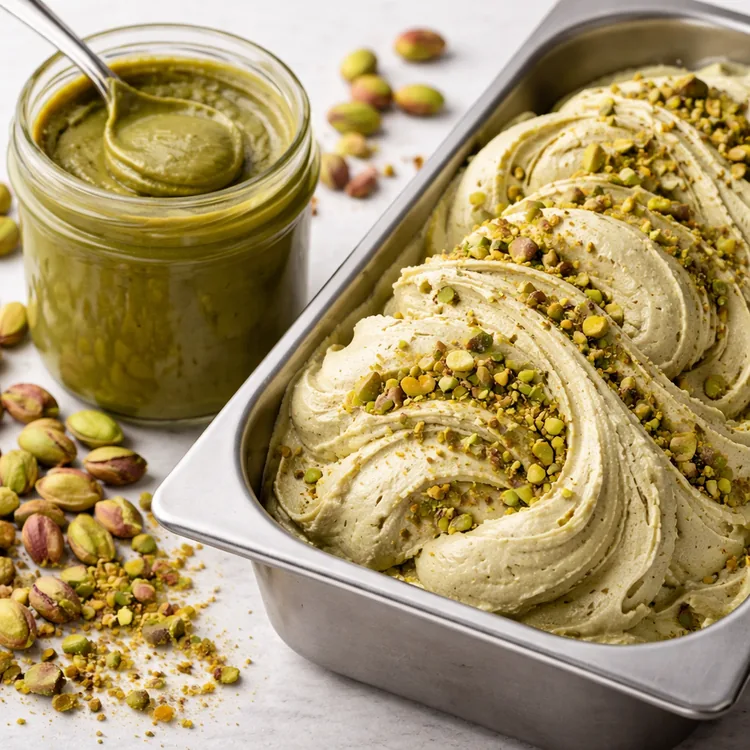
Unsweetened pistachio paste is a pistachio ingredient produced without added sugar. In simple terms, it is concentrated pistachio material processed into a paste form suitable for recipe use. Because no sugar has been added, the paste functions primarily as a pistachio flavor and nut-body ingredient rather than as a complete sweetened base.
This distinction is important. In frozen dessert production, a sweetened pistachio preparation may contribute pistachio character, but it also contributes sweetness in a fixed way. An unsweetened paste gives the formulator more direct control over how much sweetness the final product will have and how the overall formulation should be balanced. That is one reason it is widely valued in more serious or more customizable frozen dessert work.
From a B2B purchasing perspective, the product should not be treated as a generic “pistachio flavoring.” It is better understood as a pistachio core ingredient that influences both the taste and the structure of the finished dessert.
Why unsweetened paste is especially valuable in gelato and ice cream
The main commercial and technical advantage of unsweetened pistachio paste is formulation flexibility. Gelato and ice cream manufacturers already manage multiple variables such as sugar balance, fat perception, milk solids, overrun, stabilizing systems, serving temperature and final mouthfeel. If the pistachio ingredient arrives with added sweetness already built in, it can reduce the developer’s freedom to fine-tune those variables.
Unsweetened paste gives the manufacturer more room to design the recipe around the exact product goal. That goal may be a richer artisan gelato, a lighter premium scoop product, a denser pistachio-focused bar filling, a soft-serve concept, a layered dessert or a private-label frozen dessert line with a custom sweetness profile. In each case, the manufacturer can treat the pistachio paste as pistachio first, then build sweetness and structure separately.
This is especially useful in premium products where the maker wants pistachio to feel like a real ingredient rather than a standardized flavor system.
Why gelato makers often prefer unsweetened pistachio paste
Gelato is often developed with a stronger emphasis on ingredient expression and controlled texture. Producers commonly care about how the nut flavor presents at service temperature, how the paste integrates with the milk base and how the final product balances creaminess with a clean pistachio profile. In that context, unsweetened pistachio paste offers a practical advantage because it lets the maker work more precisely.
A gelato maker may want a stronger pistachio note without pushing the product too sweet. Another may want a softer or more restrained sweetness level because the serving style or market expectation is different. Another may want to create a layered recipe with variegates, inclusions or different texture components. Unsweetened paste makes these adjustments easier because the pistachio component is not locked to a predefined sugar ratio.
For premium gelato positioning, that flexibility often translates into better product differentiation and a more controlled artisanal result.
Why ice cream manufacturers also benefit from unsweetened paste
Although gelato discussions often dominate premium pistachio conversations, unsweetened pistachio paste is also highly relevant in ice cream manufacturing. Industrial and premium ice cream systems vary widely. Some products are more indulgent and creamy, some are lighter, some include ribbons or inclusions, and some are designed for branded retail tubs or foodservice use. In all of these, the manufacturer may want to determine sweetness and structural balance independently of the pistachio input.
Unsweetened paste is useful here because it can be adapted more easily across different product architectures. It supports premium pistachio scoop flavors, layered retail concepts, filled novelties, frozen desserts with inclusions and products positioned around cleaner ingredient communication. Rather than forcing the manufacturer into one sweetness system, the paste allows pistachio flavor to be built into the specific style of ice cream being produced.
Flavor control: one of the biggest reasons buyers choose unsweetened paste
In pistachio frozen desserts, flavor control matters enormously. A product can be too weak, too sweet, too generic or too dominated by supporting flavors if the pistachio ingredient is not chosen carefully. Unsweetened pistachio paste helps because it allows the product developer to focus on the pistachio contribution itself rather than on sweetness bundled into the ingredient.
This gives several practical advantages:
- clearer pistachio expression when the maker wants the nut to be the star of the flavor profile,
- greater control over sweetness balance across different frozen dessert styles,
- easier formulation adjustment when building custom product lines or market-specific profiles,
- better flexibility in premium development where the product needs a more deliberate flavor architecture.
For B2B buyers, this is one of the strongest practical reasons to consider unsweetened paste seriously. It gives more room to make the final product taste like the brand intends, not merely like the ingredient supplier decided.
Color expectations in pistachio frozen desserts
Pistachio color is one of the most commercially sensitive aspects of the category. Buyers and consumers often have strong visual expectations, whether they prefer a more natural pistachio tone or a more vivid premium look. Because frozen desserts are highly visual, the paste’s color profile can influence the overall impression of quality.
That said, color should always be evaluated in context. A gelato or ice cream developer should not assume that brighter is always better, or that every market wants the same visual style. Some premium brands prefer a more natural presentation that signals ingredient authenticity. Others want a cleaner or more visually striking look because the product needs strong shelf appeal. The correct expectation depends on brand position, market style and end-customer perception.
For buyers, the practical lesson is simple: color should be discussed intentionally during sourcing. The paste should support the final dessert concept rather than being judged by isolated appearance alone.
Texture and mouthfeel contribution
Unsweetened pistachio paste is not just a flavor carrier. It also contributes to the body and mouthfeel of the frozen dessert. In gelato and ice cream, mouthfeel is one of the clearest markers of quality. A premium pistachio product should feel smooth, rich and well integrated, not disconnected or thin.
Because pistachio paste contributes nut body, it can help create a more complete and rounded eating experience. The effect depends on the formula, the usage level and the overall frozen dessert system, but in general the paste is part of the way pistachio products gain depth. That is one reason serious buyers review the paste not only in a spoon test on its own, but also in a real or pilot frozen dessert application.
In practical terms, the paste should help the finished product feel pistachio-rich and properly structured, not merely flavored.
Why unsweetened paste supports better recipe balance
Recipe balance is central to frozen dessert quality. Too much sweetness can flatten pistachio character. Too little can make the product feel incomplete. A mismatch between nut contribution and base system can also distort the final result. Unsweetened pistachio paste helps the developer manage that balance more carefully because the pistachio component can be adjusted independently from the sugar component.
For example, a manufacturer may want a stronger pistachio presence in a premium gelato without proportionally increasing sweetness. Another may want to maintain a controlled sweetness level because the product also includes a variegate, sauce, coating or topping. Another may need to adapt the same pistachio concept across different markets or customer segments. Unsweetened paste makes those types of adjustments more practical.
This is one reason it is so often associated with more serious formulation work. It gives more control to the producer and less to chance.
Unsweetened paste versus sweetened pistachio preparations
It is useful to be clear about the difference. Sweetened pistachio preparations can be convenient in some applications, especially where a more ready-made formulation component is desirable. But convenience does not always equal flexibility. In gelato and ice cream, many professionals prefer unsweetened paste because they do not want sugar and pistachio intensity tied together in a fixed supplier ratio.
Unsweetened paste is often better suited when the producer wants:
- more precise recipe control,
- greater freedom across different frozen dessert styles,
- premium or artisan positioning,
- a more ingredient-led pistachio identity,
- or a custom sweetness system built around the brand’s own formulation goals.
The key point is not that sweetened versions are always wrong. It is that unsweetened paste is usually the more versatile starting point for premium frozen dessert work.
Flavor direction: natural, roasted or more developed pistachio character
Not every pistachio frozen dessert should taste the same. Some brands want a cleaner and more natural nut expression. Others want a slightly deeper or more developed pistachio tone that reads as richer or more indulgent. This is why buyers should not evaluate paste only by whether it tastes “strong.” They should evaluate whether it tastes right for the product they want to build.
In gelato, a more refined pistachio note may be preferred if the brand aims for an ingredient-led artisan style. In ice cream, a more developed profile may integrate well with creamier or more indulgent systems. In premium retail lines, the ideal result may be somewhere in between: clearly pistachio-forward, but still balanced and approachable.
For B2B buyers, this means flavor review should always be application-based. The best paste is not the one that is strongest in isolation. It is the one that supports the desired finished product identity.
How paste performance should be evaluated
Buyers in frozen dessert categories should evaluate pistachio paste in more than one way. A spoon test can be useful for first impressions, but it is not enough on its own. Since the paste is going into a recipe, the real question is how it behaves in the finished system.
A useful evaluation process may include:
- direct sensory review of aroma, taste and general pistachio character,
- visual review of color profile and overall appearance,
- texture observation of the paste itself for consistency and usability,
- trial incorporation into the target gelato or ice cream base,
- assessment after freezing and serving to see how the pistachio presents at real consumption temperature,
- comparison against the intended brand style rather than against abstract notions of “good” or “bad.”
This helps prevent one of the biggest sourcing mistakes in frozen desserts: approving a paste because it seems attractive on its own without confirming that it performs correctly in the actual application.
Why formulation flexibility matters for premium brands
Premium frozen dessert brands often need more freedom, not less. They may run seasonal products, regional variants, signature scoop flavors, layered retail offerings or foodservice concepts that require slightly different balance points. Unsweetened pistachio paste is helpful in those cases because it behaves like a true pistachio building block instead of a partially completed sweetened system.
This matters commercially as well as technically. A brand that can shape its pistachio offering more precisely can often build a more distinctive product line. It can control sweetness better, create clearer flavor separation between formats and adapt the same core ingredient to multiple uses. From a buyer’s perspective, that flexibility can be a strong reason to prioritize unsweetened paste in sourcing discussions.
Use in artisanal gelato versus industrial frozen dessert systems
Artisanal and industrial users may approach pistachio paste differently, but both can benefit from unsweetened formats. Artisanal gelato makers often value ingredient expression, custom balancing and direct control over taste. Industrial producers may value versatility, line consistency, large-scale recipe control and the ability to adapt the same ingredient across multiple stock keeping units.
In both cases, unsweetened paste works because it allows the buyer to define the rest of the recipe around the pistachio rather than accepting a fixed sweetness contribution from the paste supplier. The practical priorities may differ, but the core advantage remains similar: more control over the final product.
How unsweetened pistachio paste supports cleaner premium positioning
In premium frozen desserts, consumers and buyers often respond well to products that feel more ingredient-led and less artificially styled. Unsweetened pistachio paste can support that perception because it allows the brand to speak more clearly about pistachio as an actual recipe component rather than as a flavor direction added through a sweetened preparation.
This is especially useful in premium gelato counters, gourmet retail tubs and private-label ranges that want to communicate a more refined or more authentic product image. The paste does not guarantee that positioning on its own, but it supports it by giving the manufacturer more direct control over the final recipe and ingredient balance.
Application fit: not every paste profile suits every frozen dessert
Just as not every pistachio format is suited to every snack or confectionery application, not every pistachio paste profile is ideal for every frozen dessert. A paste chosen for a premium artisan gelato may not be the best match for a more indulgent, heavily layered retail ice cream line. A paste profile suited to a clean pistachio scoop flavor may not be ideal for a novelty product that includes chocolate coating or strong inclusions.
That is why buyers should define the end use before comparing offers. Helpful questions include:
- Is the pistachio the hero flavor or a supporting one?
- Should the product feel more natural and refined or more indulgent and dessert-like?
- Will the frozen dessert include sauces, variegates or inclusions?
- Does the brand want a more restrained sweetness or a more rounded sweetness?
- How visible is pistachio identity in the final product story?
The more clearly these questions are answered, the easier it becomes to identify the right paste profile.
Packaging and handling considerations
Packaging is a practical but important part of pistachio paste sourcing. Frozen dessert manufacturers need an ingredient that arrives in a condition appropriate for production use, storage and repeat handling. Packaging affects more than transportation. It influences operational convenience, cleanliness and how efficiently the ingredient can be integrated into the production environment.
For importers and distributors, packaging also matters because it affects warehouse management and downstream supply practicality. For manufacturers, it matters because the paste should be easy to work with and appropriate for the expected usage rate and production schedule. Buyers therefore should not treat packaging as an afterthought. It is part of the full sourcing evaluation.
Consistency across batches matters greatly
In gelato and ice cream, inconsistency shows quickly. If the paste profile shifts meaningfully from batch to batch, the final frozen dessert can taste different, look different or require recipe adjustment. That can be especially problematic for branded retail products, foodservice chains and any manufacturer trying to maintain a recognizable pistachio signature over time.
This is why repeatability is one of the most important supplier questions. A paste may taste excellent in a first sample, but the buyer also needs confidence that the same profile can be supplied consistently. That includes overall pistachio intensity, general color expectation, usable texture and the broader commercial standard established during approval.
How importers and distributors should think about pistachio paste
Importers and distributors are often serving multiple customer types. Some may supply artisan gelato makers, others may serve industrial dessert producers, and some may do both. For that reason, it is helpful to think of unsweetened pistachio paste not as one single commercial item, but as part of a premium ingredient category that can serve different frozen dessert needs.
Distributors can often add value by helping customers understand why unsweetened paste matters, how it differs from sweetened preparations and what kind of formulation freedom it offers. This turns the product from a generic paste line item into a more meaningful ingredient solution for frozen dessert professionals.
Common buyer mistakes to avoid
Choosing only on price
A lower-priced paste may not create the product the buyer actually wants. Flavor, color, consistency and formulation fit often matter more in premium frozen dessert development.
Evaluating the paste only on its own
A spoon test is helpful, but the paste should also be reviewed in a real or pilot gelato or ice cream system.
Ignoring sweetness flexibility
One of the biggest advantages of unsweetened paste is the ability to control sweetness independently. Buyers should use that advantage intentionally.
Assuming all pistachio pastes are equivalent
They are not. Paste profiles can differ in ways that affect the finished frozen dessert significantly.
Approving a strong sample without defining the repeat-order standard
If the paste is approved because of its flavor, color or usability, those expectations should be captured clearly in the commercial relationship.
A practical buyer checklist
Before ordering unsweetened pistachio paste for gelato or ice cream, buyers should be able to answer the following:
- What exact frozen dessert application are we developing?
- Do we want a more natural pistachio profile or a more developed one?
- How important is independent sweetness control in our formula?
- What color style best fits our brand and market?
- How does the paste perform in the actual frozen dessert base?
- Does the paste support the intended mouthfeel and product identity?
- Can the supplier repeat the approved standard consistently?
- Is the packaging suitable for our storage and production needs?
- Does this paste support our premium or commercial position effectively?
- Are we comparing paste offers according to application fit, not just cost?
How Atlas uses this knowledge
Atlas uses academy content to make product discussions clearer and more useful for serious buyers. In the case of frozen desserts, that means helping buyers understand that pistachio paste should be reviewed not only as a pistachio ingredient, but as a formulation tool that shapes the final product in multiple ways. Flavor control, sweetness independence, texture contribution and commercial positioning all matter.
Atlas approaches pistachio paste sourcing by connecting the product profile to the actual application. That helps gelato makers, importers, distributors and manufacturers ask better questions, compare offers more intelligently and move toward supply conversations that are grounded in real product goals instead of generic descriptions.
Key takeaway
Unsweetened pistachio paste is especially valuable in gelato and ice cream because it gives the maker something highly important: pistachio expression without surrendering sweetness control. That flexibility supports better formulation, stronger premium positioning and clearer product differentiation across frozen dessert styles.
For buyers of Turkish Antep pistachio ingredients, the best sourcing approach is to evaluate paste according to the intended application. Flavor, color, texture, repeatability and usability all matter. The strongest results usually come when the paste is chosen not as a generic commodity, but as a central component of the frozen dessert’s identity.
In short, better information leads to better paste selection, smoother development and more confident purchasing decisions.
Frequently asked questions
Why do many frozen dessert professionals prefer unsweetened pistachio paste?
Because it allows them to control sweetness separately from pistachio intensity. That makes formulation more flexible and usually more precise.
Is unsweetened pistachio paste only for artisan gelato makers?
No. It is also useful for premium and industrial ice cream manufacturers who need formulation control and consistent pistachio identity across product lines.
Should paste color be judged on its own?
Not completely. Color should be assessed in relation to the final frozen dessert concept, market style and the overall brand position.
What is the main risk of choosing paste based only on price?
The finished gelato or ice cream may not deliver the desired flavor, appearance or premium perception, and the cost difference may be outweighed by weaker product performance.
Does unsweetened paste automatically mean better quality?
Not automatically. Quality still depends on the paste profile, consistency and suitability for the intended application. Unsweetened simply gives more formulation flexibility.
What should happen after sample approval?
After approval, buyers should align on repeatability expectations, packaging format, supply consistency and the product characteristics that made the sample acceptable in the first place.
Talk to Atlas about pistachio paste for gelato, ice cream and frozen dessert development
If your team is sourcing Turkish pistachio paste for artisan gelato, premium retail ice cream, frozen dessert manufacturing or foodservice applications, Atlas can help clarify the right paste profile, commercial fit and sourcing approach for your formulation goals.