Introduction: why pistachio matters in this category
Snack innovation has moved far beyond simple convenience. Today’s protein and better-for-you products are often expected to do several jobs at once. They must fit a modern, active lifestyle, carry a more premium ingredient story, deliver a satisfying bite and still look commercially appealing on shelf or in digital merchandising. In many cases, the product is being evaluated not only by procurement teams or manufacturers, but also by marketers, private-label managers and commercial buyers who want something that looks clean, purposeful and more elevated than standard snack formulations.
This is one reason pistachios have become so commercially relevant in the category. They help products feel more natural, more premium and less generic. A snack that visibly includes pistachio pieces often communicates more ingredient value than one built entirely around anonymous crunch components or less expressive nut systems. In addition, pistachios work across multiple formats, from dense protein bars to lighter granola structures, from coated snack bites to cereal-inspired blends and from premium clusters to hybrid bakery-snack concepts.
For B2B buyers, however, the important question is not simply whether pistachio is attractive in theory. The real question is how to use it effectively. Which format works best for each snack style? When should the pistachio be visible and when should it be more integrated? How much does size consistency matter? What role do roast style, cut size and visual profile play in market positioning? And how should buyers compare offers when one pistachio format may work beautifully in a cluster but less well in a bar center or coated protein bite?
This article addresses those issues from both a commercial and technical perspective. The aim is to help importers, distributors, brand owners and manufacturers understand how Turkish Antep pistachios can be used more intelligently in protein snack and better-for-you product development.
What “protein snacks” and “better-for-you” products really mean in practice
These two terms are broad, and that matters for sourcing. “Protein snacks” can refer to bars, balls, bites, filled formats, granola-based systems, coated snack pieces, baked hybrids or other formats positioned around satiety, active lifestyles or performance-oriented consumption. “Better-for-you” is even broader. It can include premium snacking, cleaner ingredient positioning, lower-processed concepts, more visible whole-food components, reduced indulgence cues or a stronger balance between enjoyment and perceived product quality.
Because the category is so wide, pistachio sourcing for these products must begin with application clarity. A pistachio chosen for a visible cluster product may not be the best choice for a soft high-protein center. A powder that works in one coated bite system may not create the desired identity in a granola-based product. A large kernel piece that looks impressive on shelf may become difficult in a deposited or compressed bar system if the texture profile is not designed properly.
In other words, there is no single “protein snack pistachio.” There are multiple pistachio formats that support different product goals, and buyers should always begin with the intended use.
Why pistachio is commercially attractive in better-for-you categories
From a market perspective, pistachio gives better-for-you products several advantages at once. First, it carries a naturally premium image. Many consumers and commercial buyers associate pistachio with quality desserts, premium nuts, elevated snacking and more refined flavor systems. This premium association can help better-for-you products avoid looking austere or overfunctional. They can feel healthier-minded without sacrificing aspiration.
Second, pistachio contributes a stronger visual and sensory identity than many background inclusions. A visible pistachio piece, chopped green kernel or pistachio-forward cluster tends to communicate ingredient richness more clearly than a neutral cereal piece or a less distinctive nut fragment. This matters for packaging visuals, shelf presence and digital commerce imagery, where the product often needs to “explain itself” quickly.
Third, pistachio works well in formulations that aim to balance indulgence and restraint. A product can still feel premium and rewarding when pistachio is part of the bite, even if the overall positioning is lighter, cleaner or more lifestyle-oriented than traditional confectionery. For private-label buyers and premium snack brands, that balance can be commercially powerful.
How pistachio helps products feel more ingredient-led
One of the biggest changes in modern snack development is the desire for products to feel more transparent and ingredient-led. Buyers often want to move away from snacks that appear overly engineered, overly anonymous or visually disconnected from their ingredient story. Pistachio helps here because it is expressive. It can be seen, identified and felt in the bite.
That visibility matters. In many better-for-you products, consumers respond positively when the snack looks like it contains recognizable premium ingredients. Visible pistachio pieces can reinforce the impression that the product is built around real nuts rather than only around flavor systems. Even when pistachio is combined with other elements such as oats, seeds, cocoa, fruit components or protein systems, it can still act as a premium anchor that lifts the entire product’s perceived value.
For B2B snack developers, this means pistachio is not merely a flavor note. It is part of the product language. It influences how the item looks in a cross-section, how it reads on the front of pack, how it photographs and how it is interpreted by buyers evaluating new snack concepts.
Application areas where pistachio performs especially well
Pistachio can work in many snack categories, but its value tends to be strongest where texture, visible ingredient identity and premium positioning are important. Common applications include:
- protein bars where pistachio adds crunch, visual interest and a more premium nut profile,
- snack bites and energy balls where chopped kernels or granules create bite and visible ingredient value,
- clusters where pistachio can reinforce a premium artisan-style appearance,
- granola and muesli-style products where pistachio contributes visual distinction and upgraded nut identity,
- baked snack bars and breakfast hybrids where pistachio supports both flavor layering and market differentiation,
- better-for-you confectionery crossover products where pistachio helps bridge wellness-style positioning and indulgent taste appeal,
- premium trail mixes and portioned snack packs where pistachio reinforces a higher-value assortment.
The correct pistachio format varies across these uses, but the commercial logic is consistent: pistachio helps the product look more deliberate, more premium and more ingredient-focused.
Choosing the right pistachio format
One of the most important sourcing decisions is choosing the correct physical format. Buyers should not ask only for pistachios. They should ask for the pistachio form that supports the intended snack structure, process and final visual goal.
Whole kernels and split kernels
These are most useful where a product needs high visual impact and a recognizably premium nut appearance. They can work well in premium mixes, decorative surfaces, open-format snack bars or cluster products where visible nut identity is part of the concept. However, they are not always ideal for denser systems that require tight compression or uniform internal distribution.
Chopped kernels
This is one of the most versatile formats for snack manufacturing. Chopped pistachios can add controlled crunch, allow more even distribution and integrate well into protein bars, bites and cluster systems. The key variables are particle size and consistency. A narrow size profile usually performs better than a highly mixed one.
Granules
Granules are often useful where even dispersion and process control matter more than dramatic visual pieces. They can support more uniform texture in products that need internal consistency across every unit.
Pistachio powder
Powder is valuable when the pistachio needs to be blended more evenly into a base, contribute to visual tinting or support coating and flavor systems without creating a chunky bite. In some snack systems, powder helps reinforce pistachio identity while keeping the texture smoother.
Pistachio paste
Paste is most relevant where a snack concept needs a richer pistachio base, a binding component or a smoother pistachio flavor presence. It can also be used with visible pistachio pieces to create a layered pistachio system rather than a single-format application.
The strongest results often come from combining formats. For example, a protein bite may use pistachio paste for base character and chopped kernels for visible texture. A better-for-you bar may use granules internally and larger decorative pieces on the surface. The ideal format depends on what the product is trying to communicate and how it needs to perform in production.
Texture design: one of the most important reasons to use pistachio
Texture is central to snack satisfaction, especially in protein-oriented categories. Many high-protein or functional snack systems risk becoming dense, chewy, dry or visually flat if the texture architecture is not designed carefully. Pistachio can be a powerful corrective because it adds contrast and structure.
In bars, chopped pistachios may break up an otherwise uniform mass and create a more satisfying bite. In clusters, they can add a sharper crunch that makes the product feel less monotonous. In granola-inspired formats, they can help elevate the nut signature above a standard oat-and-seed profile. In bites or balls, they can reinforce the sense that the product contains real nuts rather than only processed inclusions.
For buyers, this means pistachio should be chosen in relation to the existing texture profile of the snack. A softer matrix may need fine or medium pieces to avoid awkward hardness. A more open cluster can support larger visible pieces. A denser bar system may benefit from a controlled inclusion size that adds crunch without undermining cut stability or portion uniformity.
Why size consistency matters in snack applications
Protein snacks and better-for-you products often rely on repeatability. Retail buyers, private-label teams and manufacturers want the same bite, appearance and visual balance across batches. This is why particle size consistency matters so much. A chopped pistachio inclusion that varies too widely may create random hard spots, uneven distribution or inconsistent visual impact from one unit to another.
In practice, consistent sizing supports:
- more predictable texture across the product,
- more balanced visual distribution,
- easier formulation control,
- better process performance during mixing or depositing,
- and stronger repeatability from development sample to full production.
Snack manufacturers often do not want overly mixed nut material if the product needs a consistent premium result. That is especially true in branded bars, private-label premium products and export programs where cross-batch uniformity influences perceived quality.
Visual appeal and premium perception
One of the strongest reasons to use pistachio in this category is visual differentiation. Better-for-you and protein snack shelves are increasingly crowded. Many products compete on similar language: active lifestyle, smart snacking, clean ingredients, convenient nutrition or premium formulation. In this environment, visible pistachio content can help a product stand out.
Pistachio pieces tend to signal a more upscale ingredient story than many standard nut or cereal inclusions. They can make a bar or cluster look more sophisticated, especially when combined with other premium cues such as cocoa, seeds, fruit pieces or layered textures. In photography, pistachio often performs well in cut-open images, overhead pack shots and premium merchandising visuals because it provides recognizable structure and color variation.
For buyers, this matters because the raw ingredient is influencing final product marketability. A product that looks more premium can often support stronger positioning, clearer communication and better perceived value.
Pistachio in protein bars
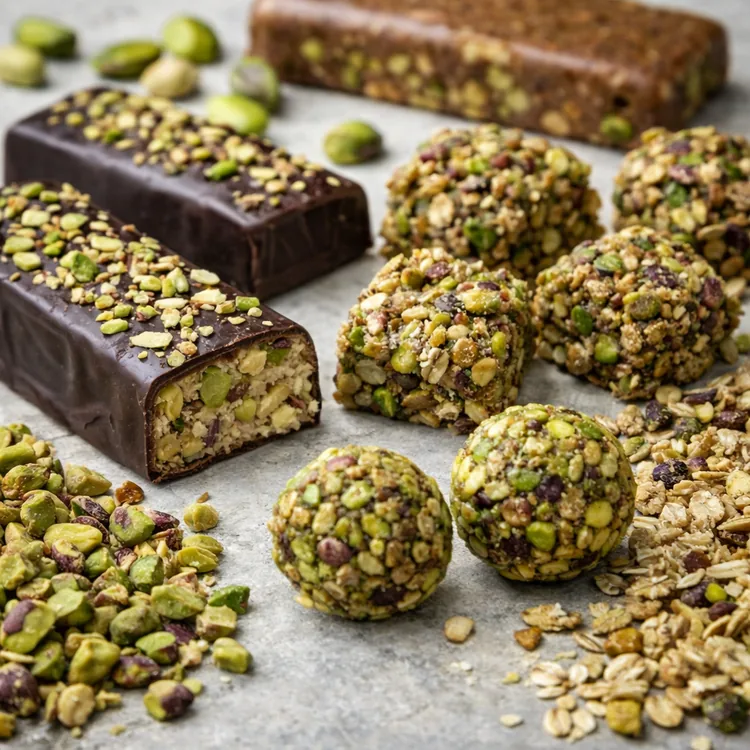
Protein bars are one of the most commercially relevant applications for pistachio. These products need to balance function, convenience and sensory appeal. Too often, protein bars become dense, overly uniform or visually uninspiring. Pistachio can help solve that by adding both visible ingredient identity and a more layered bite.
In bars, pistachio may be used as:
- a chopped inclusion inside the core matrix,
- a visible topping or surface garnish,
- part of a coating or finishing layer,
- or a combined paste-plus-piece system for stronger pistachio identity.
The best format depends on the bar style. A softer protein bar may benefit from smaller or medium pieces for balance. A layered premium bar can support more dramatic visible pieces. A coated bar may use pistachio to signal flavor identity externally as well as internally.
From a commercial standpoint, pistachio bars can also occupy an attractive position between wellness and indulgence. They feel more premium than standard sports bars while still fitting better-for-you merchandising logic.
Pistachio in bites, balls and mini snack formats
Mini snack formats are especially well suited to pistachio because they often rely on visible ingredients to communicate quality quickly. A bite-sized product needs to look appetizing and premium almost immediately. Chopped pistachios or granules can help create that effect without requiring a large serving format.
These products may use pistachio internally, externally or both. In some cases, pistachio acts as a visible coating element that reinforces the product story on sight. In others, it is incorporated into the core for a more integrated bite. Because these formats are small, inclusion size must be chosen carefully. Pieces that are too large may dominate the bite, while pieces that are too fine may disappear visually.
This is a good example of why snack developers should source pistachio with the exact format in mind rather than assuming one chopped profile will suit every application.
Pistachio in clusters and granola-style products
Clusters and granola-inspired products often benefit strongly from pistachio because these categories already lean toward visible ingredient storytelling. Pistachio can add premium distinction to an otherwise familiar oat-seed-nut profile and can help position the product as more gourmet, more curated or more upscale.
In clusters, pistachio pieces can contribute a handcrafted appearance, especially when the product is intended to feel artisanal or premium-retail oriented. In granola or cereal hybrids, pistachio can upgrade the product visually and create a more distinctive nut profile. In both cases, size and distribution matter. The inclusion should feel natural and generous, not sparse or random.
From a B2B standpoint, these categories are often highly visual. That makes the color, piece integrity and consistency of the pistachio especially important.
Pistachio in premium snack mixes and portion packs
Beyond manufactured bars and bites, pistachio also adds value in portioned snack packs, premium nut mixes and hybrid on-the-go concepts that sit between functional snacking and gourmet retail. In these products, pistachio can help lift the overall assortment and communicate that the mix is more selective than a standard commodity combination.
Here, visual appearance often matters as much as texture. The pistachio is visible from the start, so buyers tend to care about kernel integrity, visual balance and general premium presentation. This is a good example of an application where whole kernels or larger selected pieces may make more commercial sense than smaller ingredient-style cuts.
Balancing clean-label style positioning and indulgence
One challenge in better-for-you development is finding the right balance between “healthy-minded” and “desirable.” Some products lean so hard into functional messaging that they lose pleasure and premium character. Pistachio can help correct that. It allows a product to feel more ingredient-rich and satisfying without automatically pushing it into a conventional indulgence-only position.
This balance is especially useful for brands that want products to appear natural, premium and enjoyable rather than clinical. A pistachio-forward concept can support a cleaner, more culinary impression and make the snack feel less synthetic or one-dimensional. That does not mean pistachio alone solves formulation or positioning problems, but it can meaningfully improve the overall product language.
Flavor pairing potential
Pistachio is also valuable because it pairs well with many flavors commonly used in modern snack development. Depending on the concept, it can work with:
- dark chocolate and cocoa notes,
- milk chocolate and creamy dairy-style profiles,
- vanilla, honey and caramel directions,
- fruit components such as berry or citrus accents,
- seed blends and cereal systems,
- and other nuts in layered or mixed premium snack concepts.
For developers, this pairing flexibility matters because it allows pistachio to support both familiar and more distinctive flavor architectures. It can be the hero ingredient or a premium supporting element inside a broader snack concept.
Roast profile and flavor direction
Buyers should also think about whether the product needs a fresher, more natural pistachio expression or a deeper roasted nut direction. This choice can influence how the snack is perceived. A more natural profile may work well in cleaner-looking, lighter-positioned products. A more developed roast expression may better suit richer bars, cocoa-based products or snacks that aim for stronger indulgent satisfaction.
The best choice is usually the one that complements the rest of the product rather than competing with it. In a subtle grain-based cluster, a more balanced pistachio character may be ideal. In a coated protein bar with dark cocoa notes, a more assertive roast profile may integrate better. The important thing is to define this intentionally during sourcing rather than treating all pistachio formats as flavor-equivalent.
Processing fit matters
Even the most attractive pistachio format must still work in production. Snack manufacturers should therefore evaluate pistachio not only for appearance and flavor, but also for how it behaves in the real system. Relevant questions include:
- Does the pistachio distribute evenly in the matrix?
- Does it affect depositing, compression or cutting?
- Is the piece size stable enough for repeatable production?
- Does the product remain visually attractive after mixing or baking?
- Will the pistachio be visible enough in the final pack?
- Is the chosen format appropriate for the target serving size?
These questions are especially important in protein bars and better-for-you snacks because many such systems already carry formulation constraints. A pistachio inclusion that looks excellent in a sample jar may behave differently in a dense or sticky matrix. That is why sample evaluation inside the real application is so important.
Why sample approval is critical
As with most ingredient-driven products, sample approval should not stop at appearance alone. Buyers should ideally test the pistachio in the target snack format or a realistic pilot version of it. A sample can help answer not only whether the pistachio looks clean and premium, but whether it supports the actual texture, flavor release and product appearance the brand wants to achieve.
Sample review is especially useful for clarifying:
- whether the chosen cut size feels right in the bite,
- whether the visual distribution is sufficient for pack claims or cross-sections,
- whether the product looks premium enough once processed,
- and whether the approved sample can realistically be repeated in supply.
The last point matters greatly. In branded snack categories, repeatability is often more valuable than one unusually attractive sample.
Repeatability and supply discipline
Protein snacks and better-for-you products often depend on consistent brand presentation. If the pistachio profile changes too much from batch to batch, the finished snack may look different, feel different or photograph differently. That can create problems not only in product performance but in customer perception and commercial confidence.
For this reason, buyers should evaluate potential suppliers on repeatability as well as product appeal. Can the chosen cut size, visual profile and commercial standard be maintained over time? Does the supplier understand the difference between a premium visible snack inclusion and a more generic ingredient format? Can the product be packed and delivered in a way that supports predictable usage in manufacturing?
These are core sourcing questions, not minor details. In modern snack categories, consistency often influences brand trust as much as the initial concept does.
Packaging and handling considerations
Packaging is another practical factor that matters more than some buyers expect. Protein snack manufacturers and ingredient users need pistachio formats that arrive in a condition suitable for production, storage and handling. Packaging affects cleanliness, protection and operational convenience. For importers and distributors, it also affects warehouse practicality and resale logic.
The right packaging approach depends on the product form and the supply chain model, but the broader principle is simple: the pistachio should arrive in a format that protects its commercial value and supports efficient use.
How different buyer types should think about pistachio in this category
Importers
Importers should think about category segmentation. Pistachio for premium snack bars is not the same as pistachio for mixes or granola. A stronger portfolio strategy begins by separating visible premium formats from more process-oriented ingredient formats.
Distributors
Distributors benefit from being able to explain application fit clearly. Customers in better-for-you categories often need help choosing the correct pistachio form for the bite, look and positioning they want.
Food manufacturers
Manufacturers should focus on process suitability, texture, particle consistency and real-world performance in the final snack system. A good pistachio ingredient is the one that works repeatedly in production while supporting the desired consumer experience.
Private-label teams
Private-label buyers should pay special attention to visual appeal and repeatability. If pistachio is being used to help a snack look more premium or distinctive, the ingredient standard must be repeatable enough to support that position across production runs.
Brand owners
Brand owners should think about pistachio as both a formulation component and a merchandising tool. It affects the product story, pack design, photography, premium perception and the overall balance between wellness and indulgence.
Common mistakes buyers make
Choosing pistachio only for flavor
Pistachio is valuable because it contributes flavor, texture and visual identity together. Reducing it to flavor alone often means underusing its strongest commercial advantages.
Using the same cut profile for every snack type
A particle size suited to granola may not be right for a dense bar or a coated bite. Application should always guide the format choice.
Comparing offers without clarifying final use
Two pistachio quotations may look similar on paper but serve very different commercial purposes. Buyers should define the application first, then compare offers.
Ignoring visual impact
In better-for-you categories, appearance can influence perceived quality and premium positioning almost immediately. Pistachio is often chosen precisely because it improves how the product looks.
Approving a sample without documenting the standard
If size, appearance or visual distribution mattered during approval, they should be translated into clear commercial expectations for repeat orders.
A practical buyer checklist
Before ordering pistachios for protein snacks or better-for-you products, buyers should be able to answer the following:
- What exact snack format are we developing?
- Do we need visible premium pistachio identity, internal texture, smoother blending or a combination?
- Which pistachio format best supports the bite and process?
- How important are color and visual presence in the final product?
- Do we need a more natural or more roasted flavor direction?
- How consistent must the cut size be?
- Will the pistachio be visible in pack shots, cross-sections or shelf presentation?
- Can the chosen sample be repeated reliably in commercial production?
- Is the packaging appropriate for our supply chain and production handling?
- Does this pistachio format support our commercial positioning as well as our technical needs?
How Atlas approaches this topic
At Atlas, pistachio for protein snack and better-for-you categories is not treated as a generic ingredient question. It is an application question. The right supply conversation begins with the format being developed, the bite profile desired and the commercial position the product is meant to hold. A visible premium bar, a clean-looking granola cluster and a denser protein bite may all use pistachio, but they do not necessarily need the same pistachio format.
That is why Atlas uses academy content to help buyers move from broad interest to clearer product definition. Once the intended application is understood, it becomes much easier to identify whether whole kernels, chopped kernels, granules, powder, paste or a combined format will best support the product goal.
Final takeaway
Using pistachio in protein snacks and better-for-you products is about far more than adding another nut ingredient to a formulation. Done well, pistachio can elevate the product’s visual identity, improve textural contrast, support cleaner and more premium ingredient storytelling and help the snack occupy a more attractive market position.
For importers, distributors, brand owners and manufacturers working with Turkish Antep pistachios, the key is to treat pistachio selection as an application-specific decision. Format, size, consistency, roast profile, visibility and process fit all matter. The strongest results come from matching the pistachio profile to the actual snack concept rather than relying on broad ingredient labels.
When that alignment is done properly, pistachio can help better-for-you products feel more distinctive, more premium and more satisfying, all while supporting stronger commercial communication and more confident sourcing decisions.
Frequently asked questions
Why is pistachio attractive in protein snack development?
Pistachio is attractive because it adds premium identity, visible ingredient value, natural texture and broad application flexibility across bars, bites, clusters and other modern snack formats.
Is chopped pistachio the most common format?
Often yes, because chopped pistachio is versatile and works in many products. However, the best format depends on whether the snack needs visual impact, smoother integration, surface decoration or a stronger pistachio base.
Does pistachio mainly improve flavor or appearance?
It improves both, but one of its strongest advantages is that it contributes flavor, texture and visible premium character at the same time.
Should buyers think differently about pistachio for clusters versus bars?
Yes. Clusters may benefit from more visible or varied pieces, while bars often require closer control over particle size, distribution and bite consistency.
Is sample testing necessary for these applications?
Yes. Sample testing helps confirm whether the pistachio format works in the actual snack system, not just whether it looks attractive on its own.
What is the biggest sourcing mistake in this category?
One common mistake is choosing pistachio without first defining the exact snack format and the role pistachio is meant to play in it. Better results usually come from application-first sourcing.
Talk to Atlas about pistachios for bars, bites, clusters and better-for-you concepts
If your team is developing protein snacks, premium granola products, clusters, nut mixes or clean-label snack concepts, Atlas can help clarify the most suitable pistachio format, quality profile and sourcing approach for your product goals.