Why this topic matters
International pistachio purchasing is rarely a simple quote-and-buy process. Importers, distributors, private-label teams and manufacturers usually need to understand how a product will perform commercially and technically before they commit to supply. That means the buying conversation starts with questions. Those questions help reduce risk, improve internal alignment and make sure the product offered is actually appropriate for the final use.
In the Turkish pistachio trade, this is especially important because one broad product name can still cover very different commercial realities. Two items may both be described as pistachios, but one may be intended for premium retail snacks, another for pastry topping, another for grinding into paste and another for use in industrial formulations. If the buyer does not clarify the right questions early, comparison becomes weak and the risk of mismatch increases.
That is why experienced buyers tend to ask a structured set of pre-order questions. They want to understand the real product, not just the label. They want to know whether the offer fits their application, whether the supplier can support repeat orders and whether the overall commercial setup is strong enough for international trade.
The first question: what exactly is the product?
One of the first and most important buyer questions is also one of the simplest: what exactly is being offered? This sounds obvious, but in practice it is where many sourcing misunderstandings begin. A buyer may ask for pistachios, while the supplier is thinking in terms of a broad category rather than a highly defined product form.
Before ordering, international buyers usually want to clarify whether the item is in-shell pistachios, whole kernels, split kernels, chopped kernels, granules, powder, paste or another processed format. They also want to know whether the product is raw, roasted, lightly processed or prepared for a specific application. This basic clarification is essential because everything else, including quality expectations, pricing, logistics and documentation, depends on it.
A clear product definition helps procurement teams compare offers more accurately and helps technical teams evaluate whether the product is suitable for their production environment.
What is the intended end use?
Skilled buyers almost always connect product selection to application. A pistachio that works well in one use case may not be ideal in another. That is why buyers often explain what they plan to do with the product before they finalize a quotation or request a sample.
Typical applications include snack retail, confectionery, chocolate inclusions, premium pastry, desserts, ice cream, baklava-style products, fillings, ingredient blends and industrial processing. The intended end use affects what matters most. For visible pastry use, buyers may prioritize appearance, color and kernel integrity. For ingredient manufacturing, they may care more about grind behavior, size consistency, purity, moisture management and batch repeatability. For retail snack products, roast profile, shell opening and consumer-facing appearance may matter more.
This is why strong suppliers do not just ask how much the buyer needs. They ask how the buyer will use it. The best ordering decisions begin with application clarity.
What origin is the product, and why does that matter?
Origin is another common pre-order question. International buyers often ask whether the pistachios are Turkish, whether they are associated with Gaziantep or Antep identity and how origin relates to the product’s market positioning. In premium categories, origin is more than geography. It can influence buyer perception, brand storytelling and the commercial language used to describe the product.
For some buyers, origin helps differentiate a premium offering from a generic one. For others, it supports a specific sensory expectation or a traditional product narrative. That said, experienced buyers also know that origin should not replace technical evaluation. Origin may add value, but it still needs to be supported by actual product quality, fit for use and supplier reliability.
In practical sourcing discussions, origin is usually best handled as one part of a larger product identity. Buyers want the commercial story, but they also want proof that the product performs.
How does the product look?
Appearance is one of the most common reasons buyers ask for photos, samples and detailed product descriptions before placing an order. Pistachios are a visually important ingredient. Color, cleanliness, size balance, piece integrity and general lot presentation all shape how buyers interpret quality.
If the pistachio will be visible in the finished product, appearance becomes even more important. A pastry topping, chocolate inclusion or premium dessert garnish must not only taste right, but also create the right impression. International buyers therefore often ask about kernel color, the balance between larger and smaller pieces, the presence of broken material and the general visual profile of the shipment.
Appearance is not just about beauty. It is also about consistency. Buyers want to know whether the delivered product will look like the approved sample and whether future orders will remain within the same visual standard.
What is the color profile?
Color matters because it often shapes premium perception. In many pistachio applications, buyers pay attention to how green, vivid or naturally balanced the kernels appear. A greener product may be preferred for premium visible applications, while other uses may accept a wider natural range if the product performs well in processing.
International buyers ask about color because it can influence final product appeal, especially in categories like pastry, gelato, fillings and gourmet retail products. Some buyers want an intense visual effect, while others are looking for a natural pistachio appearance rather than a bright presentation. In either case, clarity matters.
Good pre-order communication on color helps the buyer avoid disappointment and helps the supplier offer a more suitable product from the start.
How consistent is the kernel size or cut size?
Size consistency is one of the most practical pre-order concerns, especially for manufacturers and ingredient buyers. International buyers often ask how uniform the kernel size is, whether the product is calibrated and how much variation should be expected in the lot.
This question matters because size affects finished-product appearance, portion control, topping coverage, mixing behavior and further processing. A buyer using pistachios in visible decoration may need a more controlled visual range. A buyer using the material for grinding or chopping may still care about the starting size because it affects how consistently the product behaves during processing.
The more application-sensitive the use, the more important size consistency becomes. Strong buyers therefore ask not only whether the product is premium, but whether the size profile suits the intended purpose.
Is the product raw, roasted or processed in a particular way?
Processing style is another important pre-order topic. Buyers often want to know whether the product is raw, lightly roasted, fully roasted, chopped, sliced, ground or blended into paste. They may also ask how the processing method affects flavor, appearance and suitability for use.
This matters because the same pistachio material can behave differently depending on how it has been handled. Roasting may change aroma, texture and application performance. Cutting or grinding may affect shelf handling, mixing behavior and visual presentation. Paste may differ in texture or intensity depending on the processing approach.
Before ordering, buyers usually want to understand what stage of preparation the product is already in so they can evaluate whether it fits their own production process or retail plan.
What quality standard should we expect?
One of the most important buyer questions is how quality will be defined. International buyers know that general terms like premium or selected are useful only up to a point. Before ordering, they usually want a clearer understanding of what quality means in commercial practice.
That can include product cleanliness, defect tolerance, visible breakage level, shell or foreign material control, aroma freshness, lot consistency and suitability for the declared application. Buyers may also want to know whether the product is selected for visual use, ingredient use or a more cost-sensitive commercial tier.
The goal is not to create unrealistic perfection standards. The goal is to reduce ambiguity. When both sides define quality more clearly before ordering, the transaction becomes easier to manage and future disputes become less likely.
What documentation is available?
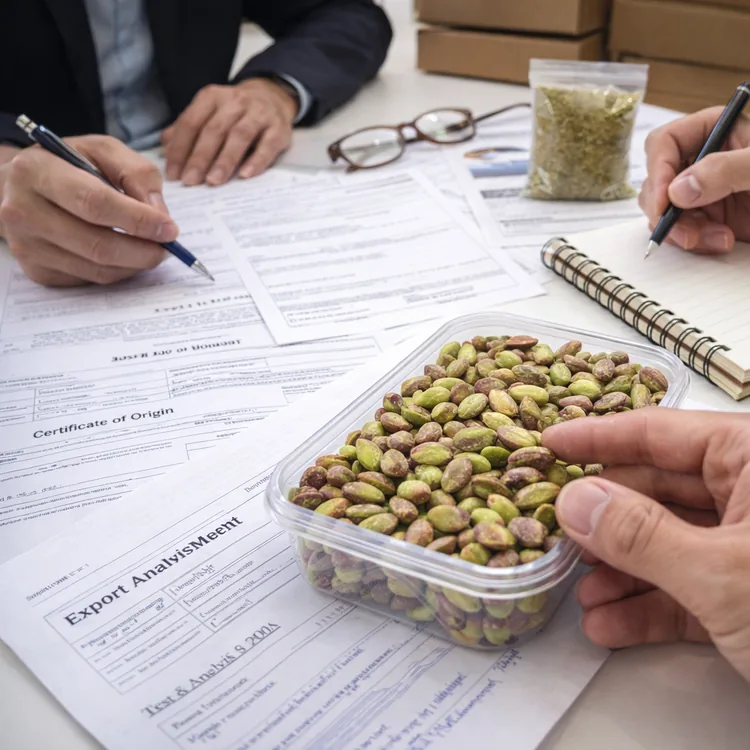
Documentation is one of the biggest differentiators in serious international trade. Buyers often ask what product information and export-related documents are available before they commit to an order. This is especially important when the pistachios are being imported into regulated markets, handled by multiple internal departments or evaluated by procurement teams that need formal documentation before approval.
Typical questions may relate to the product specification, packing details, shelf-life information, country of origin documentation, traceability support and other practical commercial papers needed to move from quotation to shipment. Even when the buyer already likes the product itself, missing or unclear documentation can delay the order.
That is why experienced buyers usually bring documentation into the conversation early rather than treating it as an afterthought.
How is the product packed?
Packaging is a highly practical pre-order question because it affects protection, storage, handling, presentation and logistics. International buyers often ask how the pistachios are packed, what type of liner or inner protection is used, how much weight is in each unit and whether the packaging suits bulk import, manufacturing use or retail-oriented distribution.
For ingredient buyers, packaging influences how the product will be received and used in production. For distributors, it affects warehouse handling and resale practicality. For private-label and premium buyers, it may also influence product positioning and freshness protection.
Packaging is not just a logistical detail. It is part of the commercial suitability of the product. Buyers therefore want to know not only what the pistachios are, but how they will arrive.
What is the shelf life and how should the product be stored?
International buyers frequently ask about shelf life and storage recommendations before ordering because those two factors shape inventory planning and downstream sales strategy. A buyer bringing product into a new market needs to understand how long the item can be held, what storage conditions are expected and whether the packaging supports that storage logic properly.
This is especially important for buyers who work with multiple warehouse locations, long transit routes or staggered production schedules. The longer and more complex the supply chain, the more important this question becomes. Even when the product itself is strong, poor planning around storage and timing can reduce commercial value.
Pre-order clarity on shelf handling helps buyers align purchasing volume with realistic stock movement and application timing.
Can you provide samples, and will the shipment match them?
Sample approval is a core part of international ingredient buying. Buyers often ask whether a supplier can provide a representative sample and how closely the commercial shipment will match what was approved. This is one of the most important trust questions in the pre-order stage.
A sample allows the buyer to evaluate appearance, color, aroma, size profile, handling and application suitability. But buyers do not want a one-time attractive sample that does not reflect normal production supply. What they really want is confidence that the approved sample is a fair reference for the shipment and, ideally, for future repeat orders as well.
This is why sample discussions should not be separated from consistency discussions. Buyers are not only asking to see the product. They are asking whether the supplier can repeat it.
What is the minimum order quantity?
Minimum order quantity is another very common pre-order question, especially for first-time buyers, new-market buyers and companies testing a product before scaling. International buyers want to know whether the supply program is suitable for their current stage. A large manufacturer may be ready for bulk orders, while a specialty importer may prefer to begin more cautiously.
MOQ is not just about budget. It also affects warehousing, risk exposure, cash flow and speed of market testing. Buyers often compare suppliers not only on price per unit, but also on how commercially flexible the order structure is for a first transaction or a trial phase.
This is why MOQ should be discussed openly. It helps both sides understand whether the opportunity is operationally realistic.
What is the lead time?
Lead time is a major concern in international purchasing because buyers need to align product arrival with sales planning, production schedules and market commitments. Before ordering, they often ask how long production or preparation will take, how quickly the order can be dispatched and whether the supplier can support predictable timelines.
In some businesses, timing is as important as price. A product that arrives too late may disrupt a launch, delay a manufacturing run or force the buyer to hold substitute inventory. Even a good product can create serious problems if lead time expectations are unclear.
That is why strong buyers ask about realistic timing rather than relying only on optimistic assumptions.
What are the logistics and shipping terms?
International buyers also ask practical logistics questions before ordering. They want to understand the shipment structure, destination feasibility, packing weight, export handling expectations and the commercial terms under which the goods will be supplied. Clear logistics communication helps prevent misunderstandings later in the transaction.
Depending on the buyer type, this may include questions about dispatch planning, palletization, container strategy, transit handling and the overall shipping basis used for quoting. For experienced procurement teams, logistics is not a secondary topic. It is part of total landed cost and supply reliability.
Pre-order logistics questions therefore help buyers move from a theoretical product interest to a commercially workable order scenario.
How is pricing structured?
Of course, buyers do ask about price, but experienced buyers usually treat price as one part of a wider conversation. Before ordering, they often want to know how pricing is structured in relation to product form, quality level, packaging, order size and supply terms. A lower price may not represent a better offer if the product is less suitable, less consistent or harder to manage operationally.
Strong buyers therefore compare price together with application fit, repeatability, documentation, packaging practicality and supplier responsiveness. In many cases, the most useful question is not “Who is cheapest?” but “Which offer delivers the right balance of quality, reliability and commercial viability for our market?”
That is the mindset that tends to produce better long-term sourcing outcomes.
Can the supplier support repeat orders consistently?
International buyers almost always think beyond the first order. Even when they begin with a trial or smaller shipment, they want to know whether the supplier can support repeat business at a stable standard. This question is central because the first order is only part of the commercial decision. The real value of a supplier relationship comes from repeatable performance.
Consistency matters in product appearance, size profile, flavor, packaging and documentation. It also matters in communication and timing. A supplier who performs well once but cannot repeat the same standard creates risk for the buyer’s brand, operations and customer relationships.
This is why buyers often use the pre-order stage to test not only the product, but also the supplier’s professionalism and reliability.
Can the product support our market positioning?
Not every pre-order question is purely technical. Many buyers, especially distributors, private-label teams and brand owners, ask whether the pistachios support the commercial story they want to build. That may involve origin, appearance, perceived premium quality or the suitability of the product for a more upscale category position.
For example, a buyer developing a premium dessert line may want a pistachio ingredient that looks refined, sounds distinctive and strengthens consumer perception. A value-focused industrial buyer may care less about story and more about performance. Both are valid. The important thing is to match the product with the market objective.
This is why suppliers should understand not only what the buyer is purchasing, but how the buyer intends to sell or use it.
What international buyers usually want to confirm before saying yes
By the time an international buyer is close to ordering, they usually want confidence in several areas at once:
- the exact product form is clearly defined,
- the product fits the intended application,
- appearance and color match expectations,
- size or cut consistency is commercially acceptable,
- the packing format is suitable,
- documentation is available,
- samples are representative,
- lead time and MOQ are workable,
- pricing is understood in context,
- and the supplier appears capable of repeating the approved standard.
This is what turns a quote into a realistic purchase decision. Buyers are not just buying pistachios. They are buying confidence in the entire supply arrangement.
Common mistakes buyers make before ordering
Even experienced buyers can make avoidable mistakes if the pre-order conversation is too shallow. Some of the most common issues include comparing offers without aligning product form, focusing on price before clarifying application, approving a sample without defining what made it acceptable and overlooking the importance of documentation or packing format.
Another frequent mistake is assuming that strong appearance automatically means the product is right for every use. In reality, the right pistachio depends on whether the buyer needs visual appeal, process consistency, retail performance, ingredient behavior or a combination of these factors.
The safest approach is to ask more specific questions early and build the order around real commercial requirements rather than general product labels.
A practical buyer checklist before ordering pistachios
Before confirming a supplier, international buyers should ideally be able to answer the following questions internally:
- What exact product form do we need?
- What is the final application?
- Which matters more for this use: appearance, consistency, processing behavior or price?
- Do we need premium visible quality, ingredient-grade efficiency or something in between?
- Have we reviewed sample suitability carefully?
- Have we defined acceptable visual and technical variation?
- Is the packaging appropriate for storage and handling?
- Do we have the documentation needed for internal approval and import handling?
- Is the lead time realistic for our schedule?
- Can this supplier support repeat orders at the same standard?
Buyers who answer these questions clearly tend to move through sourcing more efficiently and with fewer surprises.
How Atlas approaches pre-order buyer questions
At Atlas, pre-order questions are treated as a valuable part of the sourcing process, not as friction. They help define the right product, align expectations and reduce avoidable mismatch before an order is placed. A buyer asking detailed questions is usually a buyer trying to build a stronger and more sustainable supply decision.
That is why Atlas uses academy content to make these conversations more practical. The goal is to help buyers think more clearly about application, product form, quality profile and commercial fit so they can approach Turkish pistachio sourcing with better structure and confidence.
In practice, that means helping buyers move from broad interest to sharper product definition. The more clearly a buyer understands what to ask, the easier it becomes to identify the right pistachio format and the right supply setup.
Final takeaway
What international buyers ask before ordering pistachios tells you a great deal about how professional purchasing decisions are actually made. Serious buyers do not stop at price. They ask about product form, application, origin, color, size consistency, processing style, packaging, documentation, sampling, lead time and repeat-order reliability.
These questions matter because pistachio sourcing is not only about buying a nut product. It is about securing the right commercial and technical fit for a specific market or manufacturing use. Better questions lead to better comparisons, better communication and better supply outcomes.
For importers, distributors, private-label teams and food manufacturers evaluating Turkish Antep pistachios, the most useful pre-order strategy is simple: define the real need, ask precise questions and make sure the supplier can support the answer not only once, but consistently over time.
Frequently asked questions
What is the most important pre-order question for a first-time buyer?
The most important question is usually whether the offered product truly matches the intended application. If that part is unclear, price and other details become much less meaningful.
Why do international buyers ask so much about samples?
Because samples help them evaluate the product in practical terms. Buyers want to confirm appearance, color, aroma, handling and suitability before committing to a shipment.
Is origin always a deciding factor?
Not always. In some projects, origin is central to premium positioning. In others, technical performance and price structure may matter more. The importance of origin depends on the application and market strategy.
Why is packaging discussed before ordering?
Because packaging affects protection, handling, warehousing and commercial practicality. A good product can still become difficult to manage if the packing format does not suit the buyer’s supply chain.
What makes a supplier feel reliable before the first order?
Clear answers, realistic timelines, representative samples, usable documentation and a strong understanding of the buyer’s application all contribute to supplier credibility before the first shipment.
Do manufacturers and distributors ask the same questions?
They often ask overlapping questions, but their priorities may differ. Manufacturers usually focus more on process suitability and consistency, while distributors may place greater emphasis on sellability, packaging practicality and downstream customer expectations.
Talk to Atlas about your sourcing requirements
If your team is comparing Turkish pistachio kernels, cuts, powder, paste or in-shell programs, Atlas can help clarify the questions that matter most and connect you with the right supply approach for your application and market.