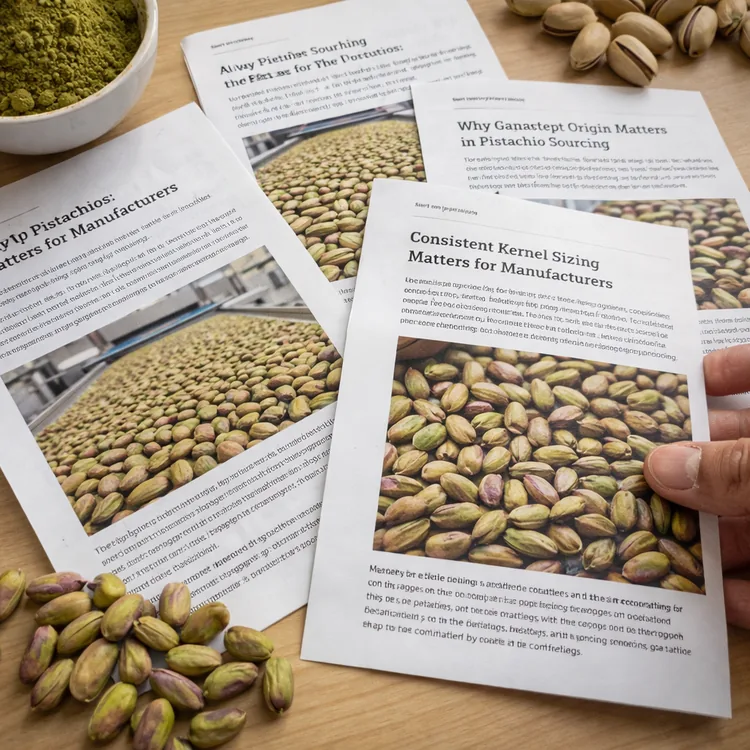
Introduction: buyers need more than a product list
In many food categories, especially in B2B ingredient trade, a buyer rarely moves from first contact to purchase based only on a product catalog. Product names can sound familiar while still hiding important differences in grade, format, application fit, processing method and consistency expectations. Pistachios are a good example. Two products may both be described as premium pistachio kernels, yet they may perform very differently depending on whether the buyer needs them for confectionery, pastry, ice cream, retail snacks or ingredient manufacturing.
This is where an article library becomes valuable. It gives buyers a framework for understanding what they are evaluating. Instead of asking only, “What is your price?”, buyers start asking better questions. They ask about cut size, kernel consistency, visual profile, roast behavior, packaging method, application suitability and repeat-order stability. That shift matters because better questions usually lead to better sourcing outcomes.
A strong article library does not replace direct supplier communication, samples or technical review. What it does is improve the quality of those conversations. It shortens the path from uncertainty to clarity. It gives buyers the language they need to compare products more accurately and helps sellers communicate value in a more structured and credible way.
Why information quality matters in pistachio sourcing
Pistachio buying is often more complex than new buyers expect. A product can be evaluated by origin, kernel appearance, color tone, size profile, roast style, cleanliness, cut consistency, packaging method and the needs of the final application. Buyers also have to think about supply continuity, price positioning, documentation and how closely future orders will match the approved sample.
Without educational guidance, these variables can feel fragmented. A buyer may know they need pistachios, but not know how to distinguish one offer from another beyond a basic commercial description. That creates risk. It can lead to weak product comparisons, vague specifications, mismatched expectations or unnecessary back-and-forth before an order is placed.
An article library adds value because it organizes these variables into understandable topics. It turns scattered information into a useful decision framework. For buyers, that means less confusion. For suppliers, it means more productive inquiries and better-qualified conversations.
What an article library actually does for the buyer
A useful article library is not just a collection of blog posts. At its best, it functions as a structured knowledge base that helps buyers move through the sourcing process with more confidence. It supports learning in stages.
- First stage: orientation. The buyer learns the basic product categories, such as in-shell pistachios, kernels, chopped products, powder and paste.
- Second stage: comparison. The buyer understands what differentiates one pistachio format or quality profile from another.
- Third stage: application fit. The buyer connects the right pistachio form to the actual use case, whether that is a visible topping, premium filling, grinding input or snack line.
- Fourth stage: purchasing readiness. The buyer becomes capable of writing a better brief, reviewing samples more intelligently and asking more specific commercial and technical questions.
That progression is valuable because it reduces purchasing friction. Buyers rarely need more noise. They need more clarity.
Why educational content improves commercial conversations
One of the biggest problems in B2B food trade is vague communication. Buyers often request “premium pistachios” without defining what they actually need. Suppliers may respond with their own interpretation of that phrase, but the two sides are not necessarily imagining the same product. The result is delay, confusion or an offer that looks attractive on paper but is not well matched to the application.
An article library helps correct this by teaching useful commercial language. It helps buyers distinguish between origin value and technical performance. It explains why kernel size matters in some applications more than others. It clarifies why one buyer may prioritize green color while another may care more about grind behavior or yield. It shows how packaging can matter for freshness protection, storage or export handling.
Once buyers understand those distinctions, conversations become more precise. Instead of saying “We need high quality pistachio,” they can say “We need a consistent kernel suitable for visible pastry topping,” or “We need a powder profile appropriate for smooth incorporation into a cream system,” or “We need a retail-oriented premium pistachio with stronger visual appeal.” That level of clarity benefits both parties.
Why an article library is especially useful in pistachio trade
Pistachios sit in an interesting position in the ingredient market. They are agricultural products, but they also carry strong premium and sensory associations. They can be sold as snacks, inclusions, visible decorations, processed ingredients or value-added consumer products. Because of that, buying decisions are shaped by both technical and emotional factors. Buyers care about physical consistency, but they also care about appearance, flavor identity, premium positioning and end-market perception.
This makes pistachios particularly well suited to an article-based knowledge approach. Buyers need content that explains not just what the product is, but why certain characteristics matter. They need articles that connect appearance to application, origin to commercial value, size consistency to manufacturing outcomes and product form to recipe performance.
A good article library creates that bridge. It helps buyers understand not only the product itself, but also how that product behaves within a commercial system.
How an article library supports different buyer types
Importers
Importers often need to assess products for a range of downstream customers. They may not be buying for one exact application. Instead, they need enough product understanding to build a sellable assortment and position each item properly. For importers, an article library provides product education that improves assortment strategy, supplier evaluation and customer communication.
It can help importers understand which pistachio formats are more relevant for premium retail, which are more relevant for industrial users and which buying criteria matter most when speaking to different customer segments. That can improve both sourcing logic and sales effectiveness.
Distributors
Distributors benefit from content that helps them turn supplier information into market-ready sales language. A product list alone does not always help a distributor explain why one kernel type is better for confectionery while another is better for bulk ingredient use. Articles can provide those distinctions clearly.
This matters because distributors often act as translators between production-focused suppliers and application-focused customers. An article library gives them better tools to do that work well.
Food manufacturers
Manufacturers usually care most about application suitability, consistency and operational reliability. They want to know how a pistachio ingredient will behave on the line, in the recipe and in the finished product. Articles that explain sizing, purity, cuts, grinding behavior, usage contexts and consistency issues are especially valuable here.
For manufacturers, educational content can reduce trial-and-error. It can also improve collaboration between procurement, quality, R&D and production teams by giving them a shared understanding of the relevant buying criteria.
Private-label and brand owners
Brand owners often think in terms of product story, shelf appeal and consumer perception as well as ingredient performance. For them, articles can clarify how origin, quality positioning, visible kernel appearance and product form influence premium messaging. This is particularly helpful when pistachios are used in products where the ingredient is front-facing and part of the marketing value.
How article content reduces buying mistakes
Many pistachio sourcing problems start before the quotation stage. They begin when the buyer has not yet defined the real requirement clearly enough. Educational content helps reduce common mistakes such as:
- comparing offers intended for different applications,
- focusing on price before defining the correct product form,
- using vague quality language that invites mismatch,
- ignoring how visual profile affects finished-product perception,
- approving samples without documenting the reasons for approval,
- underestimating the importance of repeatability across future orders,
- or overlooking how packaging and logistics affect delivered condition.
An article library cannot eliminate every sourcing risk, but it can reduce preventable misunderstandings. That alone makes it valuable in B2B trade.
Commercial value: education shortens the path to a better inquiry
One overlooked benefit of an article library is that it improves the quality of inbound inquiries. When buyers read educational content before reaching out, they tend to be better prepared. They describe their application more clearly, ask more relevant questions and understand that product selection is about fit, not just price.
This creates commercial value for both sides. Buyers spend less time untangling basic concepts. Suppliers spend less time responding to vague requests. The sales conversation becomes more focused on solution fit, feasibility and the right commercial structure.
In practical terms, that means a strong article library can help qualify leads, reduce unnecessary confusion and support more productive buyer-supplier engagement.
Technical value: content turns abstract quality into useful criteria
Terms like premium, high quality and selected can sound positive but remain too broad for technical decision-making. Buyers need more precise guidance. They need to know which characteristics matter for which uses and why. This is one of the strongest technical benefits of an article library.
For example, content can explain:
- why kernel size consistency matters for manufacturing lines,
- why visible applications often require stronger visual control,
- why chopped formats should be selected differently from whole kernels,
- why origin may influence market positioning more than industrial functionality in some cases,
- and why product performance should always be matched to the final application.
When these topics are explained clearly, buyers gain a more usable understanding of quality. They stop treating quality as a single abstract concept and start evaluating it as a combination of specific, application-linked attributes.
What topics a strong pistachio article library should include
A well-developed article library should cover a broad but organized range of buyer-relevant topics. The goal is not to publish content for its own sake. The goal is to create a learning path that answers real sourcing questions.
1. Product forms
Buyers should be able to understand the differences between in-shell pistachios, kernels, diced formats, granules, powder, paste and related ingredient forms. Each has a different commercial role and application logic.
2. Origin and market positioning
Articles can explain how regional identity influences buyer expectations, premium perception and branding value, while also making clear that origin should be supported by technical suitability.
3. Size and consistency
Content on sizing helps buyers connect physical product variation to operational outcomes such as visual uniformity, portion control, line behavior and waste reduction.
4. Color and appearance
Visual profile matters differently depending on the application. An article library should help buyers understand when color is central to value and when other criteria may be more important.
5. Application guidance
Different applications require different product profiles. Buyers benefit from content that links pistachio formats to pastry, chocolate, fillings, toppings, desserts, snacks and industrial processing contexts.
6. Packaging and logistics
Educational content should also address how products are packed, protected, stored and moved, especially for export-focused buyers.
7. Quality expectations
Articles can explain what buyers should review when approving a product, including consistency, cleanliness, suitability for use and match between sample and future orders.
8. Common sourcing errors
One of the most practical content areas is mistake prevention. Buyers often value content that helps them avoid preventable errors more than generic marketing copy.
Why article libraries support internal alignment inside buyer organizations
In many B2B purchases, more than one person influences the decision. Procurement may focus on price and supplier structure. Quality teams may focus on consistency and cleanliness. R&D may care about performance in formulation. Sales or brand teams may care about premium positioning and visual appeal. If these groups are not aligned, sourcing decisions become slower and more fragmented.
An article library can help create a common reference point. It gives internal teams shared language and shared concepts. That can make it easier to align on what matters, what should be tested and what kind of product is actually needed.
In this way, educational content does not only help external selling. It also supports internal decision quality on the buyer side.
Why an article library strengthens trust
Trust in B2B sourcing is built through clarity, consistency and usefulness. Buyers tend to trust suppliers more when they demonstrate real understanding of the product and help explain it in a practical way. An article library contributes to that trust when it is written to educate rather than merely promote.
When buyers find content that answers real questions, clarifies confusing terms and addresses both commercial and technical considerations, they are more likely to view the supplier as knowledgeable and serious. This does not replace sampling, documentation or supply performance, but it improves the credibility of the relationship from the beginning.
How article content supports SEO and buyer discovery
From a digital standpoint, article libraries also help buyers find relevant information earlier in their research process. Buyers do not always search for product pages immediately. Often, they search for questions, problems or comparisons. They may want to know how origin affects value, why consistency matters, which format suits a certain application or what buyers should ask before sourcing pistachio paste.
An article library helps capture that research intent. More importantly, it makes the website more useful once the buyer arrives. Instead of landing on a generic commercial page, the buyer finds content that helps them think more clearly. That increases the chance of a meaningful inquiry rather than a low-information request.
Why article libraries create long-term value, not just one-time traffic
Good educational content keeps working over time. A product inquiry may come and go, but a well-written article continues to support future buyers, future sales conversations and future internal reference needs. Over time, a library becomes more than a marketing asset. It becomes a knowledge asset.
This matters because not every buyer is ready to purchase immediately. Some are learning. Some are benchmarking suppliers. Some are evaluating new product directions. Some are onboarding new team members. An article library serves all of these stages. It adds value before the first inquiry, during the sourcing process and even after the relationship begins.
How Atlas uses article content strategically
At Atlas, academy content is not intended as filler. It is meant to support better decisions. The objective is to help buyers understand Turkish pistachio formats, commercial logic and application considerations more clearly so that conversations become more informed and sourcing becomes more precise.
That means using articles to:
- explain the differences between product forms,
- clarify which attributes matter most in different end uses,
- support better comparisons between offers,
- help buyers prepare more specific inquiries,
- and create a more informed path from first research to supply discussion.
For a company focused on Turkish pistachio solutions, this kind of content improves not only discoverability, but also the quality of buyer engagement.
Why this matters specifically for Turkish Antep pistachios
Turkish Antep pistachios are often evaluated in premium, specialty and quality-sensitive contexts. Buyers may care about origin identity, sensory value, visual appeal, ingredient performance and downstream brand positioning. Because the category can be nuanced, buyers benefit from resources that explain those nuances in practical terms.
An article library helps turn general interest in Turkish pistachios into more structured understanding. It gives buyers the vocabulary and confidence to distinguish between product types, evaluate fit and approach the category with stronger commercial awareness.
A practical example of how content changes the buying process
Consider a buyer looking for pistachios for a premium pastry application. Without educational content, the buyer might simply ask for a quote on premium kernels. That request is too broad. A supplier may respond with a product that is technically correct in name but not ideal in visual profile, size consistency or application suitability.
Now consider the same buyer after reading a few focused articles about kernel sizing, visible application needs, origin positioning and the importance of consistency. The buyer is more likely to ask for a kernel profile suitable for premium visible pastry use, with attention to appearance, consistency and repeatability. That is a much stronger starting point. The quote becomes more relevant. The sampling process becomes more useful. The odds of satisfaction improve.
This is the real value of an article library: it improves decision quality before a mistake happens.
Key benefits of a strong article library for pistachio buyers
- Better education: buyers understand the category more clearly.
- Stronger comparisons: offers are evaluated on fit, not only on price.
- Improved communication: inquiries become more precise and productive.
- Reduced sourcing mistakes: fewer misunderstandings about product expectations.
- Faster internal alignment: procurement, quality and application teams can work from a shared understanding.
- Higher trust: useful content signals expertise and seriousness.
- Long-term value: the knowledge base keeps supporting buyer decisions over time.
Final takeaway
An article library adds value for pistachio buyers because it transforms product research into informed decision-making. In a category shaped by origin, format, appearance, application fit, quality expectations and commercial positioning, buyers need more than short product labels and quotations. They need clear guidance that helps them understand what matters and why.
For importers, distributors, manufacturers and brand owners, that guidance improves the entire sourcing process. It helps define better requirements, reduces avoidable confusion, supports smarter product comparisons and creates a stronger foundation for long-term purchasing decisions.
In that sense, an article library is not simply a content section. It is a practical commercial tool. When built well, it helps buyers think more clearly, communicate more effectively and source Turkish Antep pistachios with greater confidence.
Frequently asked questions
Is an article library mainly useful for new buyers?
No. New buyers may benefit first, but experienced buyers also use educational content to compare product logic, onboard internal teams, refine purchasing criteria and support new applications or new markets.
Should an article library be commercial or technical?
The strongest libraries combine both. Buyers need technical clarity, but they also need help connecting those technical points to commercial decisions, brand positioning and application-specific value.
Can educational content really improve quote quality?
Yes. When buyers better understand the product and the variables that matter, they send more specific inquiries. That usually leads to more accurate quoting and fewer misunderstandings.
What makes an article library actually useful?
Usefulness comes from relevance, structure and clarity. Articles should address real buyer questions, explain differences in practical language and connect the information to real sourcing situations.
How often should a pistachio article library be expanded?
It should grow as buyer questions grow. The best libraries expand around recurring topics such as product forms, applications, quality criteria, origin, consistency, packaging and decision-making guidance.
Talk to Atlas about your sourcing goals
If your team is evaluating Turkish Antep pistachios for retail, confectionery, pastry, ice cream or ingredient use, Atlas can help clarify the right product form, buying criteria and sourcing approach for your application.