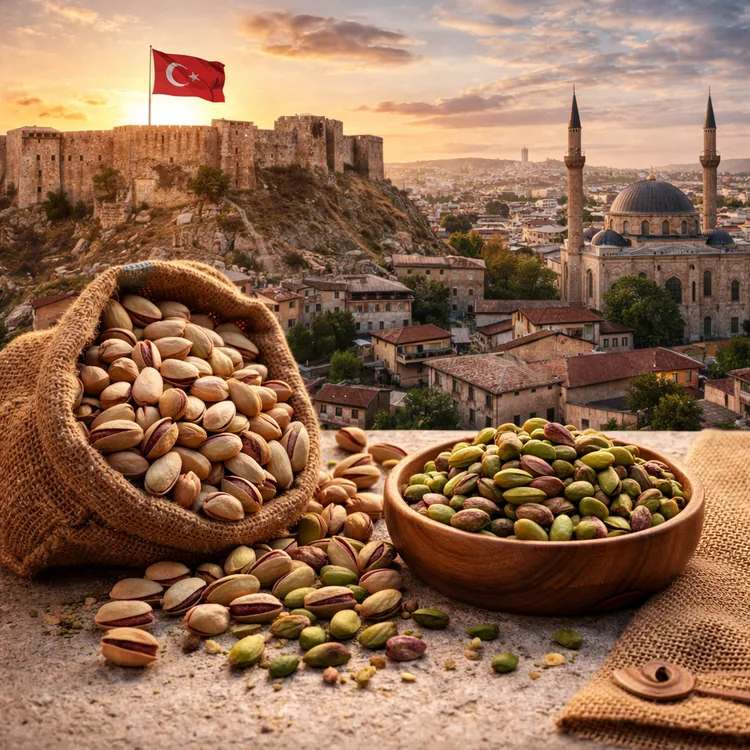
Introduction: origin is more than geography
In commodity purchasing, buyers often begin with price, packing and lead time. In premium food ingredients, however, the conversation quickly becomes more detailed. Buyers want to know how a product will look, taste, process, store, perform and sell. They want confidence that the raw material they approve today will still meet expectations after repeated orders, production scale-up and customer audits.
That is where origin becomes commercially meaningful. In pistachio sourcing, origin is not simply a dot on a map. It can function as a shorthand for expected quality style, market identity, traditional expertise, regional processing culture and the commercial language buyers use when positioning premium ingredients. In the Turkish market, Gaziantep holds special relevance because it is strongly associated with Antep pistachio identity and with a sourcing culture that many international buyers already recognize.
For importers, distributors and manufacturers, understanding origin helps answer more useful questions. Why do some suppliers emphasize region so strongly? Why are some buyers willing to pay more for clearly defined origin? Why do chefs, confectioners and premium dessert brands often care about regional identity when choosing kernels, powder or paste? And how should a procurement team evaluate origin without ignoring the practical realities of specification control, food safety and shipment reliability?
This article addresses those questions in a structured, business-oriented way. It explains why Gaziantep origin matters, what it can add to a product story, how it influences buyer perception and where it should fit within a disciplined sourcing process.
What buyers usually mean when they ask about origin
When a buyer asks about pistachio origin, they are rarely asking for geography alone. In most B2B conversations, the question carries several layers at once:
- Regional identity: whether the product comes from a recognized production area that buyers or end customers already associate with quality.
- Flavor and sensory expectation: whether the origin is linked to a particular taste profile, aroma intensity or perceived premium character.
- Commercial positioning: whether origin can be used in product storytelling, brand communication or premium menu language.
- Supply confidence: whether the region has a well-established production and processing ecosystem.
- Traceability logic: whether the supplier can clearly explain the source, handling and transformation of the product.
That means origin should be understood as both a market signal and a sourcing variable. A buyer may ask for Gaziantep-origin pistachios because they want a strong premium narrative. Another buyer may ask because their formulation team prefers the sensory profile they associate with Turkish Antep pistachios. Another may simply want alignment with an existing brand promise. In all of these cases, origin becomes part of the purchasing decision, even though the final approval still depends on technical suitability.
Why Gaziantep stands out in Turkish pistachio sourcing
Gaziantep carries strong recognition in pistachio trade because the region is closely linked with the identity of Antep pistachios. For many buyers, that link has practical value. It gives language to quality expectations and helps distinguish one sourcing story from another. Buyers who work in confectionery, pastry, dessert, ice cream and premium retail snacks often prefer products with a clear and credible regional identity because those products are easier to position at the premium end of the market.
Gaziantep also matters because origin shapes how people talk about the product. A product described only as “pistachio kernel” is technically useful, but commercially incomplete. A product described as “Turkish Antep pistachio kernel from Gaziantep” carries more meaning in a sales environment. It suggests tradition, regional association and a more refined ingredient identity. For many importers and brand owners, that language matters because it supports differentiation.
At the same time, origin does not replace disciplined sourcing. The strongest sourcing programs treat Gaziantep origin as a value-adding layer rather than a substitute for specification review. In other words, the right commercial logic is not “origin is enough,” but rather “origin is meaningful when it is supported by the right product, processor and process control.”
Regional identity and premium market perception
Premium food markets do not operate on raw cost logic alone. They operate on perception, trust, consistency and story. Regional identifiers help buyers communicate why one ingredient deserves a higher position than another. In categories like chocolate, coffee, olive oil, tea, vanilla and specialty cheese, origin can help frame value. Pistachios are no different.
For private-label retailers, origin can support a premium shelf story. For pastry brands, it can reinforce craftsmanship. For gelato makers and dessert brands, it can add sensory expectation and authenticity. For importers serving gourmet channels, it can help justify a more selective assortment. Even when the final end consumer does not know the full supply chain, regional identity influences how the product is described, sold and remembered.
Gaziantep origin is valuable in this context because it is not an invented marketing concept. It is already part of how many buyers and professionals think about Turkish pistachios. That existing recognition reduces friction in the sales message. Instead of having to build an origin story from zero, the supplier and buyer can build on a known regional reference point.
How origin influences buyer expectations
Origin shapes expectations before a sample is ever opened. When a buyer sees Gaziantep origin on a quotation or technical sheet, they may immediately expect some combination of the following:
- a premium Turkish pistachio identity rather than a generic nut ingredient position,
- a flavor profile aligned with traditional confectionery and pastry applications,
- a product suitable for artisan or premium market narratives,
- a regional sourcing story that sales teams can communicate with confidence,
- and a processor or exporter with experience in handling pistachios for demanding markets.
These expectations are commercially powerful, but they must be managed honestly. If a supplier uses origin language without delivering consistent color, flavor, cleanliness, processing quality or packaging reliability, the value of origin quickly disappears. Buyers do not reward labels alone. They reward labels that are supported by performance.
Origin and sensory perception
One reason origin matters so much in pistachio sourcing is that pistachios are not only functional ingredients. They are sensory ingredients. Buyers evaluate them by visual appeal, freshness, nut aroma, texture, roast response, sweetness perception, intensity and aftertaste. Even when a product is used as an ingredient rather than a finished snack, those sensory factors remain central.
For example, a confectionery buyer may care about how clean and expressive the pistachio flavor remains inside a filling. A pastry producer may care about the green tone and flavor visibility in creams or toppings. A gelato brand may care about aroma depth and the visual impression created by kernel, granule or paste. In each case, the product is judged not simply as an input cost, but as a contributor to the final eating experience.
That is why many premium buyers connect origin to application outcome. They do not treat origin as abstract heritage. They treat it as part of the product identity that can influence how the final application is perceived.
The ecosystem effect: origin also reflects processing culture
When professionals discuss origin, they often focus on orchards and harvest regions. But sourcing outcomes are also shaped by the broader ecosystem around the product. A strong regional ecosystem can improve buyer confidence because it suggests accumulated experience in sorting, grading, shelling, roasting, cutting, grinding, blending, packaging and preparing products for export.
In other words, origin matters not only because of agricultural association, but because regions known for a product often develop deeper know-how around that product. Buyers benefit from that because specialized processing culture typically leads to more precise commercial language, better understanding of buyer requirements and better alignment between samples and repeat orders.
For B2B buyers, this is important. A good sourcing partner should not simply sell “pistachios.” They should understand differences between snack-grade and ingredient-grade needs, between color-sensitive pastry applications and flavor-dominant paste applications, between standard export packaging and buyer-specific packaging requirements, and between spot opportunities and long-term supply programs. Origin matters when it points toward that depth of specialization.
Commercial advantages of a Gaziantep-origin sourcing strategy
A regionally anchored sourcing strategy can create advantages across several parts of the value chain:
- Better premium positioning: easier to justify a higher-value ingredient story in gourmet and specialty channels.
- Stronger differentiation: more distinctive than a generic pistachio description in catalogs, packaging and B2B sales materials.
- More useful specification conversations: buyers and suppliers can discuss not only product form, but also the style and identity expected from the ingredient.
- Higher internal confidence: procurement, product development and marketing teams can align more easily when the product has a clear sourcing identity.
- Improved customer communication: distributors can explain the product more convincingly to downstream clients.
These advantages are especially relevant for businesses selling value-added products rather than purely commodity products. If the pistachio will be invisible in the final application, origin may still matter, but less. If the pistachio will be featured, named, displayed or marketed, origin becomes much more important.
Applications where origin can matter the most
Not every pistachio application demands the same sourcing logic. In some categories, origin can be a major buying factor. In others, functionality and cost efficiency may dominate. Below are examples of where Gaziantep-origin positioning often carries the greatest value.
1. Premium confectionery
Chocolate fillings, pralines, dragées, pistachio creams and gift-box confectionery frequently benefit from strong origin language. In these categories, consumers are often buying a premium experience. The ingredient story matters alongside the taste.
2. Artisan and industrial pastry
Pastry brands using pistachio visibly in fillings, toppings, sponge inclusions, laminated products or luxury desserts often care about both sensory expression and visual identity. Region-specific sourcing can support that premium message.
3. Gelato and ice cream
Pistachio is one of the few flavors where ingredient identity can strongly shape consumer expectation. A premium pistachio gelato or ice cream line often benefits from a well-defined pistachio source story.
4. Ingredient retail and gourmet distribution
For specialty stores, gourmet wholesalers and premium ingredient catalogs, origin gives sales teams clearer language and more meaningful differentiation.
5. Private-label premium snacks
Where the pistachio is front-facing and directly marketed, regional association may help elevate perceived value more than a generic product description would.
When origin matters less
There are also applications where origin should be treated as a secondary consideration. For high-volume industrial formulations where pistachio is one component among many, purchasing decisions may focus more heavily on grind size, protein-fat behavior, moisture, microbiological control, price stability and manufacturing compatibility. In these cases, Gaziantep origin may still add value, but not enough to outweigh performance or cost requirements.
This distinction is important because strong sourcing decisions require application fit. Buyers should not pay for origin value they cannot use. At the same time, they should not ignore origin value when it can materially improve positioning, customer acceptance or final product appeal.
Origin should support, not replace, technical approval
One of the biggest mistakes in ingredient sourcing is to over-romanticize origin. A respected region may create the right expectation, but buyers still need rigorous technical review. A serious sourcing decision should include:
- clear product form definition,
- grade and cut or grind specification,
- visual review of color and cleanliness,
- aroma and flavor evaluation,
- moisture and handling suitability,
- defect and foreign matter control,
- packaging format and barrier suitability,
- traceability and documentation,
- and repeatability from approval sample to production lots.
In practice, the best approach is layered evaluation. First, determine whether Gaziantep origin supports your market objective. Second, confirm that the actual product meets your technical needs. Third, verify that the supplier can scale reliably across repeated shipments. When these three layers align, origin becomes a meaningful commercial asset rather than a decorative claim.
How origin affects specification writing
Many sourcing problems begin with vague specifications. Buyers ask for “premium pistachio” or “Antep pistachio” without defining what that means in operational terms. The result is avoidable confusion. One supplier sends bright kernels optimized for pastry display. Another sends a more economical kernel better suited to grinding. A third quotes a paste with a different roast or fat expression than expected. Everyone uses similar language, but they are not discussing the same product.
If Gaziantep origin is important, it should be written into the commercial brief in a way that supports technical alignment. That usually means defining origin together with the following variables:
- product form: in-shell, whole kernel, split kernel, diced, granule, powder, paste or butter,
- intended use: snack, chocolate filling, pastry cream, topping, gelato, bakery mix or industrial ingredient base,
- visual expectation: greener appearance, more natural variation, roasted look or neutral processing style,
- processing expectation: raw, lightly roasted, standard roasted, custom roast, cut or milled,
- packaging requirement: vacuum, bulk carton, liner bag, industrial pack, retail-ready pack or private-label format,
- and consistency requirement: sample match, seasonal tolerance, approved reference standard or target specification range.
When origin is embedded inside a clear brief, suppliers can quote more accurately and buyers can compare offers on a fair basis.
Comparing offers: what buyers should look beyond origin
Suppose two suppliers both offer Gaziantep-origin pistachio kernels. The buyer still needs a structured comparison framework. At minimum, review these areas:
Product identity
- Is the offer for the exact product form needed?
- Is the kernel whole, split, chopped, sliced, powdered or processed into paste?
- Is the product intended for direct consumption or manufacturing use?
Visual characteristics
- How uniform is the lot?
- What is the color range?
- Does it match the intended application?
- Are there visible shell fragments, dark pieces or defects?
Sensory profile
- Does the product deliver the expected pistachio aroma?
- Is the flavor clean and fresh?
- Does roasting align with the application, or is it too light or too aggressive?
Process suitability
- Will the cut size behave correctly in your equipment?
- Will the paste flow or blend as required?
- Is the powder fine enough for smooth incorporation?
Commercial reliability
- Can the supplier repeat the approved standard?
- Can they support lot documentation and export packing requirements?
- Can they explain lead times and seasonal planning clearly?
Origin becomes truly useful when it is combined with this broader evaluation discipline.
Why origin matters for private-label and brand storytelling
For private-label buyers and consumer brand owners, ingredients are part of the product story, even when consumers never see the supply chain directly. A premium dessert line made with generic pistachio ingredients can be difficult to distinguish from competitors. A line positioned around Turkish Antep pistachio heritage and carefully sourced regional identity can be easier to frame at the premium end of the market.
That does not mean every product must communicate full origin details on-pack. It means the brand team, sales team and buying team benefit from having a stronger story foundation. In many categories, the most effective premium products combine three elements:
- credible source identity,
- consistent sensory performance,
- and disciplined quality execution.
Gaziantep origin can strengthen the first element significantly. When supported by the other two, it becomes an asset that improves marketability rather than just adding words to a brochure.
Origin and risk management
Good buyers appreciate value, but they also manage risk. Origin-based sourcing should therefore be paired with practical controls. These include alternate processing options, buffer inventory logic, quality approval procedures, packaging standards, shipment documentation and clear definitions of what constitutes an acceptable lot.
Why is this important? Because the more premium the positioning, the more costly inconsistency becomes. A commodity buyer may tolerate wider variation. A premium buyer usually cannot. If the pistachio color shifts too far, if cut size drifts, if aroma weakens, if paste behavior changes or if a retailer complaint occurs, the cost is not limited to the raw material. It can affect brand trust, recipe balance, customer satisfaction and rework expenses.
That is why the most successful origin-based programs are not loose, romantic sourcing arrangements. They are controlled supply programs built around a defined regional value proposition.
How distributors can use Gaziantep origin more effectively
Distributors often sit between the source and the final industrial or retail buyer. For them, origin can be both a selling tool and a category-education tool. Instead of presenting pistachios as a single undifferentiated item, distributors can build a more intelligent portfolio structure:
- Value tier: efficient pistachio formats for cost-sensitive industrial use.
- Performance tier: application-specific kernels, cuts or powders focused on technical suitability.
- Premium origin tier: Gaziantep-positioned products designed for customers who value regional identity, premium flavor language and a stronger end-market narrative.
This kind of portfolio logic helps downstream customers choose more intelligently. It also reduces the common sourcing problem of comparing products that are not intended for the same purpose.
Common misconceptions about origin
“If it says Gaziantep, it must automatically be premium.”
Not necessarily. Origin can add value, but the actual product still needs to be evaluated on its own merits. Buyers should request samples, define specifications and review quality systems.
“Origin only matters for luxury brands.”
Luxury brands may use origin more visibly, but origin can also help ingredient distributors, mid-market premium products and specialist manufacturers that need consistent positioning.
“Origin is just marketing.”
Origin certainly has marketing value, but it also affects how buyers structure expectations, how suppliers describe product identity and how ingredient value is communicated in the supply chain.
“Price should decide everything.”
Price always matters, but in premium food categories the cheapest material is often not the best value. Rejection risk, quality drift, weaker story value and poor application fit can create larger downstream costs than the initial price difference.
A practical buyer checklist
When evaluating Gaziantep-origin pistachio offers, buyers should ask the following:
- What is the exact product form and intended application?
- How is origin defined and communicated in the product documentation?
- What visual profile should we expect from the approved lot?
- What sensory profile should we expect in the final application?
- How is the product processed: raw, roasted, chopped, ground or made into paste?
- What pack format is used for protection, shelf-life management and logistics?
- How does the supplier manage consistency across batches and seasons?
- What traceability and quality documentation are available?
- How closely will commercial samples match shipped production lots?
- Does the origin value actually support our brand, product or channel strategy?
This kind of checklist protects the buyer from vague language while preserving the commercial value of origin.
Guidance for different buyer types
For importers
Focus on repeatability, supply planning and downstream sales language. You need a product that is both commercially appealing and operationally manageable. Ask whether the supplier can support the same profile over multiple shipments, not just a single sample approval.
For distributors
Think in portfolio terms. Gaziantep-origin products are most effective when positioned intentionally, not mixed into a generic pistachio assortment without explanation. Train your sales team to explain the difference between origin value and simple commodity pricing.
For food manufacturers
Begin with application fit. If the ingredient will directly shape the sensory or premium perception of the final product, origin may deserve a central place in the sourcing brief. If it is mainly a functional input, test whether the added commercial value is worth the premium.
For brand owners and private-label teams
Use origin where it strengthens premium identity, but only when your sourcing partner can maintain the standard. The strongest brand stories are the ones operations teams can actually deliver at scale.
How Atlas approaches this topic
At Atlas, we see origin as one important part of a larger sourcing equation. Buyers should not have to choose between story and substance. The right sourcing approach brings them together. That means helping buyers define what they really need, matching origin language to actual application requirements and connecting them with Turkish pistachio processors and exporters who understand commercial expectations as well as technical ones.
In practice, that involves asking the right questions early:
- What is the final application?
- Is the pistachio visible or hidden in the finished product?
- Does the buyer need stronger flavor expression, stronger visual appeal or both?
- Is the goal premium storytelling, production efficiency or a balance of both?
- What level of consistency is required lot after lot?
Once those answers are clear, origin can be evaluated properly. Sometimes Gaziantep-origin positioning is central to the project. Sometimes it is supportive but secondary. Sometimes a more specification-driven approach makes more commercial sense. The value lies in matching the sourcing logic to the real business objective.
Final takeaway
Gaziantep origin matters in pistachio sourcing because it helps bridge product identity and commercial value. It gives buyers a stronger language for premium positioning, supports differentiation in quality-sensitive markets and aligns naturally with the broader identity of Turkish Antep pistachios. For importers, distributors and food manufacturers, that can be highly valuable.
But the most effective buyers do not stop at origin. They treat it as a meaningful advantage that must be supported by technical approval, process discipline, reliable supply relationships and application-specific specification control. When those elements work together, origin becomes more than a regional reference. It becomes part of a stronger, smarter and more profitable sourcing strategy.
If your team is evaluating Turkish pistachio kernels, cuts, powder, paste or in-shell programs and wants to understand how origin should fit into the commercial decision, Atlas can help structure that conversation clearly.
Frequently asked questions
Does Gaziantep origin always mean the most expensive option?
Not always. Pricing depends on product form, grade, processing style, packaging, order size, seasonal conditions and commercial terms. Origin can support premium positioning, but final price still reflects the full specification and supply setup.
Can origin influence both flavor and marketability?
Yes. In many premium categories, buyers care about both the sensory contribution of the ingredient and the commercial value of the source story. Pistachios are especially relevant here because they are judged visually and sensorially as well as technically.
Should industrial buyers care about origin if the product is used inside a formulation?
It depends on how visible the pistachio value is in the final product. If the pistachio strongly contributes to flavor identity, visual appeal or premium messaging, origin may matter a great deal. If it functions mainly as one background ingredient, specification and cost may matter more.
What is the biggest sourcing mistake buyers make?
One common mistake is asking for a premium origin product without defining the exact product form and application. Another is approving a compelling sample but failing to define the repeat-order standard in enough detail.
What should happen after sample approval?
After sample approval, buyers should align on documentation, acceptable quality range, packaging format, shipment conditions and repeatability expectations. This is where origin moves from being a marketing point to becoming part of a stable supply program.