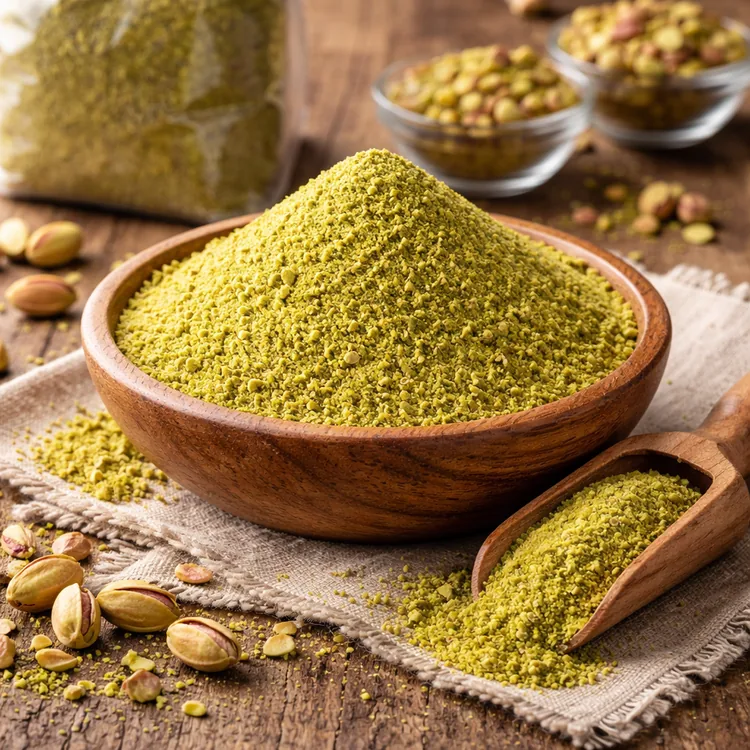
When is powder better than granules?
Powder is usually preferred when smooth integration, even dispersion and process-friendly behavior matter more than visible nut texture or decorative appearance.
Is this format suitable for pastry creams?
Yes. It is often used in pastry creams and fillings where controlled distribution and smoother ingredient incorporation are important.
Which businesses buy pistachio meal most often?
Industrial bakeries, dessert manufacturers, filling specialists, dry blend producers and recipe development teams commonly choose this format.
What should be clarified before requesting a quote?
The intended application, desired process behavior, approximate volume and packaging direction are the most useful first details to share.
Why choose powder or meal instead of whole kernels?
Because this format can be easier to blend, easier to scale in production and more practical when the recipe does not need visible kernel pieces.
Can this product work in bakery dough systems?
Yes. It is often chosen when the recipe needs pistachio character distributed through the dough rather than appearing as separate visible inclusions.
Is this format mainly for industrial buyers?
It is especially relevant for industrial and professional users, but it can also suit premium artisan manufacturers that need a more process-friendly pistachio ingredient.
Can pistachio powder help reduce internal preparation work?
Yes. Many buyers choose it to reduce the need for extra cutting or further size reduction inside their own facility.
Does this product suit dry blend manufacturing?
Yes. Dry blend and mix systems are among the most relevant commercial environments for fine pistachio formats.
What is the main commercial advantage of meal over larger cuts?
Meal can support more even recipe integration while still offering a dry pistachio format that is easier to handle than visible cut pieces in certain systems.
How does this differ from pistachio paste?
Powder and meal remain dry, ingredient-style formats for blending and formulation work, while paste is already processed for creamy, spreadable or emulsified applications.
Is this useful in product development?
Yes. Development teams often prefer it when they want to test pistachio integration without committing too early to larger cuts or paste systems.
Can this format support repeat manufacturing programs?
Yes. It is often well suited to repeat production where consistent process behavior and efficient handling matter.
Why do buyers focus on process behavior with this product?
Because the commercial value of powder and meal often comes from how well the ingredient performs in the real manufacturing environment, not just from how it looks in a sample.
What applications benefit most from this format?
Bakery mixes, pastry creams, fillings, dough systems, dessert bases and dry blend formulations are among the most common use cases.
Can it work for premium products as well as industrial ones?
Yes. It can support premium pastry and dessert concepts as well as larger-scale industrial applications, depending on how the buyer uses and positions it.
Why is packaging direction important?
Because the right supply format helps align ingredient storage, internal movement, batching and production efficiency with the buyer’s real operating model.
What makes this a useful format in a wider pistachio range?
It complements kernels, granules and paste by serving the applications that require fine, dry and process-friendly pistachio integration.